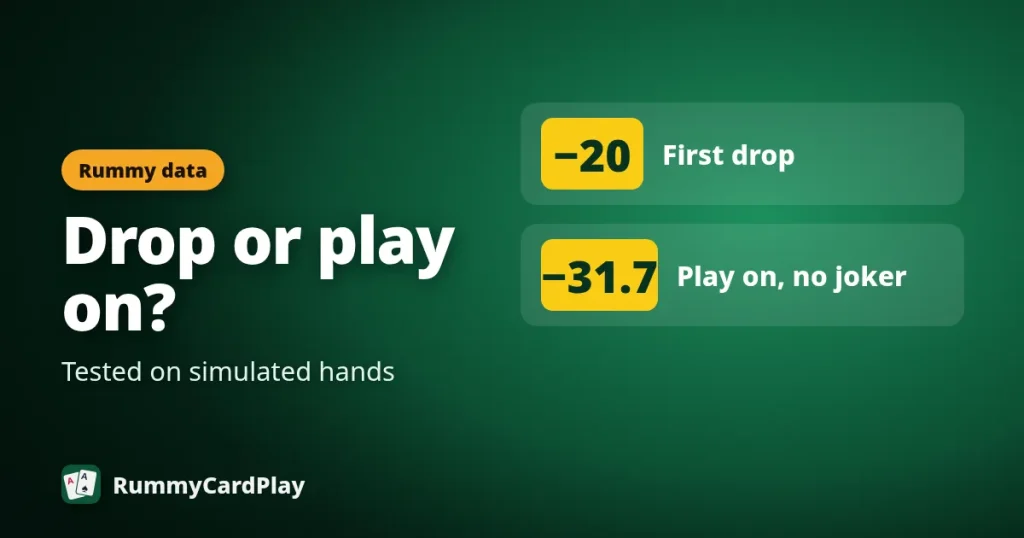
Should you drop a weak rummy hand for 20 points, or play it out and hope? Advice on this usually comes from experience. We wanted numbers, so we took the 26,000 hands from our jokers study, in which nobody was allowed to drop, and asked a simple question for each kind of opening hand: on average, did playing on cost more or less than dropping would have?
Key findings
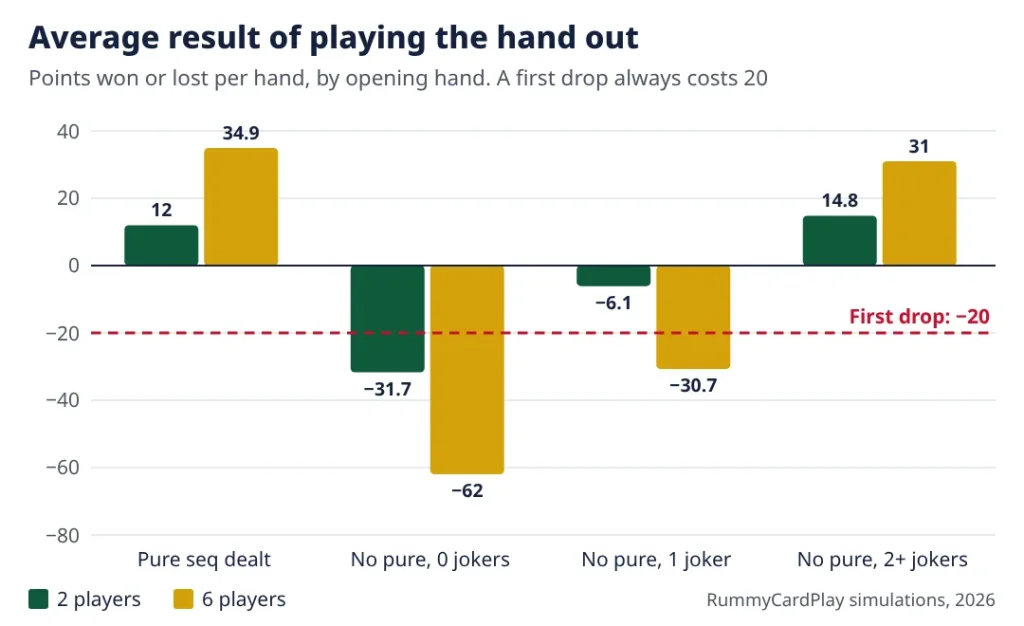
- With a pure sequence at the deal, playing on averaged 12 points per hand in two-player games and 34.9 with six players. Never drop these.
- With no pure sequence and no joker, playing on averaged −31.7 (two players) and −62 (six players), against −20 for a first drop.
- With no pure sequence but one joker, playing on averaged −6.1 and −30.7.
- A player still without a pure sequence after three turns averaged −16.2 (two players) and −38.7 (six players) by playing on. A middle drop costs 40.
How to read the numbers
For each player we know the opening hand and the final result: plus what the others paid if they won, minus their count if they lost. Averaging that “net” over every player with the same kind of hand gives the expected result of playing on. A first drop always costs exactly 20, so:
- Net above −20: playing on did better than a first drop, on average.
- Net below −20: a first drop would have saved points, on average.
Hands were grouped by whether a pure sequence was dealt, by jokers (0, 1, 2 or more), and by connected pairs: pairs of cards of the same suit one or two ranks apart, such as 5♣ 6♣ or 5♣ 7♣. Each one is a possible pure sequence. Three cards like 5♣ 6♣ 8♣ contain two connected pairs.
Play on or drop: the results
Two players
| Opening hand | Share of hands | Win | Net |
|---|---|---|---|
| Pure sequence dealt | 36.5% | 56.7% | 12 |
| No joker, 0–3 connected pairs | 3.6% | 19.3% | −38.4 |
| No joker, 4–5 connected pairs | 8.6% | 23.6% | −32.4 |
| No joker, 6 or more | 6% | 28% | −26.9 |
| 1 joker, 0–3 connected pairs | 5.6% | 40% | −12.4 |
| 1 joker, 4–5 connected pairs | 12.1% | 45.2% | −5.9 |
| 1 joker, 6 or more | 7.6% | 47.8% | −1.6 |
| 2+ jokers, 0–3 connected pairs | 5.3% | 63.3% | 8.1 |
| 2+ jokers, 4–5 connected pairs | 9.7% | 68.3% | 15.4 |
| 2+ jokers, 6 or more | 5% | 71.9% | 20.7 |
Six players
| Opening hand | Win | Net |
|---|---|---|
| Pure sequence dealt | 23.8% | 34.9 |
| No joker, 0–3 connected pairs | 1% | −67.5 |
| No joker, 4–5 connected pairs | 1.8% | −62.1 |
| No joker, 6 or more | 2.1% | −58.5 |
| 1 joker, 0–3 connected pairs | 5.4% | −41.7 |
| 1 joker, 4–5 connected pairs | 7.6% | −31.5 |
| 1 joker, 6 or more | 10.6% | −21.4 |
| 2+ jokers, 0–3 connected pairs | 21.5% | 6.5 |
| 2+ jokers, 4–5 connected pairs | 28.5% | 33.6 |
| 2+ jokers, 6 or more | 33.6% | 50.8 |
Sample sizes: 40,000 two-player and 36,000 six-player results; the smallest group above has 1,437 two-player results.
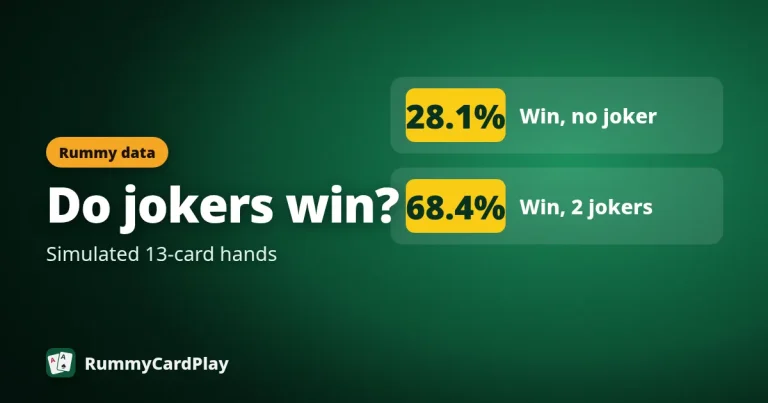
With two players, every no-joker group averaged worse than a first drop, even hands with six or more connected pairs (−26.9). Every one-joker group did better than −20, and with two or more jokers playing on came out ahead.
With six players the line moves. Hands with no joker averaged −62, three times the cost of a first drop. One joker was no longer enough: −30.7 on average, and only well-connected one-joker hands (−21.4) came close to the −20 mark. Two or more jokers still paid (31).
The middle drop
Once you have drawn, a drop costs 40. We looked at every player who was still in the hand after three of their own turns and had no pure sequence yet:
Two players
| Jokers dealt | Players | Win | Net |
|---|---|---|---|
| None | 4,013 | 21.1% | −39.3 |
| 1 | 5,414 | 40.1% | −15.3 |
| 2 or more | 4,438 | 61.2% | 3.5 |
| All | 13,865 | 41.3% | −16.2 |
Six players
| Jokers dealt | Players | Win | Net |
|---|---|---|---|
| None | 2,702 | 1.1% | −69.4 |
| 1 | 4,066 | 5.3% | −47.9 |
| 2 or more | 3,474 | 20.6% | −4.1 |
| All | 10,242 | 9.4% | −38.7 |
For comparison, two-player hands that did have a pure sequence by then averaged 11.4. A player with no pure sequence after five turns averaged −20.3 (two players, 7,888 results), and 32% of those who lost paid the full 80.
With two players, a hand with no joker and no pure sequence after three turns averaged −39.3, about the same as a 40-point middle drop. With six players the same hands averaged −69.4, and hands with one joker −47.9: in both cases a middle drop would have saved points on average. With two or more jokers, playing on was still the better choice at both table sizes.
What this means at the table
- Pure sequence dealt: play on. It averaged 12 with two players and 34.9 with six.
- No pure sequence, no joker: take the 20-point first drop, especially at bigger tables. Connected cards help a little, but in our data never enough to beat −20.
- No pure sequence, one joker: play on in a two-player game. At a full table, drop unless the hand is well connected.
- Two or more jokers: play on.
- Three turns in, still no pure sequence: with no joker, or with one joker at a big table, a 40-point middle drop is about break-even or better.
Our when to drop guide turns these results into a first-turn checklist and works through four real hands.
Method
- Data: the same 20,000 two-player and 6,000 six-player Points Rummy hands as our jokers study: every seat played by our “Hard” computer player, dropping switched off, every hand played to the end, fixed random seeds.
- Rules: 13 cards, two decks with two printed jokers, 80-point cap, first drop 20, middle drop 40, as in our Points Rummy game.
- Net: points won minus points lost in the hand. A winner’s gain is everything the other players paid, which is why net values are larger at six-player tables.
- Groups: decided from the 13 cards dealt, before any draw. “After three turns” uses only players whose hand was still going after their third turn.
Limitations. Because nobody dropped, every opponent stayed in every hand. At a real table some opponents drop early, which changes both who you are playing against and what a win pays, so treat small differences (a few points either side of −20) as a tie. The averages also hide risk: a hand that averages −18 can still cost 80. And in Pool Rummy a drop is worth more or less than its points, depending on how close you are to elimination; see Pool Rummy 101 vs 201 in numbers.
FAQ
Should I drop a rummy hand with no joker?
If you also have no pure sequence, the numbers say a first drop usually costs less. Playing on averaged −31.7 in two-player games and −62 with six players, against −20 for a first drop.
Is it ever right to play on without a pure sequence?
Yes, if you have jokers. With one joker and no pure sequence, playing on averaged −6.1 in two-player games, better than a 20-point drop. At six-player tables you need two jokers: those hands averaged 31.
When is a middle drop worth it?
When you still have no pure sequence a few turns in and no joker to help. Those hands averaged −39.3 in two-player games, about the same as a 40-point middle drop, and −69.4 at six-player tables, far worse.
Do these results apply to Pool or Deals Rummy?
The card odds are the same, but the cost of a drop is not. In Pool Rummy, points take you closer to elimination; in Deals Rummy the chips decide. Use these numbers as a guide for Points Rummy.