What does a typical 13-card rummy hand look like before you have made a single move? We shuffled and dealt 1,000,000 (10 lakh) opening hands with the same deck, cut-joker rules and grouping checker as our free Points Rummy game, and counted what each hand held. Where the answer can also be worked out exactly, we did that too, as a check on the simulation.
Key findings
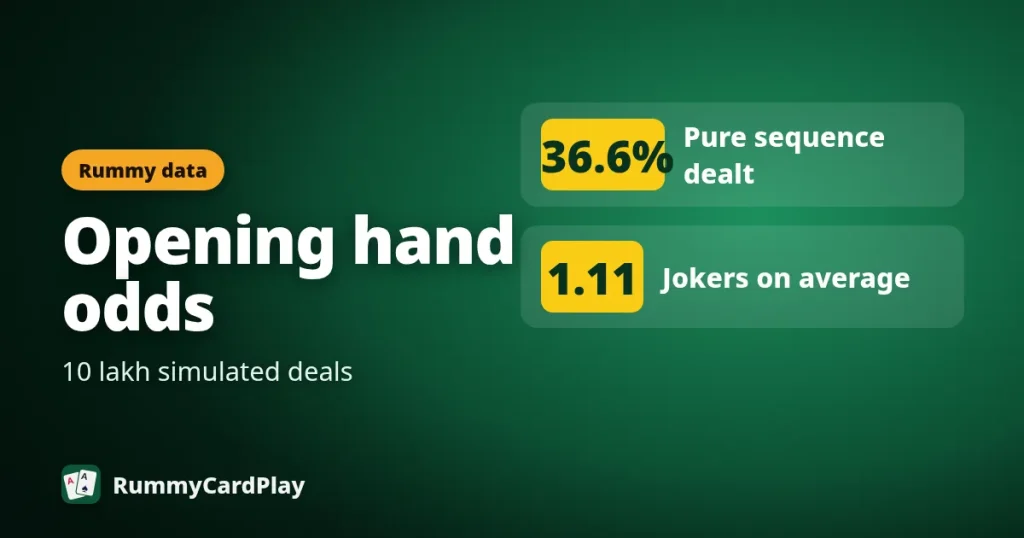
- 36.6% of opening hands already hold a pure sequence. After the first draw from the closed deck, 43.5% do.
- The average hand is dealt 1.11 jokers. 28.9% of hands get none and 8.1% get three or more.
- If someone declared before you moved, your hand would count 78 in the middle case (median), and 47.2% of hands would hit the 80-point cap.
- About 1 deal in 193 can be declared straight away after the first draw.
Jokers in the opening hand
Jokers here means printed jokers plus every card of the wild rank in your 13 cards. Whatever card is cut, exactly 9 jokers are left among the other 105 cards: 7 of the wild rank and 2 printed jokers, or, when a printed joker is cut, 8 Aces and the other printed joker. That makes the joker count a textbook calculation, so we can compare the simulation with the exact answer:
| Jokers in 13 cards | Simulated | Exact |
|---|---|---|
| 0 | 28.9% | 28.9% |
| 1 | 40.3% | 40.3% |
| 2 | 22.7% | 22.7% |
| 3 or more | 8.1% | 8.1% |
| Average | 1.11 | 1.11 |
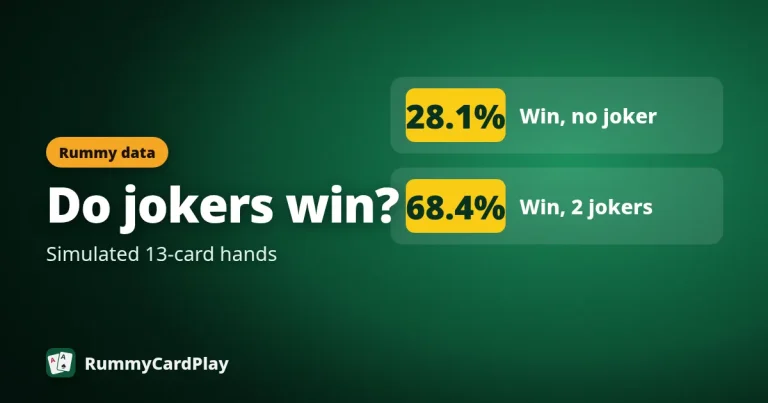
A printed joker was the cut card in 1.9% of deals (exact: 2 in 106, or 1.89%). The two columns agree, which is a good sign that the shuffling and counting are right. How much each joker is worth once the hand is played is in our study Do jokers win rummy hands?
A pure sequence at the deal
A pure sequence is three or more cards of one suit in order, with no joker standing in for a missing card. A wild card in its natural place still counts as pure.
| Moment | Hands with a pure sequence |
|---|---|
| As dealt (13 cards) | 36.6% |
| After the first draw (14 cards) | 43.5% |
| Still none after the first draw | 56.5% |
So most players start without a first life, and one draw does not change that much. In our played-out games the share climbs steadily over the next few turns; see the turn-by-turn chart in the jokers study and our guide on how to make a pure sequence.
What an opening hand would count
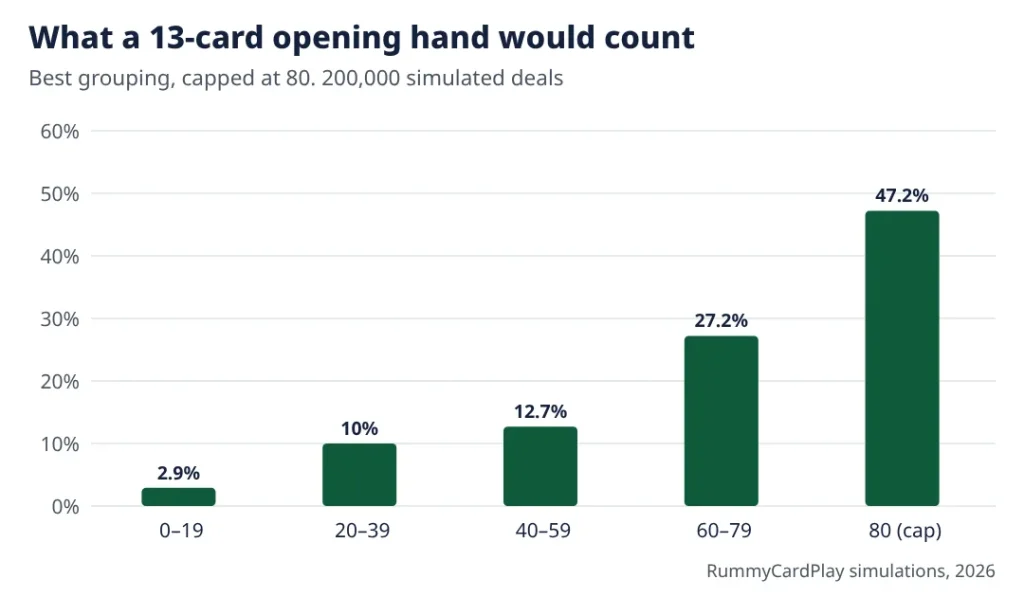
For the first 200,000 deals we also asked the engine for the count of the 13-card hand in its best grouping, as if another player declared before you moved:
- Average count: 66.8; median: 78.
- 47.2% of hands would pay the full 80.
- Only 13% would count under 40.
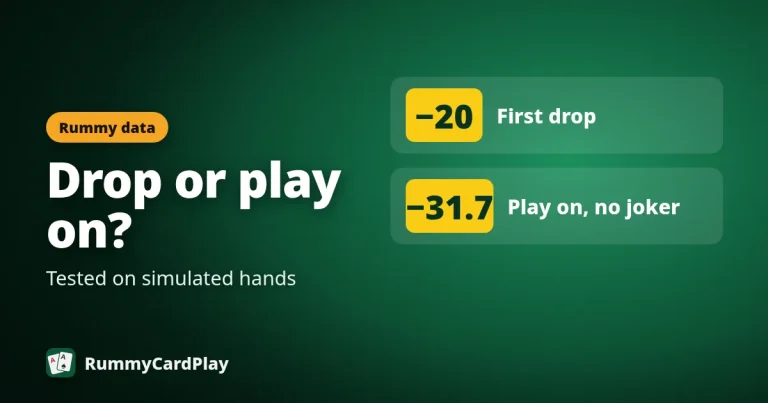
This is why a 20-point first drop is such a common decision: for a large share of hands, getting caught early costs the full 80. Whether dropping actually pays is tested in Drop or play on?, and our points calculator shows how any hand is counted.
Instant declarations
In 5,173 of the 1,000,000 deals, the 13 cards plus the first card drawn could already be grouped into a valid declaration, about 1 in 193. Each one was checked by the same declaration checker as the game. You can test your own hands in the declare checker.
Method
- Deck and deal: two standard decks plus two printed jokers (106 cards). Each sample is a full shuffle: 13 cards to you, the next card is the cut joker, and the next is your first draw from the closed deck. The open card is not used.
- Wild cards: every card of the cut rank is wild. When a printed joker is cut, Aces are wild, as in our games.
- Sample: 1,000,000 deals. The counts use the first 200,000 of them, because finding the best grouping takes longer.
- Pure sequence: at least three cards of one suit in order, Ace high or low, with no stand-in joker.
- Count: the engine’s best grouping, with the 80-point cap and Aces at 10, exactly as a losing hand is counted in the game.
- Randomness: every deal comes from a fixed seed (1,402 plus the deal number), so the run can be repeated exactly. We keep the scripts and raw results with the site’s source.
Limitations. This study looks at the cards only, not at play. With 10 lakh deals, the percentages above are accurate to about 0.1 of a percentage point; the counts, from 200,000 deals, to about 0.2.
FAQ
What are the chances of being dealt a pure sequence in rummy?
In our 1,000,000 simulated deals, 36.6% of 13-card hands had a pure sequence as dealt, and 43.5% after the first draw.
How many jokers will I get in 13-card rummy?
1.11 on average. About 29% of hands get none and about 8% get three or more. The exact figures are in the table above.
How often can you declare on the first turn?
Rarely: about once in 193 deals, using the first card drawn from the closed deck.
Why does my opening hand count so much?
Before you group anything, most cards are loose, and only a pure sequence plus a second sequence stop the rest from counting. 47.2% of opening hands would pay the 80-point cap.