Indian Rummy has its own vocabulary. Some terms are modern rule-book words (first drop, wrong show), some come from family games (life, pack), and some from the 21-card game (tiplu, paplu, nichlu). Even regular players mix these up. This glossary explains each term as it is used in 13-card Points Rummy, the version you can play free on our Points Rummy page. Where a word belongs to a different game, we say so.
Points vs Pool vs Deals Rummy
The three common formats of 13-card rummy share the same rules for sequences, sets and declaring. They differ in how many deals make a game and what a drop costs. All of them can be played free on this site.
| Format | How a game works | First / middle drop |
|---|---|---|
| Points Rummy | One deal. The winner collects everyone else’s points. Play it here. | 20 / 40 |
| 101 Pool | Many deals. Your points add up and you are out at 101 or more. The last player left wins. Play Pool 101. | 20 / 40 |
| 201 Pool | Same as 101 Pool, but you are out at 201 or more. Play Pool 201. | 25 / 50 |
| Deals Rummy | A fixed number of deals (often 2 or 3), settled in chips. Most chips wins. Play Deals Rummy. | Some tables use 20 / 40. Our version has no drop. |
In all four formats the full count and a wrong show are both 80 points. Our pool games have no rejoin and no split: every pool is played to one winner.
Two more games are free here, each with its own rules: 21 Card Rummy, played with three decks and 21 cards each, and two-player Gin Rummy. Their terms are explained below.
Cards and jokers
For where jokers earn most, see rummy joker strategy.
- Printed joker: one of the two picture jokers in the 106-card pack (two decks plus two jokers). It can stand in for any card and counts 0 points. Shown as “JK” in our game.
- Wild joker (cut joker): the card turned face up after the deal. Every card of that rank, in all four suits, becomes a joker for that hand. Shown with a ★ in our game.
- Printed joker as the cut card: if a printed joker is turned up, Aces are wild for that hand in our game. Some home games use a different rule (Pagat notes the variation).
- Natural card: any card used as itself and not as a joker. A wild-rank card in its own position (the 7♥ in 6♥ 7♥ 8♥ when 7s are wild) is acting naturally.
- Closed deck (stock): the face-down pile you draw from.
- Open pile (discard pile): the face-up pile. You can take its top card, except a joker.
- Finish card: the 14th card you put aside when you declare.
Groups
- Sequence (run): three or more consecutive cards of the same suit. The Ace is low (A-2-3) or high (Q-K-A), never K-A-2.
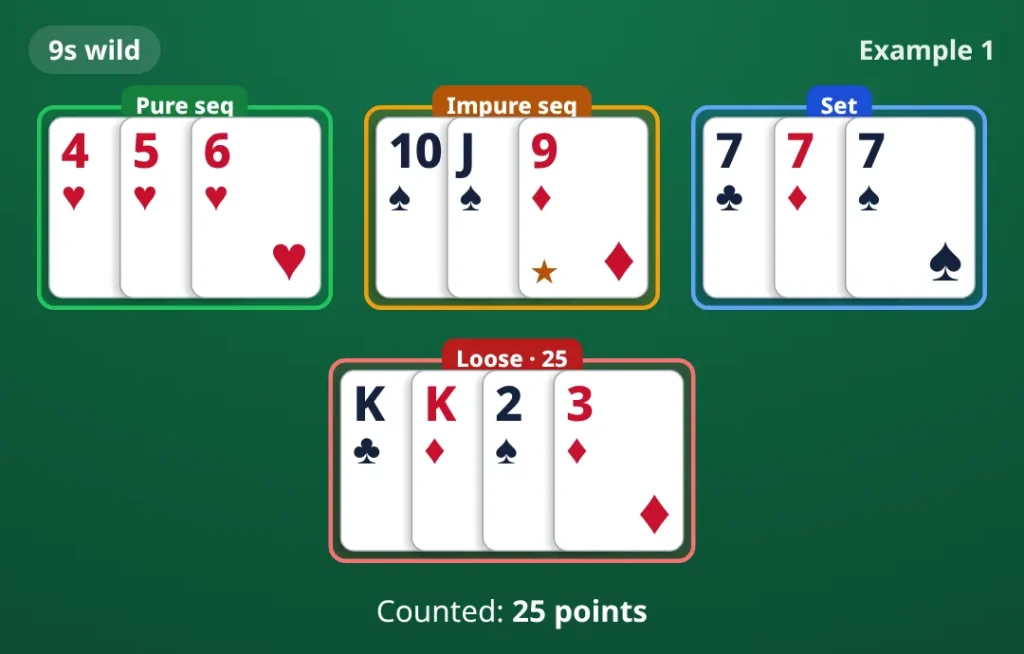
- Pure sequence: a sequence with no joker standing in for a missing card, for example 4♥ 5♥ 6♥.
- First Life: the pure sequence every valid hand needs. Older rule books and family games say original life or Life 1 (The Rummy Rulebook, Pagat).
- Second Life: the second sequence, which may be pure or impure. Once you have both lives, your sets and other sequences are protected when cards are counted.
- Impure sequence: a sequence where a joker fills a gap, such as 10♠ J♠ + joker.
- Set: three or four cards of the same rank in different suits, such as 7♣ 7♦ 7♠. Jokers are allowed. Two identical cards (7♣ 7♣) never go in one set.
- Tanala: three identical cards. It is valid only in the three-deck version of the game, not in two-deck 13-card rummy (Board Games Stack Exchange).
- Loose card (deadwood): a card that is not part of any valid group. Loose cards are what you pay for.
Moves
- Draw / pick: take one card from the closed deck or the open pile at the start of your turn.
- Discard / throw: put one card face up on the open pile to end your turn.
- Declare / show: finish the hand by laying down 13 cards in valid groups.
- Valid declaration: at least two sequences, at least one of them pure, and all 13 cards grouped. See 10 valid and invalid declaration examples.
- Wrong show (invalid declaration): declaring a hand that fails any of those conditions. It costs 80 points.
- Drop / pack / scoot: leave the hand at the start of your turn. First drop (before your first draw) costs 20, middle drop costs 40. See When to drop.
- Sort / group: arrange your cards. In our game, labels show a group’s type in colour: green for pure, orange for impure, blue for a set and red for invalid.
Scoring
- Points (count): the value of a loser’s counted cards: A, K, Q, J and 10 are worth 10 each, 2 to 9 their face value, and jokers 0.
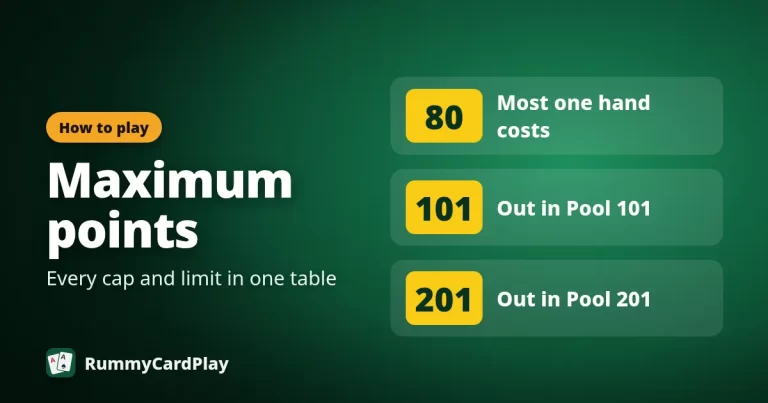
- Full count: the maximum of 80 points for one hand.
- What counts: with no pure sequence, every card counts. With a pure sequence but no second sequence, everything except that pure sequence counts. With both lives, only loose cards count. Worked examples are on the Points Rummy rules page.
- Chips: the units used to settle Deals Rummy. On this site they are just a score, with no money value.
What does Paplu mean?
“Paplu” has two meanings we can source. Paplu as a game is another name for 13-card Indian Rummy: Pagat’s page on Indian Rummy is titled “Indian Rummy: Paplu” and describes the 13-card game with two decks. Paplu as a card belongs to 21-card rummy and Marriage: the card one rank above the cut card (tiplu) in the same suit. We have not found a reliable rules source for a separate 3-card game called Paplu, so this site does not describe one. If your family plays a local version, agree its rules before the first deal. To play the 13-card game online, start with Points Rummy.
Paplu, Tiplu, Nichlu and other 21-card terms
These words are often searched together with 13-card rummy, but in practice they belong to 21-card rummy and Marriage. They are not used in the 13-card Points, Pool or Deals games.
- Paplu (the game): another name for 13-card Indian Rummy, which Pagat describes as popular across India and in Maharashtra in particular (Pagat).
- Tiplu: in 21-card rummy, the card cut at random to set the jokers. In the Nepali game Marriage, the cards that exactly match it are especially valuable (Pagat: Marriage).
- Paplu (the card): in 21-card rummy, the card one rank above the tiplu in the same suit, also called the upper joker. Pagat’s Marriage page calls it poplu.
- Nichlu: the card one rank below the tiplu in the same suit, the lower joker. Pagat calls it jhiplu.
- Marriage: the nichlu, tiplu and paplu of one suit held together (for example 8♠ 9♠ 10♠ when the tiplu is 9♠). It earns a bonus in 21-card rummy: in our game, 100 from each other player still in the hand.
- Tunnela: three identical cards (same rank and suit), possible because three decks are used. It counts as a pure sequence.
- Dublee: two identical cards. Eight Dublees is a valid declaration in our 21 Card Rummy.
- Maal: the bonus value of these special cards in Marriage.
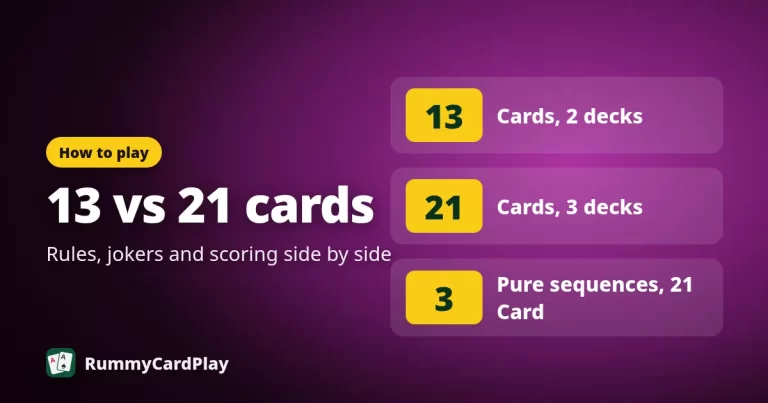
Names vary between regions and families, so check what your table means before a game. The bigger game is compared with 13-card rummy in 13 card vs 21 card rummy, and 21 Card Rummy tips covers planning three pure sequences. Our 21 Card Rummy game calls the paplu and nichlu the upper joker and lower joker, and its page lists the exact rules it uses, including value cards and the marriage.
Gin Rummy terms
Gin is a different game with its own scoring: see Gin Rummy strategy for how knocking works in practice.
Gin Rummy is a two-player game with its own words. None of them are used in Indian Rummy.
- Run: 3 or more cards in a row of one suit. In Gin the Ace is low only, so Q-K-A is not a run.
- Deadwood: the cards that are not in a run or set. J, Q and K count 10, Ace 1.
- Upcard: the first face-up card, which each player may take or pass at the start of a hand.
- Knock: ending the hand with 10 or less deadwood.
- Lay off: after a knock, the defender adds deadwood cards to the knocker’s runs and sets.
- Gin: knocking with no deadwood at all. It earns a bonus (25 in our game) and can’t be undercut.
- Undercut: when the defender ends with deadwood equal to or lower than the knocker’s. The defender scores the difference plus a bonus (25 in our game).
- Box (line) bonus and game bonus: extra points added when the match ends: 25 per hand won and 100 for winning, in our Gin Rummy.
FAQ
What is First Life and Second Life in rummy?
First Life is the pure sequence every valid hand needs. Second Life is a second sequence, pure or impure. Together they protect your other groups when cards are counted.
Are Paplu, Tiplu and Nichlu used in 13-card rummy?
No. They are 21-card rummy and Marriage terms for the cut card (tiplu), the card above it (paplu) and the card below it (nichlu). In 13-card rummy only the wild joker’s rank and printed jokers act as jokers. Paplu is also an old regional name for Indian Rummy itself.
What is the difference between a wild joker and a printed joker?
A printed joker is a picture joker in the pack. The wild joker is the card turned up after the deal: every card of its rank becomes a joker for that hand. Both count 0 points, and neither can be picked from the open pile.
What does full count mean?
The maximum a losing hand can cost: 80 points in 13-card rummy. A wrong show also costs 80.
What is Paplu in rummy?
Most often, a name for 13-card Indian Rummy itself, as Pagat records. In 21-card rummy and Marriage, the paplu (or poplu) is the card one rank above the tiplu in the same suit.
Is Paplu a 3-card game?
We could not find a reliable rules source for a 3-card game by that name, so we do not describe one. The Paplu we can source is 13-card Indian Rummy. Other three-card games have their own rules and are not covered here.