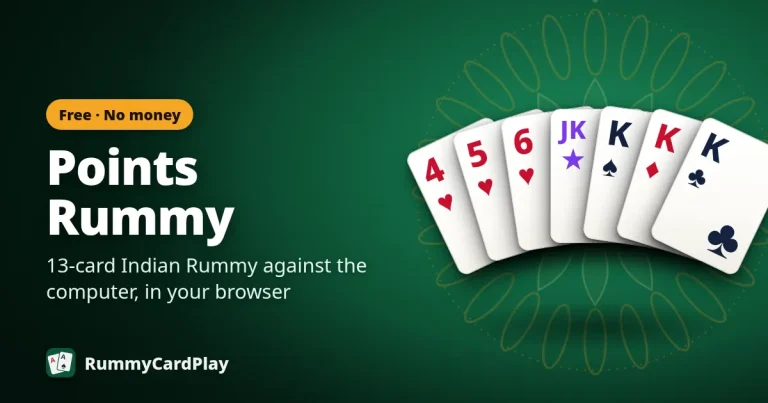
Play Deals Rummy free in your browser, against 1 to 5 computer players. It is 13-card Indian Rummy over a fixed number of deals, 2 or 3 (you choose). Everyone starts with the same number of chips. The winner of each deal takes the losers’ points as chips, and whoever holds the most chips after the last deal wins. Here chips are just points: they have no money value and never leave your phone. Tap the table above to start, or tap हिं to play in Hindi.
Deals Rummy at a glance
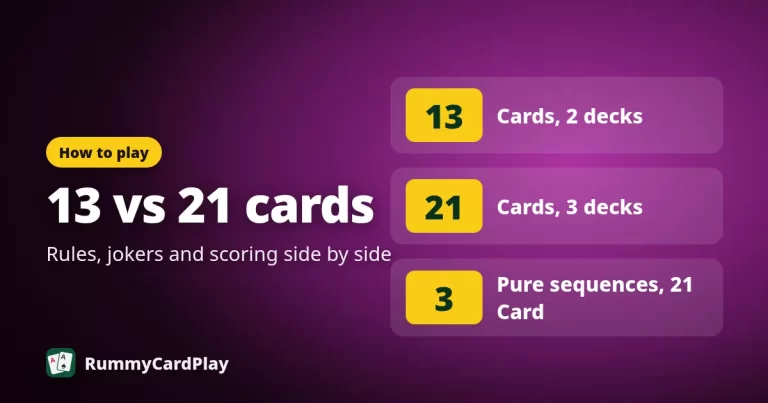
- 13 cards each from two decks with two printed jokers (106 cards), with a wild joker each deal.
- You against 1 to 5 computer players, on Easy, Medium or Hard.
- Best of 2 or 3 deals, chosen when you start (2 is the default).
- Everyone starts with 80 × the number of players in chips: 160 each with 2 players, 480 each with 6.
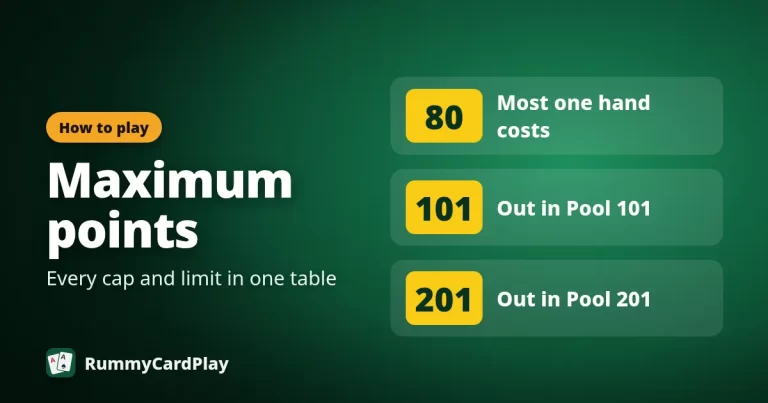
- The winner of a deal takes everyone else’s count as chips. A loser’s count is at most 80. A wrong declaration costs 80.
- No drop: every deal is played out.
- Most chips after the last deal wins. A tie at the top is settled with a tie-breaker deal.
- Free: no money, no sign-up, no download. Chips are only a score.
How to play Deals Rummy
Each deal is a normal hand of 13-card Indian Rummy, played exactly as in Points Rummy. You draw and discard, and declare once you have at least two sequences, one of them pure, with every other card in a valid group. What makes Deals different is how the deals are scored and how the match ends.
Chips
Everyone starts with the same pile of chips: 80 times the number of players. With 3 players that’s 240 each. The total number of chips at the table never changes. Chips only move from the losers to the winner of each deal.
After each deal
- Every loser’s cards are counted in their best grouping: J, Q, K and Ace 10, number cards face value, jokers 0, at most 80. A player who made a wrong declaration counts 80.
- Each loser gives that many chips to the winner. If two losers count 52 and 46, the winner gains 98.
- The top bar shows your chips and the deal number, for example Deal 2 of 3.
No drop
There is no drop in this version of Deals Rummy. The Drop button is removed and every deal is played to the end. Some tables allow drops in Deals too. We left them out because with only 2 or 3 deals in a match, folding a deal would leave little game to play. Without a drop, keeping your count low when the cards go against you is the main defensive skill.
The end of the match
After the last deal, the player with the most chips wins. If two or more players are level at the top, only they play a tie-breaker deal, and the others keep their final chips. The tie-breaker repeats until one player is ahead. The winner screen lists everyone’s final chips.
Chips, not points-totals
Wikipedia’s Indian Rummy article describes a Deals format where each player’s points are added up over the deals and the lowest total wins, usually over 2 or 3 deals. The chip format used here is common in online play, and it rewards winning a deal as well as losing small: a declaration earns you everyone else’s points.
A worked example: two deals, three players
You, Asha and Ravi play a best-of-2 match. With 3 players, everyone starts with 240 chips. Jacks are wild in both deals. Every count below comes from the game’s own rules engine, and the chip totals were replayed through the same match code the game uses.
Deal 1: you declare
You make a valid declaration. Asha is caught with 6♥ 7♥ 8♥ 2♣ 3♣ 5♣ J♠ A♠ 9♠ 4♥ 9♦ K♦ K♣.
Ravi is caught with A♦ 2♦ 3♦ 10♥ Q♥ PJ 2♠ 8♠ 8♥ 7♦ 5♣ 6♣ Q♣.
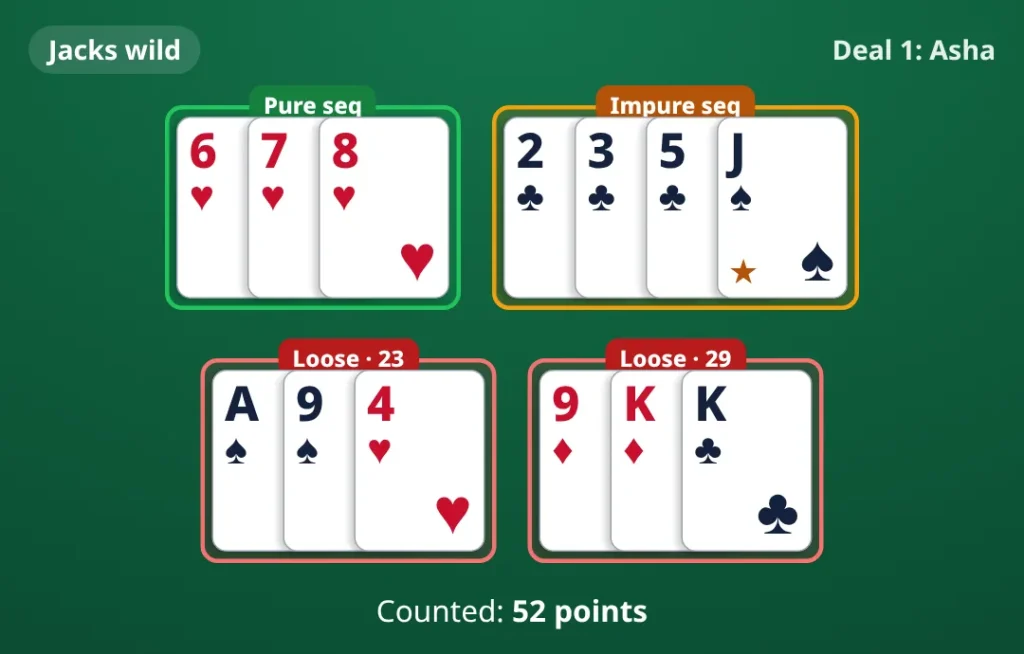
Asha has a pure sequence (6♥ 7♥ 8♥) and an impure one: the wild J♠ fills the 4 in 2♣ 3♣ _ 5♣. Her six loose cards count A♠ 10 + 9♠ 9 + 4♥ 4 + 9♦ 9 + K♦ 10 + K♣ 10 = 52.
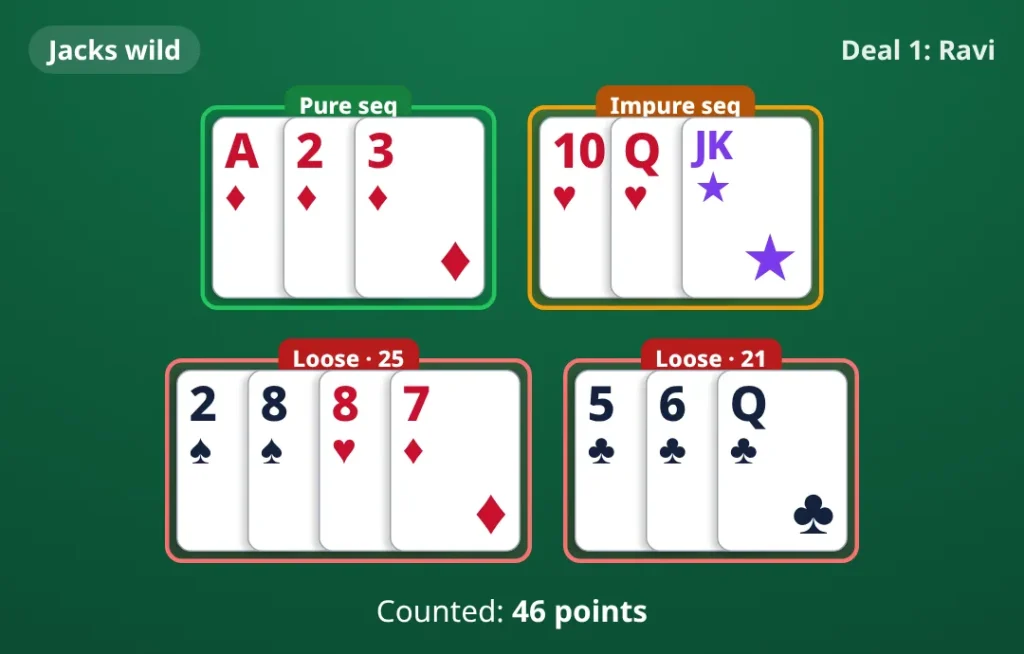
Ravi has A♦ 2♦ 3♦ as a pure sequence and 10♥ Q♥ with the printed joker as an impure one. His seven loose cards (2♠ 8♠ 8♥ 7♦ 5♣ 6♣ Q♣) count 46.
You collect 52 + 46 = 98 chips.
| After deal 1 | You | Asha | Ravi |
|---|---|---|---|
| Chips | 240 + 98 = 338 | 240 − 52 = 188 | 240 − 46 = 194 |
Deal 2: Ravi declares
Now Ravi makes a valid declaration. Asha is caught with 30. You hold 10♠ J♠ Q♠ 4♦ 4♣ 4♥ 7♥ 8♥ 3♥ 2♦ 6♣ K♣ 9♦.
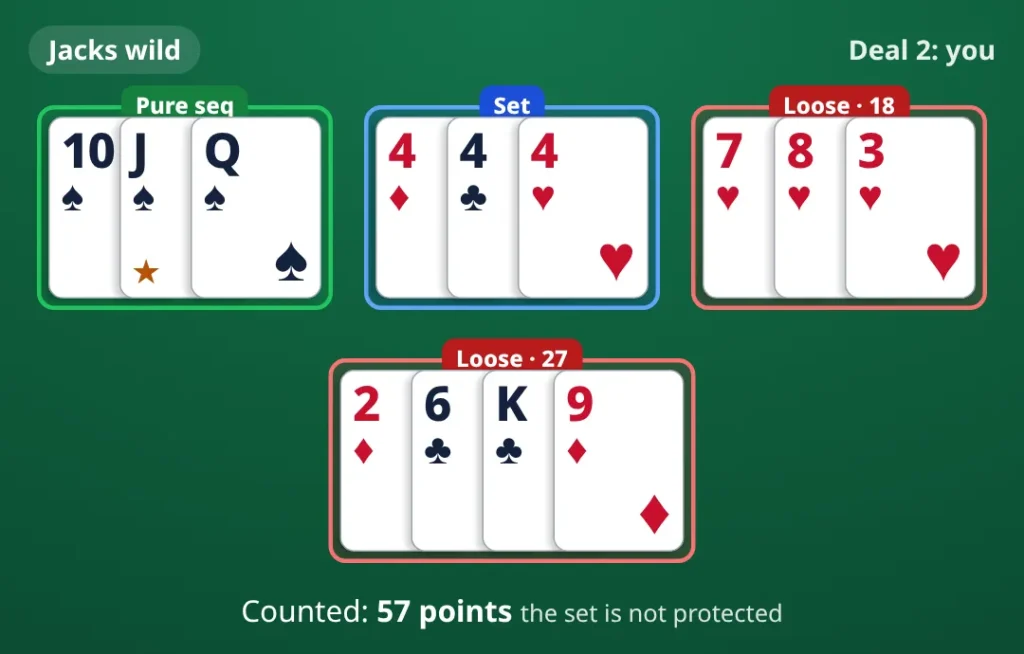
You have a pure sequence, 10♠ J♠ Q♠ (the J♠ is in its natural place, so it still counts as pure). But you have no second sequence, so your set of 4s isn’t protected. Everything except the pure sequence counts: 4 + 4 + 4 + 7 + 8 + 3 + 2 + 6 + 10 + 9 = 57. Ravi collects 57 + 30 = 87.
| After deal 2 | You | Asha | Ravi |
|---|---|---|---|
| Chips | 338 − 57 = 281 | 188 − 30 = 158 | 194 + 87 = 281 |
Tie-breaker
After two deals you and Ravi are level on 281. Asha finishes third with 158 and sits out, while you and Ravi play one more deal, head to head. Whoever wins it takes the other’s count and the match.
Notice how fast the lead changed. After deal 1 you were 144 chips ahead of Ravi, but one deal where you were caught with an unprotected set of 4s wiped that out. In a two-sequence hand, the set would have counted 0.
Deals Rummy strategy
General card play is the same as in Points Rummy. These tips are about the deals format.
1. Without a drop, damage control is a skill
You can’t fold a hopeless deal, so plan to lose small. Early on, throw high cards that aren’t part of a group, keep jokers and low cards, and make the pure sequence your first goal. A loss of 20 instead of 70 is a 50-chip swing.
2. Get the second sequence before you collect sets
As the example shows, a set of three counts in full until you have two sequences. A second sequence (pure or impure) protects every other meld you hold.
3. With 2 players, every point counts twice
Heads-up, the winner gains exactly what the loser loses, so the gap between you moves by twice the count. If you lead by 60 going into the last deal, your opponent overturns it by declaring while you hold 31 or more, and a count of exactly 30 means a tie-breaker deal.
4. With more players, a declaration is worth more
At a 6-player table the winner takes five losing counts at once, which often adds up to more than 200 chips. A quick declaration matters more as the table grows, and so does not being the player who loses 80.
5. Play the last deal by the scoreboard
Before the final deal, look at the chip gap. A big lead calls for a low count: shed high cards from the start. If you are far behind, a small loss changes nothing, so keep cards that give you the best chance to declare first.
6. Best of 3 gives you room to recover
In a best-of-2 match one bad deal is hard to undo. If you want a match that is decided by more than one deal, choose 3 deals on the start screen.
Going deeper: Deals Rummy strategy shows how to cut a bad hand’s count without a drop, with the chip maths for the last deal. The 80 cap and the starting chips are summarised in maximum points in rummy.
Common Deals Rummy mistakes
- Looking for the Drop button. There isn’t one. Plan from the first draw to either declare or lose small.
- Collecting sets before the second sequence. Sets don’t protect you until you have two sequences.
- Keeping court cards for a sequence that never comes. Every King, Queen, Jack and Ace still in your hand is 10 chips to the winner.
- Ignoring the chip gap in the last deal. The right risk level depends on whether you are ahead or behind.
- A wrong show. It costs 80 chips, which can decide a two-deal match on its own.
What players ask about Deals Rummy
Paraphrased from public sources, with links.
- How many deals? The r/cardgames thread on rummy variants mentions Deals played over 2, 3, 4 or 6 deals. Wikipedia says 2 or 3 is usual. Those are the two choices here.
- Who wins: fewest points or most chips? Both versions exist. Wikipedia describes lowest total points over the deals. This game uses chips, where the winner of each deal collects the others’ points. The worked example above shows how that plays out.
- Do chips mean money? On some apps, chips are bought with money. Here they are just a score kept in your browser. Nothing is bought, won or paid out.
- Keeping track of discards. In an r/digitalcards thread about a free rummy game, one commenter asked to see the discard pile instead of remembering it. Here the History button lists the last 30 moves.
Prefer Hindi? Read the Deals Rummy rules in Hindi.
Features of this Deals Rummy game
- 2 or 3 deals, chosen on the start screen, against 1 to 5 computer players on Easy, Medium or Hard.
- Chip standings for everyone on the table, the deal number in the top bar, and the chip change for each player on the result screen.
- Tie-breakers handled automatically, and a winner screen with everyone’s final chips.
- English or Hindi, switchable at any time with हिं / EN.
- Colour-coded groups (pure, impure, set, invalid) and a live status line.
- Discard history of the last 30 moves.
- Fair play: cryptographic shuffle, computer players that see only public cards, every hand revealed after each deal.
- Resume and offline: the match is saved after every move, and the game works offline once added to your Home screen.
- Free: chips have no money value. No ₹ deposit, no prize, no ads during a deal.
Our testing
- Rules check: 1,000 best-of-2 and 1,000 best-of-3 matches of computer players (2 to 6 players, mixed levels, 5,009 deals in total), run on 9 October 2026. In every deal all 106 cards were accounted for, losing hands were re-scored, no count went above 80 and no joker was taken from the open pile. In every match the chips added up to the starting total, nobody dropped, ties were settled only between the tied players, and the winner held the most chips. 0 rule violations were found.
- Ties: 6 of the best-of-2 matches (0.6%) and 3 of the best-of-3 matches (0.3%) ended level at the top after the last deal and needed a tie-breaker.
- Difficulty levels, from complete two-player matches with seats alternated (2,000 matches per pairing): in best-of-2, Hard beat Medium in 55.7% (±1.1), Medium beat Easy in 80.1% (±0.9) and Hard beat Easy in 84.9% (±0.8). In best-of-3: 57.3% (±1.1), 83.7% (±0.8) and 88.5% (±0.7). Matches level after the last deal were settled by tie-breaker deals, as in the game.
- Browser tests check the 2/3 deals choice, that there is no Drop button, the starting chips, the chip changes after a deal, the “Deal 1 of 3” display, the winner screen, and that a reload restores the match.
Deals Rummy FAQ
Is Deals Rummy free here? Do chips cost money?
It is free, and chips are not money. They are a score kept on your own device. You can’t buy them, win them or cash them out.
How many chips do I start with?
80 times the number of players: 160 each with 2 players, 240 with 3, up to 480 with 6.
Can I drop in Deals Rummy?
Not in this version. Every deal is played out, so keeping your count low when the cards are bad matters a lot.
How many deals are there?
2 or 3. You choose on the start screen, and 2 is the default. A tie at the top after the last deal adds tie-breaker deals for the tied players only.
What does the winner of a deal get?
The sum of all the losers’ counts, as chips. Each loser pays their own count, at most 80, or 80 for a wrong declaration.
What happens in a tie?
The players level at the top play a tie-breaker deal head to head. The others keep their chips and their final places.
Can my chips go below zero?
Only in a two-player, best-of-3 match. Each of you starts with 160, and three deals lost with 80 each would cost 240. With 3 or more players, the starting chips cover the worst possible 2 or 3 deals. A negative total is just a score that shows you are behind.
How is Deals different from Pool Rummy?
Pool Rummy goes on until all but one player have reached the limit (101 or 201), and it has drops. Deals is a fixed number of deals with no drop, scored with chips.
What if I close the browser mid-match?
The match is saved after every move. Open the game again and carry on. Starting a new game ends the old match.
Can I play Deals Rummy in Hindi?
Yes. Tap हिं at the top of the table, and the game remembers your choice.