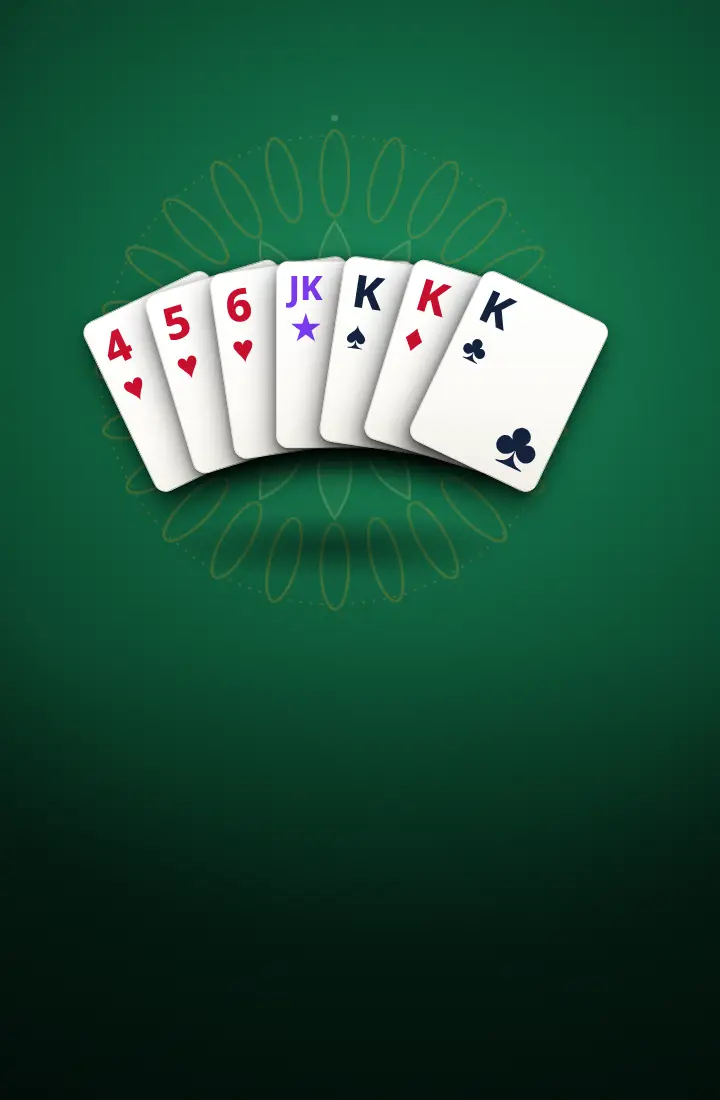
Play 13-card Indian Points Rummy free in your browser, against 1 to 5 computer players. Tap the table above to start. The game loads only when you tap, so this page stays light on mobile data. The game can also be played in Hindi: tap हिं at the top of the table.
Points Rummy at a glance
- 13 cards each, dealt from two decks with two printed jokers (106 cards).
- You against 1 to 5 computer players, on Easy, Medium or Hard.
- Declare with at least two sequences, one of them pure (no joker). Sets are 3 or 4 cards of one rank in different suits.
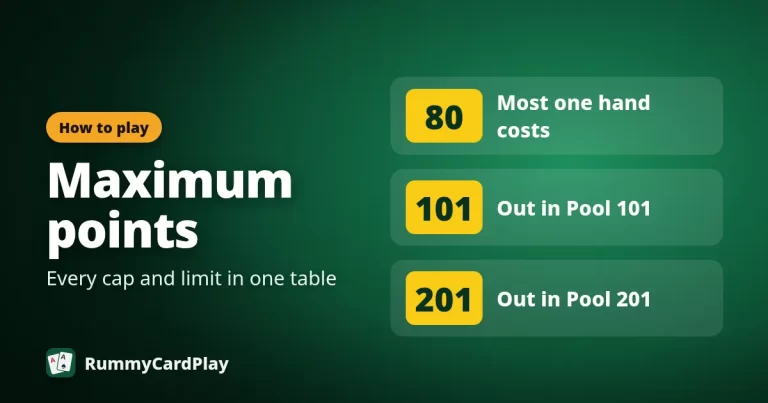
- Points: J, Q, K and Ace count 10, number cards their face value, jokers 0. Nobody pays more than 80 for a hand.
- Drop: 20 points on your first turn before you draw, 40 points later. A wrong declaration costs 80.
- Free: no money, no sign-up, no download. Your game is saved on your phone and keeps working offline.
How to play Points Rummy: the 13-card Indian rules
Points Rummy is the one-deal version of Indian Rummy, the 13-card game also known as Paplu (Pagat). One hand is a complete game: one player makes a valid declaration, everyone else counts their cards, and the next hand is dealt. Everything below is exactly what the game on this page enforces. Where family tables often play differently, we say so.
The deal
- Two standard decks plus two printed jokers: 106 cards in total.
- 2 to 6 players. Here that means you plus 1 to 5 computer players, set to Easy, Medium or Hard.
- Everyone gets 13 cards. Then one card is turned face up as the wild joker (also called the cut joker), one card starts the open pile, and the rest form the closed deck.
- Every card of the wild joker’s rank is a joker for that hand. If the 9♣ is turned up, all eight 9s in the two decks are jokers.
- If a printed joker is turned up, Aces are wild for that hand.
Your turn
- Draw one card: the top of the closed deck or the top of the open pile.
- Discard one card face up onto the open pile.
Two restrictions surprise new players:
- You cannot pick up a joker from the open pile. That includes printed jokers and cards of the wild rank: if 9s are wild and someone throws a 9, nobody can take it.
- If you picked up the top open card, you cannot throw that same card back in the same turn, and you cannot finish (declare) with it.
If the closed deck runs out, the open pile (except its top card) is reshuffled into a new closed deck.
Sequences and sets
- Pure sequence (First Life): three or more consecutive cards of one suit, with no joker standing in for a missing card. Example: 4♥ 5♥ 6♥.
- A wild card in its own place keeps a sequence pure. With 7s wild, 6♥ 7♥ 8♥ is still pure, because the 7♥ is simply being the 7♥.
- Impure sequence: a sequence where a joker fills a gap. With 9s wild, 10♠ J♠ 9♦ is impure: the 9♦ plays the Q♠.
- Ace is low (A♣ 2♣ 3♣) or high (Q♦ K♦ A♦), never in the middle. K♠ A♠ 2♠ is not a sequence.
- Set: three or four cards of one rank in different suits, such as 7♣ 7♦ 7♠. Jokers can complete a set (K♠ K♥ + joker). With two decks you will often hold two identical cards, like two 7♣. They can never be in the same set, and a set never has more than four cards.
- In this game, a group made only of jokers (for example a printed joker and two wild cards) counts as an impure sequence.
Declaring
After drawing you hold 14 cards. When 13 of them form valid groups, select the 14th card and tap Declare. That card is your finish card, and the other 13 are shown exactly as you grouped them. A valid declaration needs all three of these:
- At least two sequences.
- At least one of them pure.
- Every other card in a valid sequence or set, with no loose card left over.
If any condition fails, it is a wrong show: you take 80 points and sit out while the others finish the hand. If only one other player is still in, that player wins.
Dropping
At the start of your turn, before drawing, you can drop (pack) instead of playing:
- First drop, before you have drawn any card in this hand: 20 points.
- Middle drop, after you have drawn at least once: 40 points.
If everyone else drops, the last player left wins the hand.
House rules you may know from home
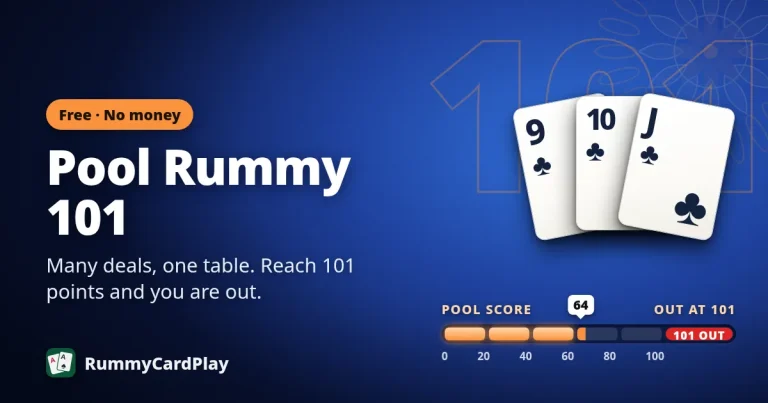
Indian Rummy has many family versions. Pagat’s Indian Rummy page records one common home version where the first drop costs 10 points. It also notes that some groups make Aces wild when a printed joker is turned up and others do not. This game uses the 20/40 drop values found in most modern 13-card rule sets, and plays Aces wild after a printed-joker cut. Our pool games use 20/40 for Pool Rummy 101 and 25/50 for Pool Rummy 201.
Scoring: how points are counted, with real hands
In Points Rummy lower is better. The winner’s hand counts 0, and the winner collects every other player’s points, so their running total goes up by that amount. Each loser’s points are taken off their own running total, which is why a total can go below zero (shown with a minus sign).
| Card | Points |
|---|---|
| A, K, Q, J, 10 | 10 each |
| 2 to 9 | Face value |
| Printed jokers and wild-rank cards | 0 |
An Ace counts 10 even though it can sit low in A-2-3. A stray Ace hurts as much as a King.
What counts depends on your sequences:
- No pure sequence: every card counts.
- A pure sequence but no second sequence: everything except that pure sequence counts. Your sets still count.
- A pure sequence plus at least one more sequence: only cards outside valid groups count.
- Whatever the total, nobody pays more than 80 for one hand. This is the full count.
You don’t need to tidy your cards before the count. When someone declares, this game counts every losing hand in its best possible grouping and shows that grouping face up on the result screen.
Example 1: pure, impure and a set (25 points)
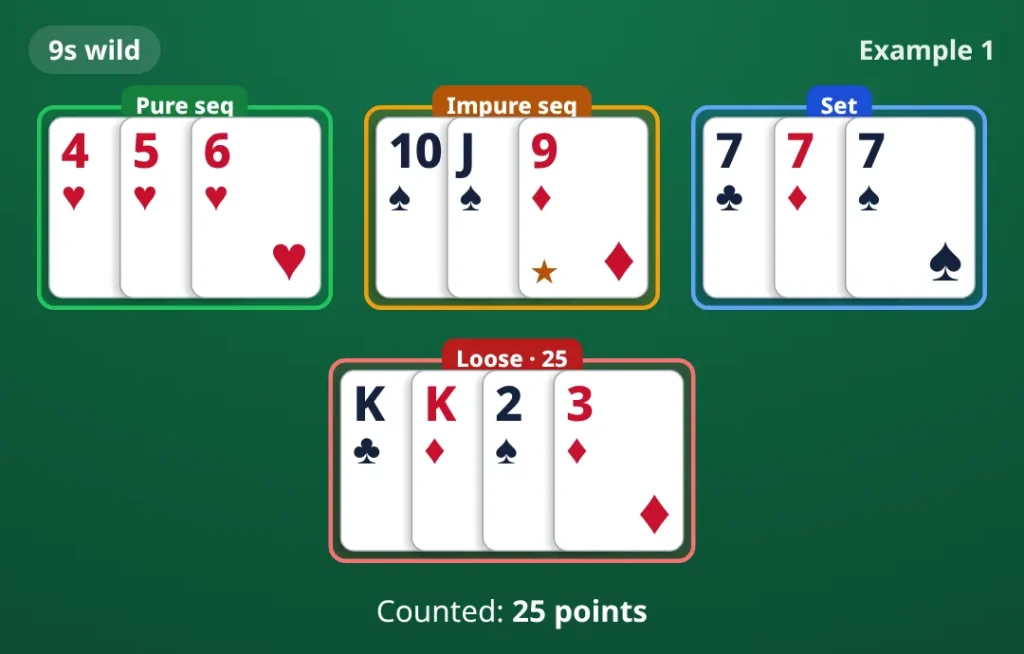
The wild joker is 9♣, so all 9s are wild. Your hand when someone declares:
- 4♥ 5♥ 6♥: pure sequence
- 10♠ J♠ 9♦: impure sequence (the 9♦ is a joker)
- 7♣ 7♦ 7♠: set
- K♣ K♦ 2♠ 3♦: loose
You have both lives, so only the loose cards count: 10 + 10 + 2 + 3 = 25 points. The two Kings are 20 of those points. Throwing them earlier would have saved most of the damage.
Example 2: pure sequence only (63 points)
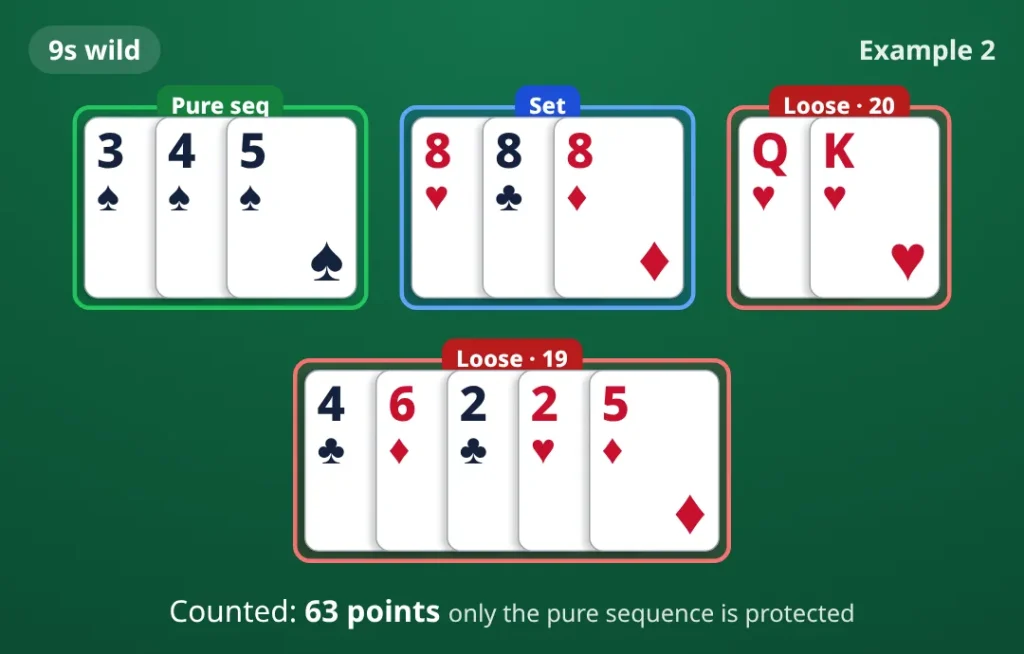
9s wild. Hand: 3♠ 4♠ 5♠ (pure) · 8♥ 8♣ 8♦ (set) · Q♥ K♥ · 4♣ 6♦ 2♣ 2♥ 5♦.
There is no second sequence, so everything except the pure sequence counts, including the set of 8s: 24 + 20 + 19 = 63 points. If the 5♦ had been a joker, Q♥ K♥ + joker would have formed a second sequence and the 8s would have become a protected set. The hand would then cost only 14. One joker, a 49-point difference.
Example 3: no pure sequence (80, capped)
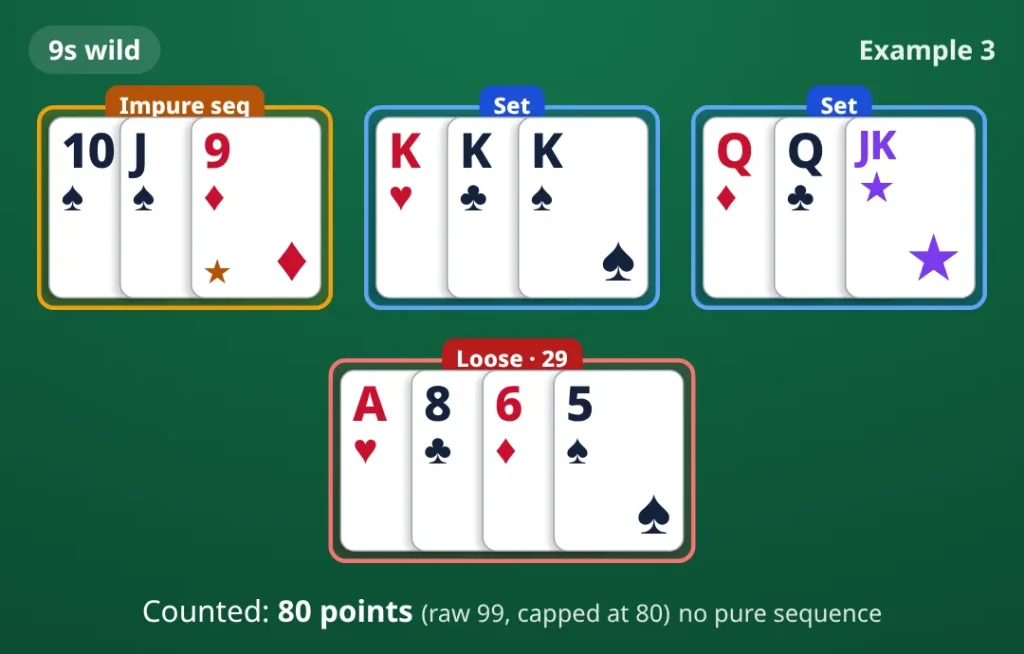
9s wild. Hand: 10♠ J♠ 9♦ (impure) · K♥ K♣ K♠ (set) · Q♦ Q♣ + printed joker (set) · A♥ 8♣ 6♦ 5♠.
It looks organised, but without a pure sequence nothing is protected. The raw total is 99, capped at 80. That is why the pure sequence always comes first.
Example 4: printed joker cut, Aces wild (25 points)
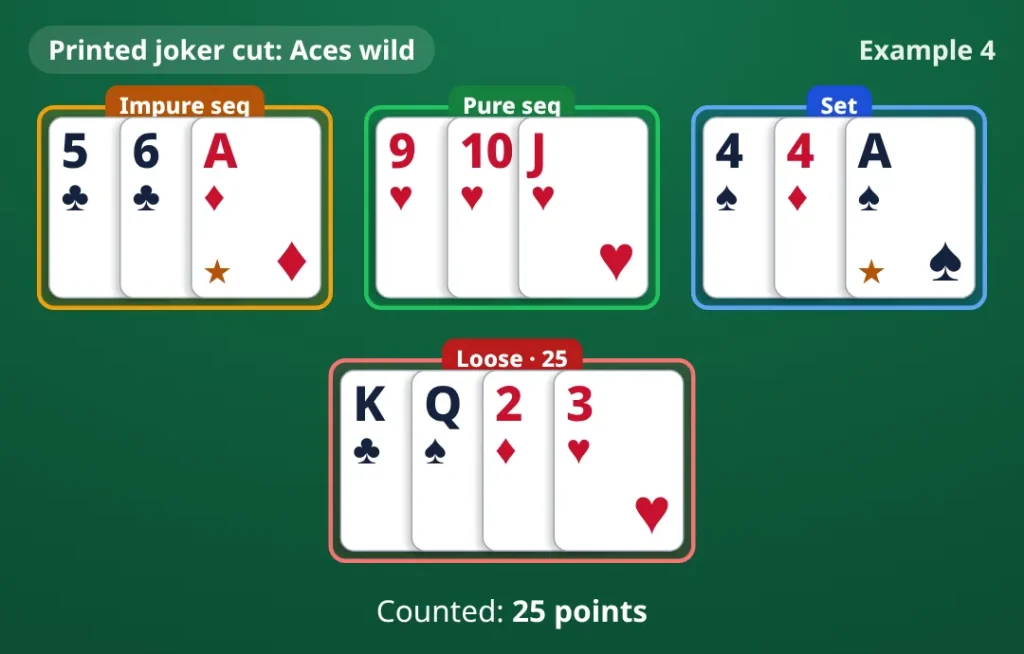
The printed joker is turned up, so Aces are wild. Hand: 5♣ 6♣ A♦ (impure, the A♦ is a joker) · 9♥ 10♥ J♥ (pure) · 4♠ 4♦ A♠ (set, the A♠ is a joker) · K♣ Q♠ 2♦ 3♥.
Both lives are there, so 10 + 10 + 2 + 3 = 25 points. In this hand the two Aces are worth 0 instead of 10 each.
Example 5: the game finds a better grouping (22, not 27)
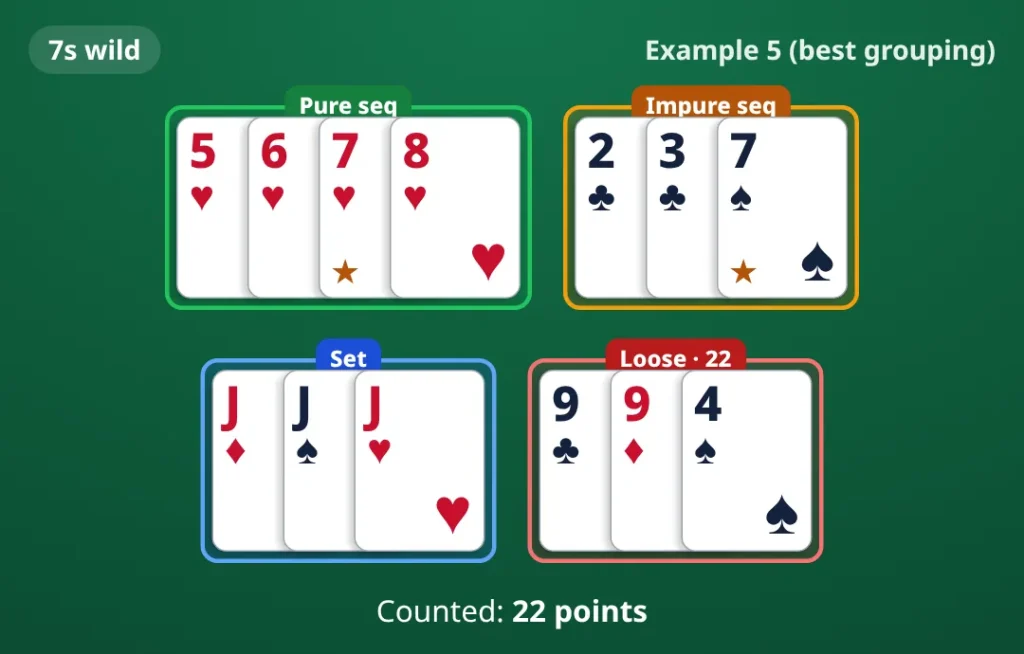
7s wild. You arranged 6♥ 7♥ 8♥ (pure, because the 7♥ is in its natural place) · 2♣ 3♣ 7♠ (impure) · J♦ J♠ J♥ · and left 5♥ 9♣ 9♦ 4♠ loose. That arrangement counts 27.
The result screen regroups it: the 5♥ joins 5♥ 6♥ 7♥ 8♥, leaving 9♣ 9♦ 4♠ = 22 points. You never pay extra for an untidy hand at the count. When you declare, though, your own grouping is what gets checked.
Example 6: what the winner collects
Four players, and you declare validly. Player 2 holds the hand from Example 1 (25 points), player 3 holds Example 3 (80) and player 4 dropped before drawing (20). You score 0 and collect 25 + 80 + 20 = 125 points. Your running total goes up by 125, and the others’ totals go down by 25, 80 and 20.
Playing with real cards? The free rummy points calculator keeps the score sheet for you, and our guide to counting points has more checked hands.
Valid and invalid declarations
Each row is a complete 13-card hand with 9s wild. “PJ” means a printed joker. This is the first hand as the game shows it, with every group labelled:
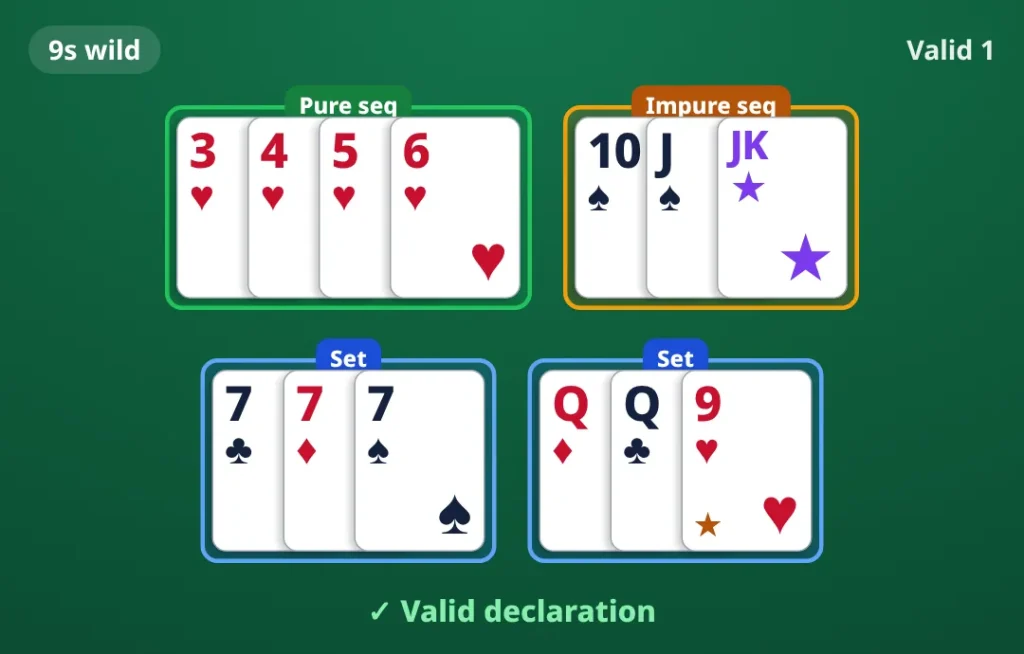
| Hand as shown | Result | Why |
|---|---|---|
| 3♥ 4♥ 5♥ 6♥ · 10♠ J♠ PJ · 7♣ 7♦ 7♠ · Q♦ Q♣ 9♥ | Valid | Pure + impure sequence, two sets (the 9♥ is a joker in the Queens) |
| A♣ 2♣ 3♣ · Q♦ K♦ A♦ · 5♠ 5♥ 5♦ 5♣ · 8♥ 8♠ 8♣ | Valid | Two pure sequences, one with Ace low and one with Ace high |
| 3♥ 4♥ PJ 6♥ · 10♠ J♠ 9♦ · 7♣ 7♦ 7♠ · Q♦ Q♣ Q♥ | Wrong show (80) | Two sequences, but both use a joker: no pure sequence |
| 3♥ 4♥ 5♥ · 10♠ J♠ PJ · 7♣ 7♣ 7♦ · K♦ K♠ K♥ K♣ | Wrong show (80) | 7♣ appears twice; a set needs different suits |
| K♠ A♠ 2♠ · 6♦ 7♦ 9♣ · 4♣ 4♦ 4♥ · J♥ J♠ J♦ J♣ | Wrong show (80) | K-A-2 is not a sequence, so there is no pure sequence |
| 3♥ 4♥ 5♥ · 7♣ 7♦ 7♠ · Q♦ Q♣ Q♥ · 2♠ 2♦ 2♣ 9♥ | Wrong show (80) | Only one sequence; sets cannot replace the second |
| 3♥ 4♥ 5♥ · 10♠ J♠ PJ · 8♣ 8♦ 8♠ 8♥ 9♦ · K♣ K♦ | Wrong show (80) | A set cannot have five cards |
Two details are worth noticing. In row 4, if someone else had declared first, the same cards would have cost only 21 points as a losing hand. Declaring them cost 80. In row 7 the cards are actually complete: 8♠ 8♥ 8♦ 8♣ plus K♣ K♦ 9♦ would have been valid. The grouping was wrong, not the hand. Ten more hands are worked through in Valid vs invalid declaration: 10 example hands, and the declare checker tests any hand you tap in.
Points Rummy strategy
1. Build the pure sequence first
Until you have a pure sequence, every card counts against you and you cannot declare. Keep two connected cards of one suit (5♦ 6♦ or 5♦ 7♦) over loose high cards. A four-card pure sequence is even better, because it can give up an end card later without breaking.
2. Keep middle cards, throw lonely high cards
A 6 can go into 4-5-6, 5-6-7 or 6-7-8, or into a set. A King only fits J-Q-K, Q-K-A or a set of Kings. Unconnected A, K, Q, J and 10 cost 10 points each if someone declares, so throw them early unless they already belong to a pair or a run. Remember that the Ace is 10 here.
3. Joker strategy
- Never spend a joker trying to make your first life: a sequence with a joker in it cannot be pure anyway.
- The best use of a joker is the second life. Turning Q♥ K♥ into a sequence protects every set you hold at once (Example 2 shows a 49-point difference).
- The next best use is completing a set of high cards: K♠ K♥ + joker takes 20 points off your count.
- A joker in your hand is worth 0 points, so holding one costs nothing at the count. Throwing one doesn’t help anybody, since jokers can’t be picked from the open pile, but it wastes your most flexible card.
- When a printed joker is the cut card, every Ace becomes a joker. The Ace you were about to throw is suddenly worth keeping.
4. Read the open pile
Tap History to see the last 30 moves: who threw which card, and who picked it up. If the player before you just took the 8♥, think twice before giving them the 7♥ or 9♥. Once both copies of a card have been thrown, stop waiting for it: 5♦ _ 7♦ can then only be completed with a joker.
5. Discard safely late in the hand
Late in a hand, throwing a card of the same rank as one just discarded is usually safer than throwing a fresh middle card that might complete someone’s sequence.
6. Know when to drop
- First drop (20): take it when you have no pure sequence and no joker, even if some cards look connected. At a full table, also drop a hand with only one joker and no pure sequence.
- Middle drop (40): consider it when about three of your turns have passed and you still have no pure sequence and no joker (at a full table, one joker is not enough either).
- Play on with a pure sequence, with two or more jokers, or with one joker in a two-player game.
In our 26,000 simulated hands against Hard computer players, playing on with no pure sequence and no joker averaged −31.7 points with two players and −62 with six, against 20 for a first drop. The checklist and four example opening hands are in When to drop in Points Rummy, and the full figures in our data study Drop or play on?
7. Check before you declare
The status line above your cards reads, for example, “Pure seq ✓ · Sequences 2/2”. Make sure every card except your finish card sits in a coloured group: green, orange or blue, and no red. The game checks your groups exactly as shown, like a strict table would.
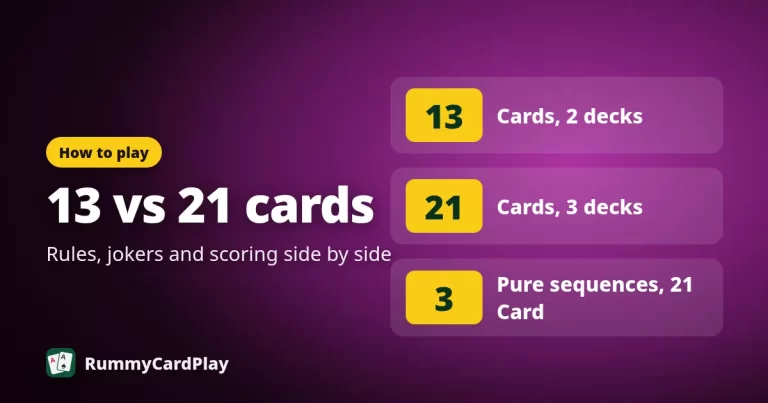
Going deeper: how to make a pure sequence fast, joker strategy and 12 common rummy mistakes., plus maximum points in rummy and 13 card vs 21 card rummy. New to free rummy? Read how free rummy works here.
Common mistakes
- Declaring with two impure sequences. This is the most common wrong show. One of the two lives must be clean.
- A set with a repeated suit. Two decks means two 7♣. 7♣ 7♣ 7♦ is not a set, even with a joker added.
- Treating K-A-2 as a sequence. The Ace goes at one end only.
- Thinking sets protect you before you have two sequences. In Example 2 the set of 8s still cost 24 points.
- Keeping Aces because they feel low. An Ace is 10 points.
- Five cards in one set. Split them into a set and another group.
- Waiting for a dead card. Check History: if both copies have gone, your gap needs a joker.
- Never dropping. Paying 20 to skip a hopeless hand beats paying 80.
- Throwing the card the next player wants. Look at what they just picked up before throwing middle cards.
What players say: common complaints about free rummy games
We read player reviews and discussions about free rummy games to see what trips people up. Everything below is paraphrased from the linked sources. The few words in quotation marks are exactly what the reviewers wrote.
- Suspicion that the computer cheats. Several Google Play reviews of free offline Indian Rummy apps doubt the shuffle. One 2019 review of an Indian Rummy app said the computer won before the first round in three of five games and that the open cards repeated. A 2025 review of another offline app called it “fishy” that the player could rarely pick up the face-up card or the joker thrown by the previous player. Part of that second complaint is actually a rule: in 13-card Indian Rummy, jokers can never be picked from the open pile. For the rest, this game shuffles with your browser’s cryptographic random number generator, the computer players see only what a person at a real table could see, and every hand is shown face up at the end so you can check.
- Ads in the middle of play. Reviews complain about an advert after every game, or about turning off mobile data just to avoid ads (example, example). This game never interrupts a hand with an ad. At most, one promotion card for another free game can appear on the result screen after a hand ends.
- Accidental discards. Reviewers of one long-running Indian Rummy app praised its fairness, but said tightly packed cards and no undo button led them to throw the wrong card (reviews from 2024 and 2025). Here a discard takes two separate steps: select the card, then press Discard.
- Auto-sort that groups badly. Reviews of other apps complain that automatic grouping can’t be undone, or doesn’t let you make your own groups, and that this costs points (example, example). Here you build your own groups with the Group button. At the count, the game uses your hand’s best grouping anyway.
- Missing Indian rules. One older review praised an app but missed the option to drop (“scoot”) when the cards are bad, and wanted a cut joker on top of the printed jokers (2018 review). Both are standard in Indian Rummy, and both are in this game.
- Remembering discards. In an r/cardgames thread asking for rummy help, one commenter advised tracking every discard and every face-up card an opponent picks up, and holding middle cards like 6s and 7s because they fit the most sequences. Another listed the Indian drop costs: 20 at the start, 40 later. The History button exists for exactly this kind of tracking.
- Duplicate cards in a set. A Board Games Stack Exchange question asked whether 6♠ 6♠ + joker is a valid set. The accepted answer: not in two-deck Indian Rummy. Three identical cards (a tanala) only exist in the three-deck version. This game follows the two-deck rule.
The same reviews also show what players value when a free rummy game gets it right: offline play, choosing the number of opponents, and no money involved. One 2026 review praised exactly those three things.
Features of this Points Rummy game
- English or Hindi: the हिं / EN button switches every button, message, the help screen and the screen-reader labels. The game remembers your choice.
- Colour-coded groups: green for a pure sequence, orange for an impure sequence, blue for a set and red for an invalid group. The labels update as you move cards.
- Live status line: shows whether you have a pure sequence, how many sequences you have (x/2) and your current points.
- Discard history: the last 30 moves, including who picked up which card from the open pile.
- Fair play: cryptographic shuffle (crypto.getRandomValues), computer players that use only public information, every hand revealed after the deal, and losing hands counted in their best grouping.
- Works offline: add it to your Home screen. After the first visit it plays without internet. Your hand is saved on your phone, so you can close the tab mid-game and carry on later.
- Your table, your level: 1 to 5 computer opponents on Easy, Medium or Hard.
- Free: no sign-up, no ₹ deposits, no cash prizes and no ads interrupting a hand. Points are just a score.
Our testing
Nobody on our team claims to be a rummy champion. What we can show is how carefully the game was checked.
- 2,400 computer-vs-computer hands (480 each at 2, 3, 4, 5 and 6 players, mixing Easy, Medium and Hard) went through an automatic rules checker on 8 October 2026. In every hand: all 106 cards were accounted for, every winning declaration was re-checked, every losing hand was re-scored from the grouping shown on the result screen, no hand scored above 80, and no joker was ever taken from the open pile. The checker found zero rule violations.
- What those hands looked like: a losing hand cost 46.1 points on average, and 1,332 of 6,811 losing hands (19.6%) hit the 80-point cap. A printed joker was the cut card in 47 hands (about 2%, close to the 2-in-106 chance you would expect), making Aces wild.
- Difficulty levels, measured over 8,000 one-on-one hands: Hard won 55.4% of 3,200 hands against Medium (+5.3 points per hand), Medium won 73.3% of 2,400 hands against Easy (+24.6), and Hard won 76.1% of 2,400 hands against Easy (+27.3).
- Hindi and English: an automated browser test switches the language in the middle of a hand and checks that the buttons, status line, card labels for screen readers, help and result screens all change, and that the choice is remembered after a reload (20 checks, 8 October 2026).
- What the simulation doesn’t cover: the computer players never made a middle drop or a wrong show in that run. Those two penalties (40 and 80) are checked by separate automated tests instead, including a browser test that declares a set with a repeated suit and confirms the 80-point wrong show.
Points Rummy FAQ
Is this Points Rummy game really free?
Yes. There is no sign-up, no deposit and no cash prize. Points are only a score, and your running total is stored on your own device.
How many points is an Ace worth?
10, the same as a King, Queen, Jack or 10. An Ace can be low (A-2-3) or high (Q-K-A) in a sequence, but K-A-2 is not allowed.
What happens if I make a wrong declaration?
You take 80 points and sit out the rest of the hand while the others play on. If only one other player is left, that player wins the hand.
What is the most I can lose in one hand?
80 points, the full count. A first drop costs 20 and a middle drop costs 40.
Can I pick up a joker from the open pile?
No. Neither a printed joker nor a card of the wild rank can be taken from the open pile. You also cannot throw back the card you just picked up from it.
Can the wild joker be part of a pure sequence?
Only in its own natural place. If 7s are wild, 6♥ 7♥ 8♥ is pure. If the 7♠ stands in for the 7♥, the sequence becomes impure.
Can a set have two cards of the same suit?
No. Two decks mean you can hold identical cards such as two 7♣, but they cannot be in the same set. A set has three or four cards, all in different suits.
What happens when the printed joker is the cut card?
Aces become wild for that hand. They score 0 and can stand in for any card in an impure sequence or a set.
Do my sets count if I don’t have two sequences?
Yes, they count against you. With a pure sequence but no second sequence, only the pure sequence is protected. Without a pure sequence, every card counts, up to the 80 cap.
What is the difference between Points, Pool and Deals Rummy?
Points Rummy is a single deal. Pool Rummy adds up your points over many deals and knocks you out at 101 or 201. Deals Rummy is played over 2 or 3 deals with chips and no drop. The rules for melds and declaring are the same in all of them, and all can be played free here. See the rummy glossary for a side-by-side comparison.
Do the computer players see my cards?
No. They decide using only their own hand, the wild joker and the cards everyone can see on the open pile. All hands are shown face up after each deal.
Can I play without internet?
Yes. Open the game once while online, then use your browser’s “Add to Home screen”. After that it works offline, and an unfinished hand is restored when you come back.