When someone declares in 13-card Indian Rummy, everyone else counts the cards they could not group. The rules are short, but three details catch players out: what happens without a pure sequence, what happens with only one sequence, and the fact that your hand is counted in its best grouping, not the one on your screen. This guide works through each rule with real hands, all counted by the rules engine behind our free Points Rummy game. For quick sums at the table, use the rummy points calculator.
Card values
| Card | Points |
|---|---|
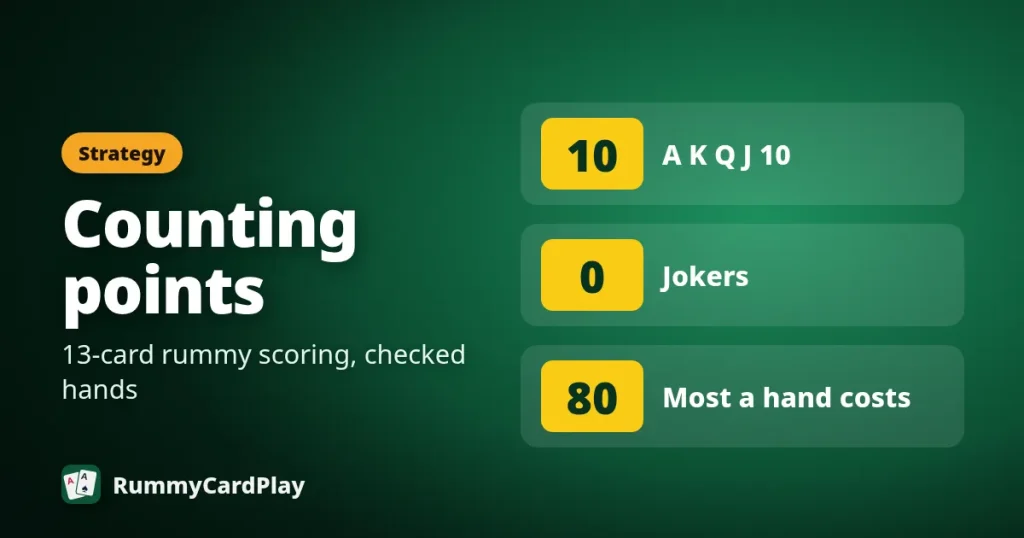
| Ace, King, Queen, Jack, 10 | 10 each |
| 2 to 9 | Face value (a 7 is 7 points) |
| Printed joker, any card of the wild rank | 0 |
| Most a losing hand can cost | 80 |
| Wrong show (invalid declaration) | 80 |
| First drop / middle drop | 20 / 40 (25 / 50 in Pool 201) |
Some home games count the Ace as 1, or charge 10 for a first drop. Pagat lists these variations. Our games, the calculator and every example here use the common modern rules above.
How to count points in rummy: four steps
Counting happens only for the players who did not win. Take this losing hand with 8 as the wild joker:
3♥ 4♥ 5♥ · 9♠ 10♠ J♠ · Q♣ Q♦ Q♠ · K♣ 2♦ A♠ 7♦
- Find the pure sequences. 3♥ 4♥ 5♥ and 9♠ 10♠ J♠ are both pure (no joker), so the hand has a pure sequence and a second sequence.
- Protect every valid group. With two sequences, all valid groups are safe, so the set Q♣ Q♦ Q♠ is protected too. Those nine cards count 0.
- List the loose cards. What is left is K♣, 2♦, A♠ and 7♦.
- Add them up, tens first. K and A are 10 each, then 2 and 7: 10 + 10 + 2 + 7 = 29. The cap of 80 does not apply because 29 is well below it.
The engine behind our games agrees: 29. If the second sequence were missing, everything outside the pure sequence would count and the same hand would cost much more, as Rules 1 and 2 below show. If you are unsure which cards are protected, the rummy points calculator and the declare checker do the sums for you. For every cap and limit in one table, see maximum points in rummy.
Rule 1: no pure sequence, every card counts
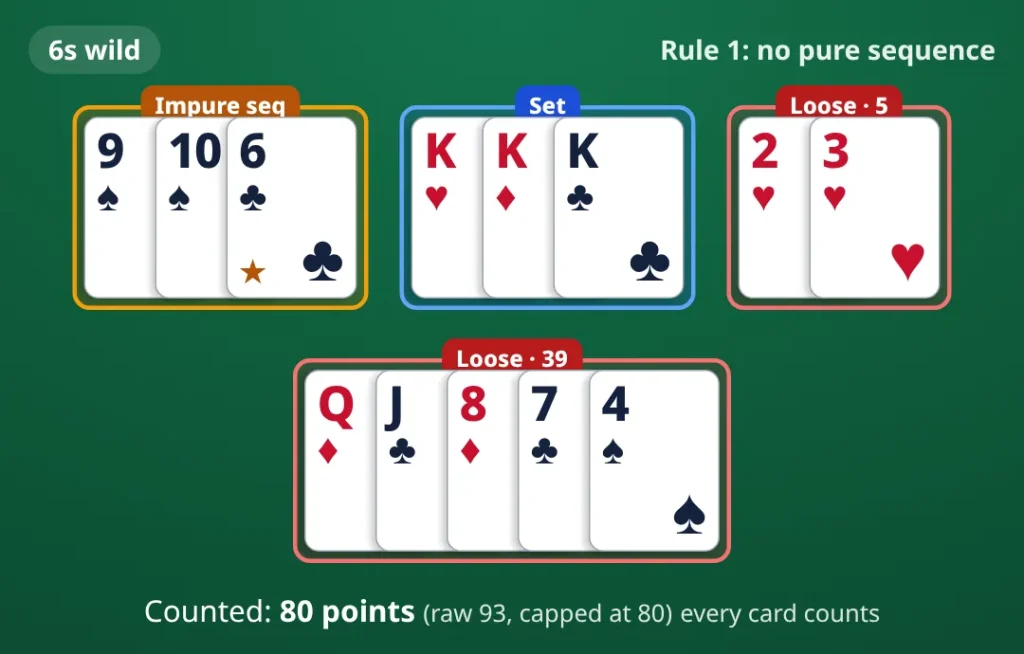
9♠ 10♠ 6♣ · K♥ K♦ K♣ · 2♥ 3♥ · Q♦ J♣ 8♦ 7♣ 4♠
6s are wild. This hand has an impure sequence (9♠ 10♠ with the 6♣ joker) and a set of Kings, but no pure sequence, so neither group protects anything. All 13 cards count: 93 points in total, but the hand cannot cost more than 80. The only free card is the 6♣ joker, which always counts 0.
Rule 2: a pure sequence but no second sequence
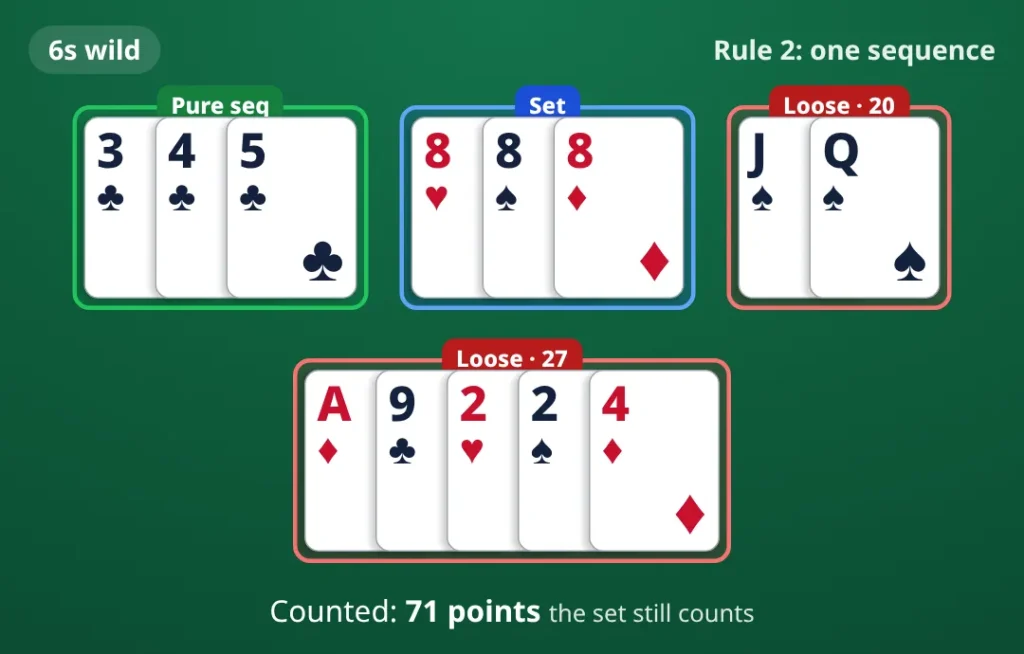
3♣ 4♣ 5♣ · 8♥ 8♠ 8♦ · J♠ Q♠ · A♦ 9♣ 2♥ 2♠ 4♦
Same wild rank. The pure sequence 3♣ 4♣ 5♣ is protected and counts 0. But a set only protects once you have two sequences, so the three 8s count, along with everything else: 71. If the A♦ had been a 10♠, then 10♠ J♠ Q♠ would be a second sequence, the 8s would be protected, and the engine would count only 9♣, 2♥, 2♠ and 4♦: 17.
Rule 3: both sequences, only loose cards count
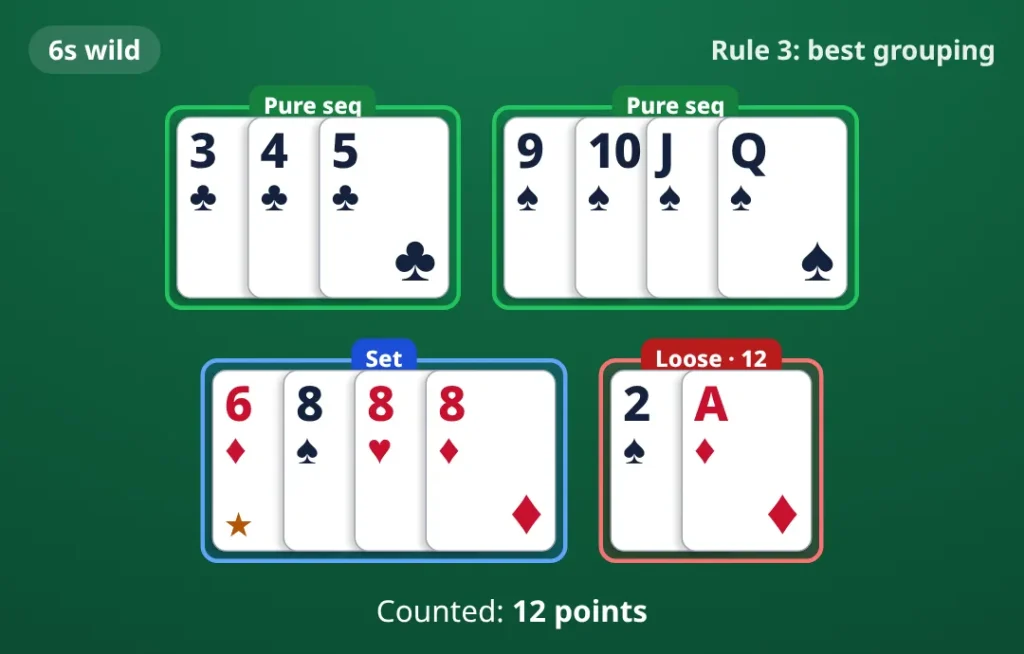
3♣ 4♣ 5♣ · 9♠ 10♠ J♠ Q♠ · 6♦ 8♠ 8♥ 8♦ · 2♠ A♦
Now there are two sequences, so every valid group is protected and only the loose cards count: 2♠ and A♦, 12 points.
This hand also shows the most useful scoring rule of all: the game counts your best grouping, not your arrangement. Suppose you had arranged the same 13 cards as 3♣ 4♣ 5♣ · 9♠ 10♠ 6♦ · 8♥ 8♠ 8♦ · J♠ Q♠ A♦ 2♠. That grouping is valid too, but it leaves J♠, Q♠, A♦ and 2♠ loose, for 32. The engine finds the better arrangement: 9♠ 10♠ J♠ Q♠ as a second pure sequence, with the 6♦ joker completing the 8s. Our games always count a losing hand this way, and so does the declare checker.
Rule 4: a printed joker cut makes Aces wild
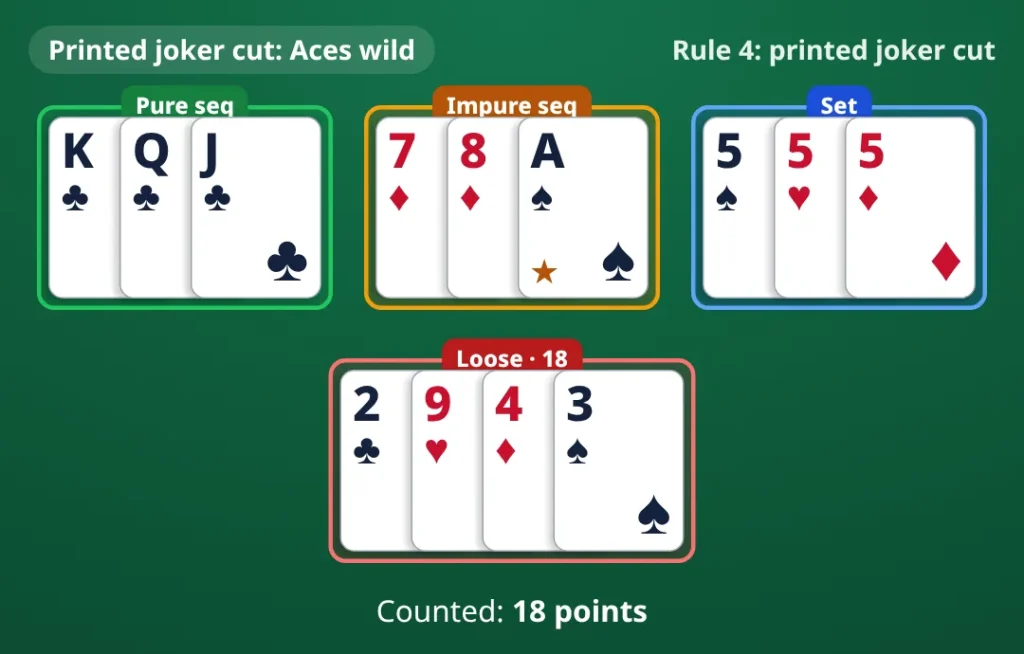
K♣ Q♣ J♣ · 7♦ 8♦ A♠ · 5♠ 5♥ 5♦ · 2♣ 9♥ 4♦ 3♠
When the cut card is a printed joker, every Ace is a joker for the hand. The A♠ completes 7♦ 8♦ as an impure sequence, and with K♣ Q♣ J♣ as the pure sequence the set of 5s is protected too. Only 2♣, 9♥, 4♦ and 3♠ count: 18.
Wrong shows, drops and the 80 cap
- A wrong show costs 80, whatever the hand would have counted. If you are not sure, check first: see ten valid and invalid declarations.
- A first drop (before your first draw) costs 20, a middle drop 40. Our guide on when to drop explains when each pays.
- The 80 cap means a hand can never cost more than a wrong show, so once you are over 80 with no pure sequence, extra high cards cost nothing more. Getting below 80 is what matters.
How the points are settled
| Format | What happens to the points |
|---|---|
| Points Rummy | The winner collects every loser’s count. Each hand stands alone |
| Pool Rummy 101 | Your count is added to your running total. Reach 101 and you are out |
| Pool Rummy 201 | The same, out at 201, with drops of 25 and 50 |
| Deals Rummy | The winner takes the losers’ counts as chips; after the last deal, most chips wins |
| 21 Card Rummy | The cap is 120, and value cards are settled separately |
The rummy points calculator keeps a score sheet for each of these formats.
Strategy for each format: Pool Rummy, Deals Rummy, 21 Card Rummy and Gin Rummy. How often a hand starts at the 80 cap is in rummy opening hand odds.
Quick counting habits
- Count in tens first: every A, K, Q, J and 10 is 10. Then add the small cards.
- Ask the two questions in order: Do I have a pure sequence? Do I have a second sequence? They decide which cards count.
- Count your own hand before every discard. It tells you what to throw and when a middle drop is cheaper.
- Practise with the counting puzzles in the daily rummy puzzle.
FAQ
How are points counted in 13-card rummy?
Only for losing hands. Add up the cards that are not in a valid group: A, K, Q, J and 10 are 10 each, other cards their number, jokers 0. Without a pure sequence every card counts. With a pure sequence but no second sequence, everything except the pure sequence counts. The total is capped at 80.
Does the Ace count as 1 or 10 in Indian Rummy?
10 in our games and in most modern rule sets. Some home games count it as 1, so agree the rule before playing.
Do sets count if I have no second sequence?
Yes. A set is only protected once you have a pure sequence and a second sequence. Until then, its cards are counted.
Is my hand counted the way I arranged it?
In our games a losing hand is counted in its best possible grouping, so you never pay extra because of how you arranged your cards. When you declare, though, your groups are checked exactly as you arranged them.
How do you count points in rummy step by step?
Check for a pure sequence and a second sequence. If both are there, only the cards outside valid groups count. Add those cards: A, K, Q, J and 10 are 10 each, other cards their number, jokers 0. The total is never more than 80. The “four steps” section above works through a hand.
How many points is a joker in rummy?
Zero. Printed jokers and cards of the wild joker’s rank count 0 in your hand, whether or not they are in a group.
How are points counted in Pool Rummy?
The same way as in Points Rummy, but your count is added to your running pool score instead of being paid out hand by hand. In Pool 101 you are out at 101 or more, in Pool 201 at 201 or more. See Pool Rummy strategy.
What is the maximum points in rummy?
80 for one hand in 13-card rummy (120 in 21 Card Rummy). The full table is in maximum points in rummy.