The first ten seconds of a rummy hand decide a lot. Before you draw, you need to see your pure-sequence chances, your jokers, the cards that work two ways and the cards you will throw first. This guide gives a five-step routine for sorting and planning a 13-card hand, shows it on a real deal checked by our rules engine, and explains how to do it quickly on a phone screen with the Sort and Group buttons in our free Points Rummy game.
The five-step routine
- Sort by suit. Put each suit together in rank order. Pairs in the same suit that sit one or two ranks apart are now easy to see.
- Find the jokers. Note the cut card’s rank, then every card of that rank and every printed joker. Move them to one side.
- Mark pure-sequence chances. Every same-suit pair or trio that could become a run without a joker. These come first (see how to make a pure sequence fast).
- Mark the two-way cards. A card that fits a run and a set, or two different runs, is worth more than it looks. Keep it until one of its plans comes in.
- List your first three discards. Usually lonely high cards (A, K, Q, J, 10 with no neighbour or pair), then the weakest chance. Decide now, so you are not deciding under time pressure later.
If step 2 finds no joker and you have no pure sequence yet, read when to drop before you draw: in our simulations such hands cost more to play out than a 20-point first drop, even when step 3 found some chances.
A worked deal (5s wild)
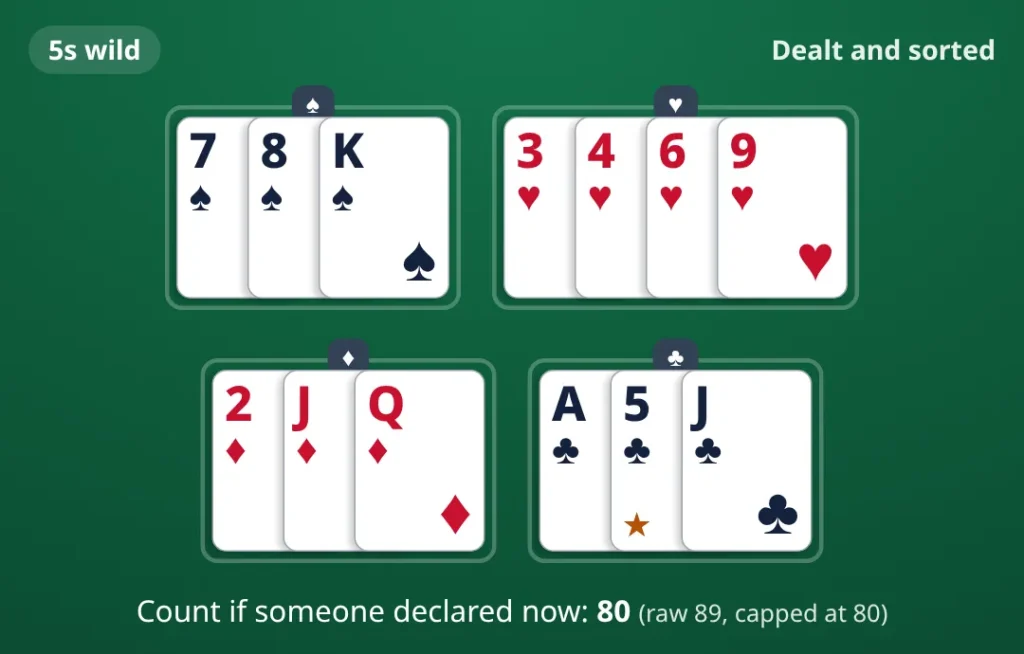
7♠ 8♠ K♠ · 3♥ 4♥ 6♥ 9♥ · 2♦ J♦ Q♦ · A♣ 5♣ J♣
This is the hand after Sort: one row per suit. The engine counts it at 80 (89 raw), because there is no pure sequence yet. Now the routine:
- Jokers: 5♣ is a joker (5s are wild). There are no printed jokers.
- Pure-sequence chances: 3♥ 4♥ _ 6♥ needs only 5♥, and the 5♥ counts as itself, so 3♥ 4♥ 5♥ 6♥ would be pure. 7♠ 8♠ needs 6♠ or 9♠. J♦ Q♦ needs 10♦ or K♦. That is 2 + 4 + 4 = 10 physical cards.
- Two-way cards: J♦ fits J♦ Q♦ and a set of Jacks with J♣. 4♥ fits 3♥ 4♥ and 4♥ _ 6♥. Keep both.
- First discards: K♠, then A♣ (lonely tens), then 9♥. Keep the 2♦: it is lonely too, but if you are caught it costs only 2.
- Drop or play? One joker and no pure sequence: in a two-player game, play on, as here. At a full table our drop data study found a first drop cheaper on average.
Two turns later
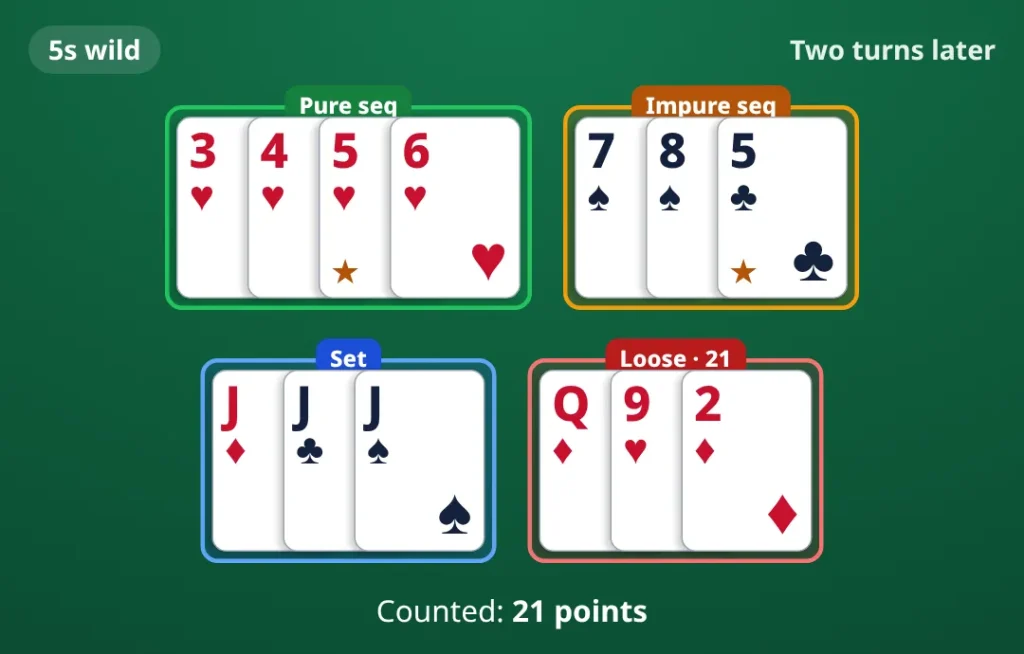
3♥ 4♥ 5♥ 6♥ · 7♠ 8♠ 5♣ · J♦ J♣ J♠ · Q♦ 9♥ 2♦
Turn 1: 5♥ from the closed deck, K♠ thrown. Turn 2: J♠ picked from the open pile, A♣ thrown. The pure sequence is done, the 5♣ joker turns 7♠ 8♠ into a second sequence, and the Jacks are a set. The engine now counts 21: just Q♦, 9♥ and 2♦. The hand is still two useful cards from a show, but almost any related card now helps: 10♦ or K♦ next to the Q♦, 8♥ or 10♥ next to the 9♥, or a joker to pair with either. Each of those leaves you one card away. Planning early is what made this possible: the J♦ was kept because it worked two ways.
Sorting on a phone
A 13-card hand on a 360-pixel-wide screen is cramped. In our games:
- Sort arranges your hand into suit groups in rank order, with printed jokers in their own group. Press it once at the start; it is step 1 done for you.
- Group: tap cards to select them, then press Group to put them in a new group. To move cards into an existing group, select them and tap that group’s label. You can have up to 6 groups in the 13-card games.
- Colours: green = pure sequence, amber = impure sequence, blue = set, red = invalid. A quick glance tells you whether your pure sequence is really pure.
- Re-sort only at the start. Once your groups are built, pressing Sort again would undo them. Add new cards to groups by hand instead.
- Your grouping is only for your eyes. If someone else declares, the game counts your cards in their best possible grouping, so you never lose points for an untidy hand. When you declare, though, the game checks your groups exactly as you arranged them.
Two habits help on a small screen: keep your jokers at the right end of the hand, and keep your planned discards at the far left so the next throw is always in the same place.
Planning beyond the first turn
- Re-plan after every pick. A new card can turn a 2-card chance into a 4-card one, or make a set out of a pair you meant to throw.
- Do not lock cards into sets too early. Before you have two sequences, a set protects nothing. Keep set cards flexible until the sequences are in place.
- Watch the open pile for the cards you need. If an opponent throws the 9♠ you need, someone else is not collecting spades. Our guide to reading discards goes further.
- Count before every discard. If someone declared now, what would you pay? The points calculator has a card counter for practice, and the declare checker shows the best grouping of any hand you enter.
The slips most players make in the first few turns are in 12 common rummy mistakes. For how often a deal already holds a pure sequence, see rummy opening hand odds, and for how a losing hand is counted, how to count points.
FAQ
How should I arrange my cards in 13-card rummy?
Sort by suit first, then build groups: your pure sequence on the left, then the second sequence, then sets, with jokers and loose cards at the end. Our games’ Sort button does the first step for you.
Does the order of my cards matter when I declare?
In our games, yes: you declare with the groups exactly as you arranged them, so every card must be in a valid group. If someone else declares, your hand is counted in its best grouping automatically.
What is a two-way card in rummy?
A card that fits more than one plan, such as J♦ when you hold J♣ (a set) and Q♦ (a run). Keep two-way cards until one plan is complete.
Should I keep low cards or high cards?
Throw lonely high cards first: A, K, Q, J and 10 cost 10 points each if you are caught. Lonely low cards cost little and can wait.