Most points in 13-card Indian Rummy are not lost to bad luck but to a handful of repeat mistakes. This guide lists the twelve we see most often, with two real hands counted by the rules engine behind our free Points Rummy game. Two big topics have their own guides, so they are only summarised here: invalid declarations (10 valid and invalid declarations, checked) and dropping (when to drop).
Mistakes in building your hand
1. Collecting sets before sequences
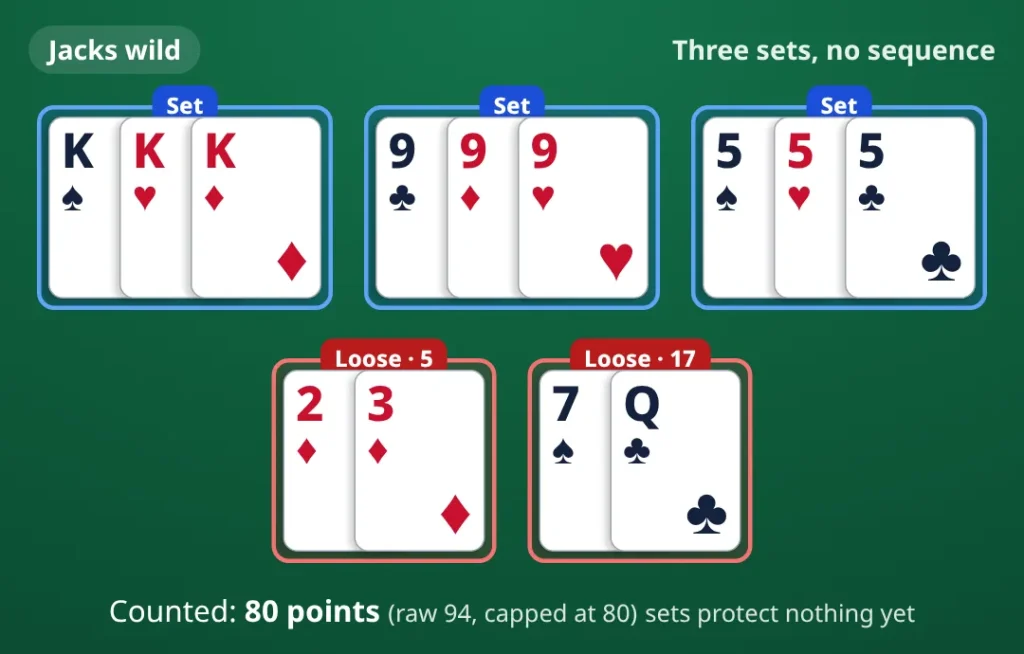
K♠ K♥ K♦ · 9♣ 9♦ 9♥ · 5♠ 5♥ 5♣ · 2♦ 3♦ · 7♠ Q♣
Three perfect sets of different suits, and the hand still counts 80 (94 raw) if someone declares. Without a pure sequence and a second sequence, sets protect nothing. This hand needs a 4♦ or A♦ to turn 2♦ 3♦ into a pure sequence, and then a second sequence as well, before any of the sets count for anything. Build the sequences first, then the sets. See how to make a pure sequence fast.
2. Using a joker in your first sequence
A joker in your only sequence makes it impure, so you still have no first life. Keep jokers for the second sequence or a set; joker strategy explains where each joker earns most.
3. Hoarding high cards
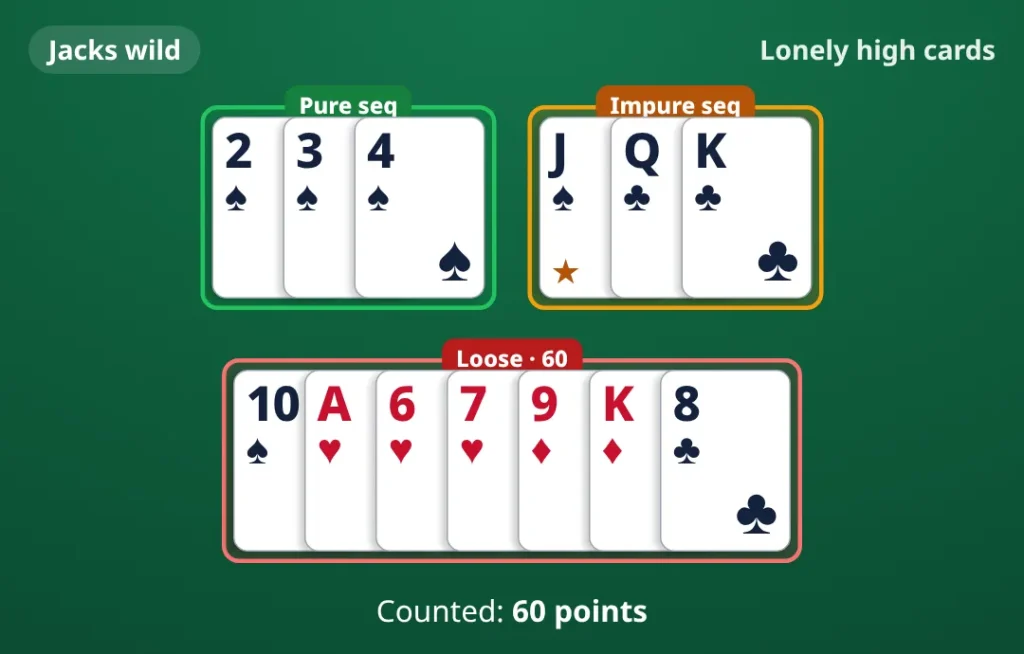
2♠ 3♠ 4♠ · J♠ Q♣ K♣ · 10♠ A♥ 6♥ 7♥ 9♦ K♦ 8♣
Both sequences are done (the J♠ is a joker, Jacks are wild), so only the seven loose cards count: 60. Half of that comes from three lonely tens: the 10♠, A♥ and K♦. Throwing lonely high cards in your first few turns is the cheapest insurance in rummy.
4. Chasing a gapped sequence over a connected one
5♣ 7♣ needs exactly one rank (6♣: 2 cards in two decks). 5♣ 6♣ needs either 4♣ or 7♣ (4 cards). When you must break one, break the gapped one. The odds are in how to make a pure sequence fast.
5. Keeping too many pairs
Pairs feel promising, but a pair of different suits only becomes a set, and sets come last. Five pairs and no sequence chances is a hand to drop, not to nurse.
Mistakes at the table
6. Feeding the next player
Throwing the card next to one your opponent just picked from the open pile can hand them the game. Check History before you discard; reading discards explains what each move tells you.
7. Picking from the open pile for the wrong reason
Taking an open card that only completes a set, before you have sequences, tells everyone what you hold and gives you nothing protected.
8. Forgetting what the cut joker means
With a printed joker cut, every Ace is wild. With 7s wild, 5♥ 6♥ 7♥ is still a pure sequence. Both are easy to miss in a fast game. The declare checker marks the wild cards for you.
9. Playing too fast
Most wrong shows happen in the last second. Before you press Declare, check: a pure sequence, a second sequence, every card grouped, no repeated suit in a set, no K A 2. The ten checked hands in valid vs invalid declarations show each trap.
Mistakes in scoring and dropping
10. Not counting your own hand
If you do not know your count, you cannot tell whether a middle drop is cheaper than playing on. Count before every discard; 13-card scoring with examples shows how, and the daily puzzle trains it.
11. Shedding points that do not count
Without a pure sequence, your hand costs 80 once its raw total is 80 or more. Throwing a King to go from 94 to 84 saves nothing. Until your raw total is below 80, the only discards that matter are the ones that bring a pure sequence closer.
12. Never dropping, or dropping too late
A first drop costs 20 and a middle drop 40. Players who never drop pay full counts on hopeless hands, and players who wait too long pay 40 for a decision they could have made for 20. Our data study drop or play on? compares the two with simulated hands: with no pure sequence and no joker, playing on averaged −31.7 points with two players and −62 with six, so that hand is a first drop at any table.
A pre-declare checklist
- Is there a pure sequence with no joker standing in?
- Is there a second sequence (pure or impure)?
- Is every card in a valid group?
- Does every set have different suits?
- No K A 2 anywhere?
If any answer is no, do not declare: a wrong show costs 80, more than any losing hand.
Related: a wrong show is the most expensive mistake, and ten valid and invalid declarations shows what it costs. The caps are in maximum points in rummy, and the counting rules in how to count points. For the bigger game, see 21 Card Rummy tips, and for the two-player game, Gin Rummy strategy.
FAQ
What is the most common mistake in rummy?
Building sets before sequences. Without a pure sequence and a second sequence, sets protect nothing, so a hand of three sets can still cost 80.
Why did I get 80 points even though I had three sets?
Because you had no pure sequence. Without it, every card counts, up to the 80 cap.
How do I avoid a wrong show?
Run through the five-point checklist above before every declaration, or test the hand in the declare checker first.
Should I throw high cards early in rummy?
Lonely ones, yes. An A, K, Q, J or 10 with no partner costs 10 points if someone declares. Keep high cards that are part of a sequence or set you are close to finishing.