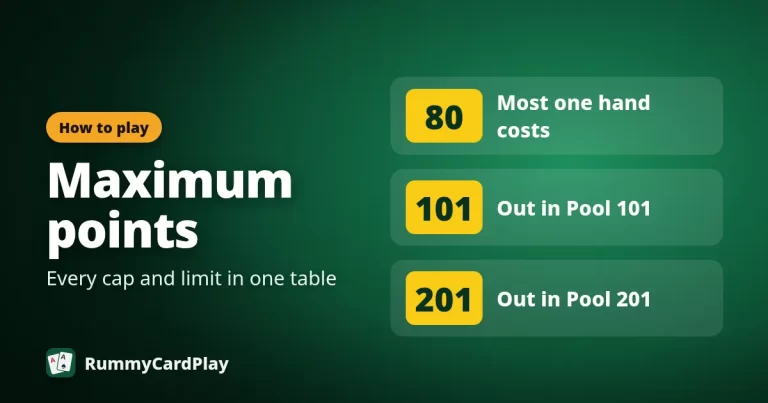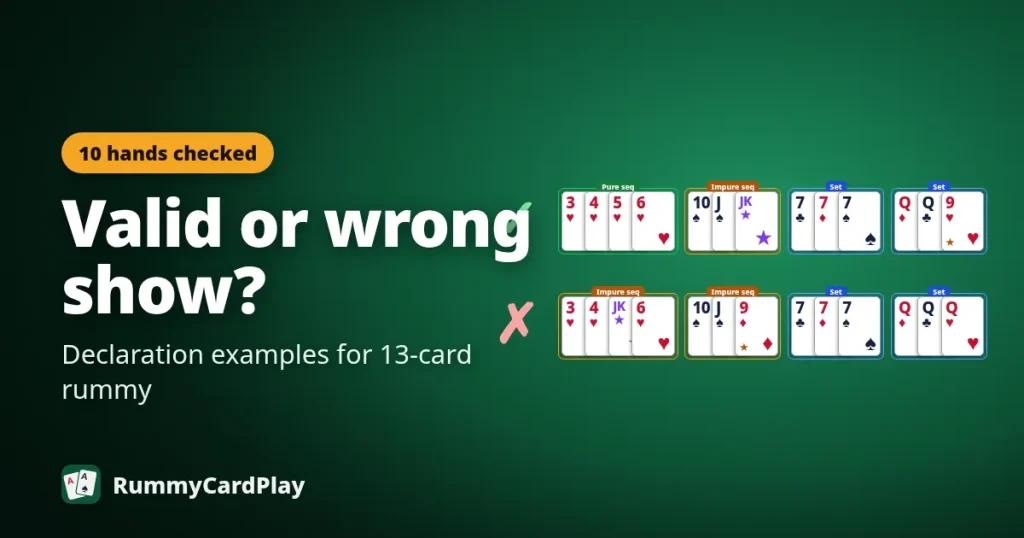
In 13-card Indian Rummy a wrong declaration (a wrong show) costs the full 80 points. That is the same as the worst possible losing hand, and four times a first drop. Most wrong shows come from a few rules that look obvious until two decks and two kinds of joker get involved. We put ten complete hands through the same rules engine that runs our free Points Rummy game and recorded the result for each one. We also recorded what each hand would have cost if someone else had declared first. Every number below comes from that engine.
Throughout this guide the wild joker is 9♣, so all 9s are jokers. “PJ” means a printed joker.
Wrong show in rummy: what it is and what it costs
A wrong show is a declaration that does not pass the rules. You press Declare, but the hand has no pure sequence, only one sequence, a sequence with a missing card, a set with two cards of the same suit, or a card left outside every group. Everything else about the hand is ignored: the penalty is fixed.
| Format | Cost of a wrong show | What happens next |
|---|---|---|
| Points Rummy | 80 points | The others finish the hand and the winner collects your 80 |
| Pool Rummy 101 and 201 | 80 added to your pool score | You are out if the total reaches 101 (201) |
| Deals Rummy | 80 chips | Paid to the winner of that deal |
| 21 Card Rummy | 120 | The same, with the 120 cap |
In our games you are asked to confirm before a declaration, and the prompt reminds you that a wrong one costs the full amount. After you confirm, it is final: your cards are shown as you grouped them, you drop out of the hand, and the other players carry on. Gin Rummy has no wrong show, because Knock is only available when your deadwood is 10 or less.
The penalty is usually far larger than what the same cards would cost if someone else won. Take this hand with 8 as the wild joker:
3♥ 4♥ 5♥ · 9♠ 10♠ J♠ · Q♣ Q♦ Q♠ · K♣ 2♦ A♠ 7♦
It has two pure sequences and a set of Queens, but four cards (K♣, 2♦, A♠ and 7♦) are in no group, so declaring is a wrong show: 80 points. As a loser, the engine counts only those four cards: 29. The difference is why you should check the hand before pressing Declare. The declare checker tests any 13 cards, and the checklist at the bottom of this page takes ten seconds. The most common slips are listed in 12 common rummy mistakes, and the full cap and penalty table is in maximum points in rummy.
The three conditions for a valid declaration
- At least two sequences (runs of the same suit).
- At least one pure sequence: no joker standing in for a missing card. A wild card in its own natural position, such as 8♥ 9♥ 10♥ with 9s wild, still counts as pure.
- All 13 cards in valid sequences or sets. A set is 3 or 4 cards of one rank in different suits.
Your 14th card is the finish card that goes face down. In our game, and at any strict table, your cards are checked exactly as you grouped them.
Four valid hands
Valid 1: pure, impure and two sets
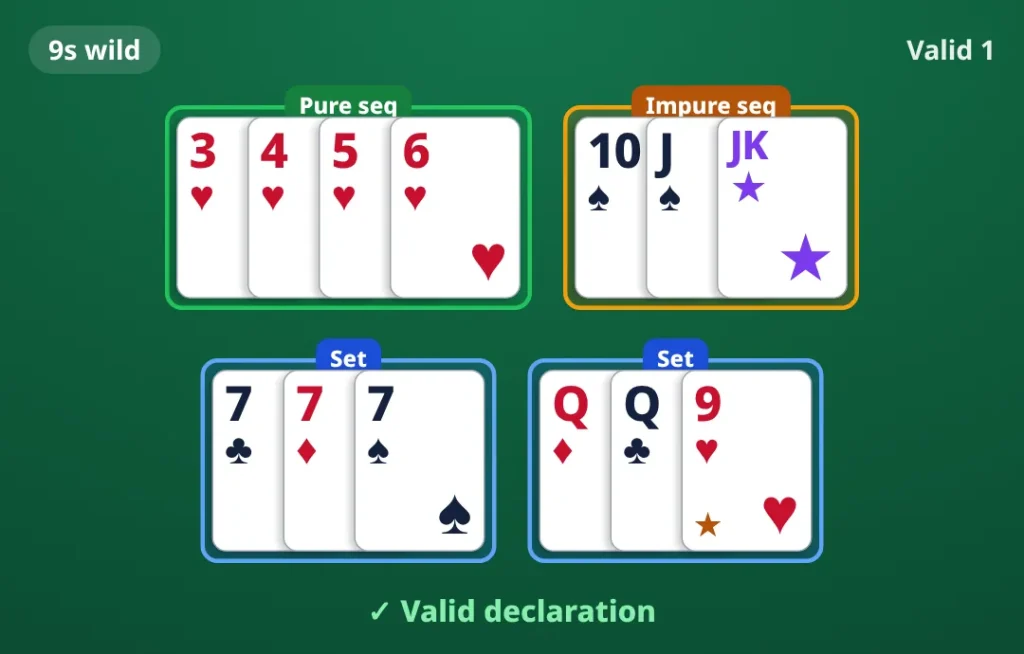
3♥ 4♥ 5♥ 6♥ · 10♠ J♠ PJ · 7♣ 7♦ 7♠ · Q♦ Q♣ 9♥
The four-card pure sequence is the first life. 10♠ J♠ PJ is the second life (the printed joker plays the Q♠ or 9♠). The 7s are a set in three suits. In Q♦ Q♣ 9♥ the 9♥ is a wild card acting as a third Queen. Valid.
Valid 2: Ace low and Ace high
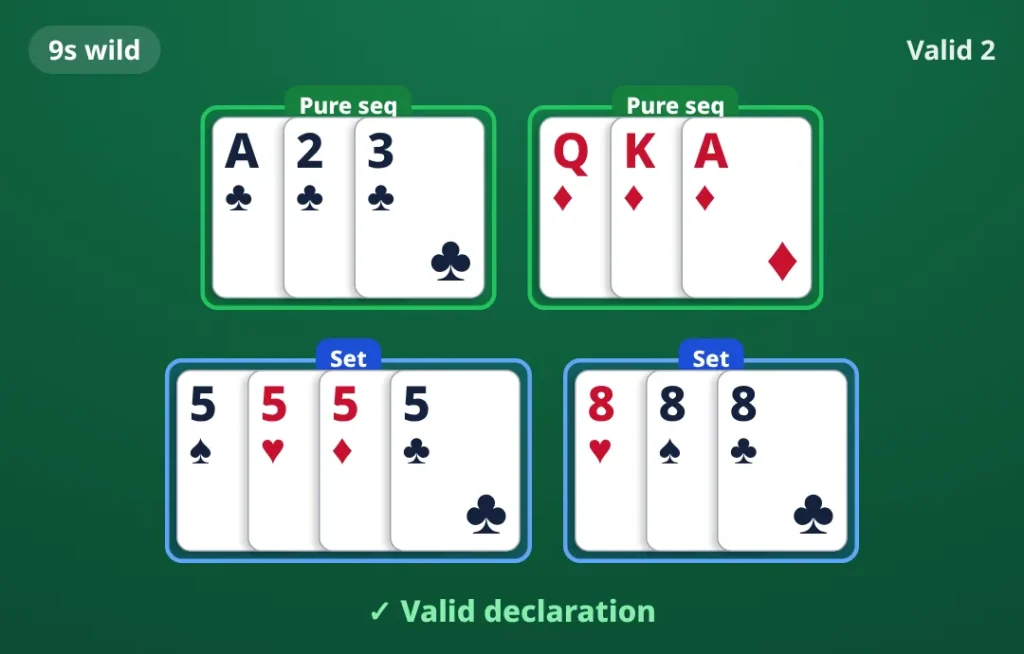
A♣ 2♣ 3♣ · Q♦ K♦ A♦ · 5♠ 5♥ 5♦ 5♣ · 8♥ 8♠ 8♣
Two pure sequences, one using the Ace low and one using it high, plus a four-card set and a three-card set. No joker needed. Valid.
Valid 3: a group made only of jokers
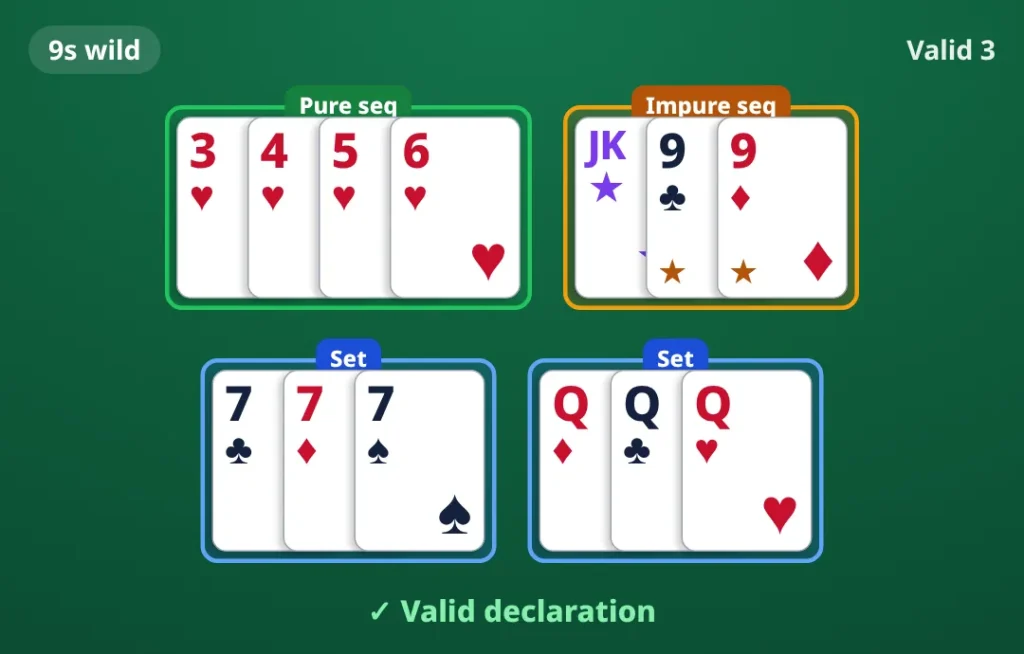
3♥ 4♥ 5♥ 6♥ · PJ 9♣ 9♦ · 7♣ 7♦ 7♠ · Q♦ Q♣ Q♥
Three jokers together count as an impure sequence in our game, so this hand has a pure and an impure sequence. Valid. Some home tables argue about this one. Agree on it before you start.
Valid 4: two pure sequences and a joker in a set
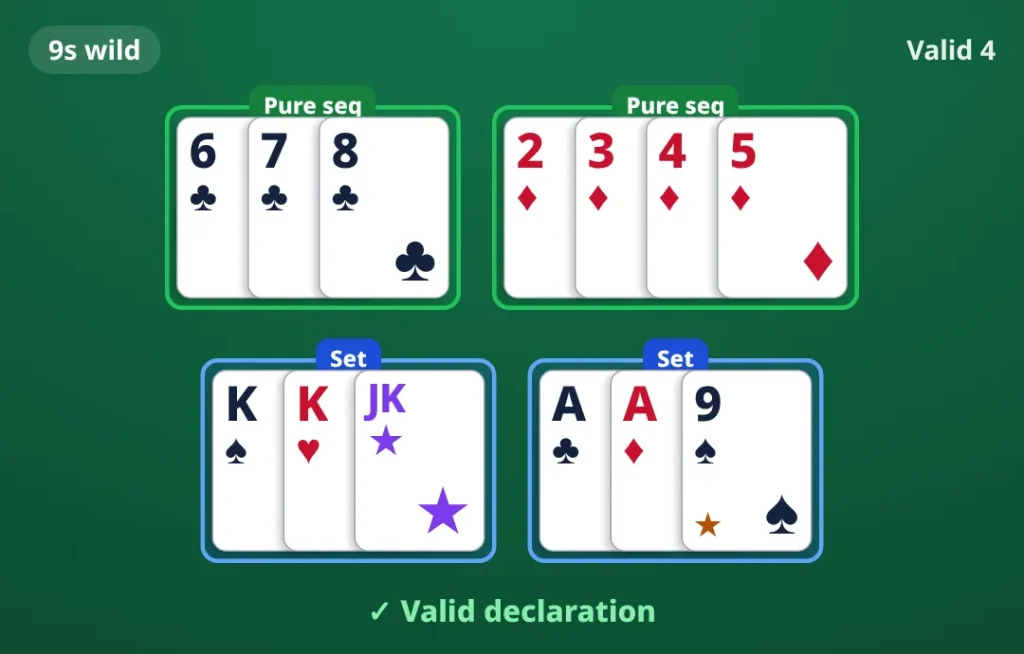
6♣ 7♣ 8♣ · 2♦ 3♦ 4♦ 5♦ · K♠ K♥ PJ · A♣ A♦ 9♠
Two pure sequences. The printed joker completes the Kings, and the 9♠ (wild) completes the Aces. Valid.
Six invalid hands, and what they would cost as a loser
Invalid 1: two sequences, both with jokers
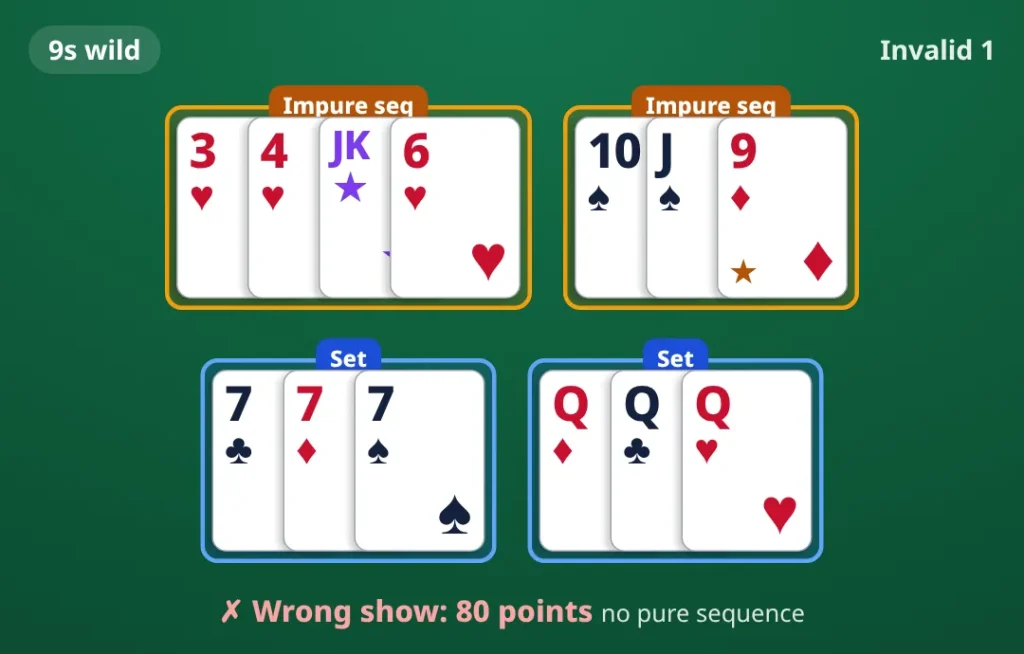
3♥ 4♥ PJ 6♥ · 10♠ J♠ 9♦ · 7♣ 7♦ 7♠ · Q♦ Q♣ Q♥
Two sequences, but the printed joker fills the 5♥ gap and the 9♦ fills the Q♠, so neither is pure. Wrong show: 80. As a losing hand it also counts 80 (84 raw, capped), because without a pure sequence nothing is protected.
Invalid 2: a repeated suit in a set
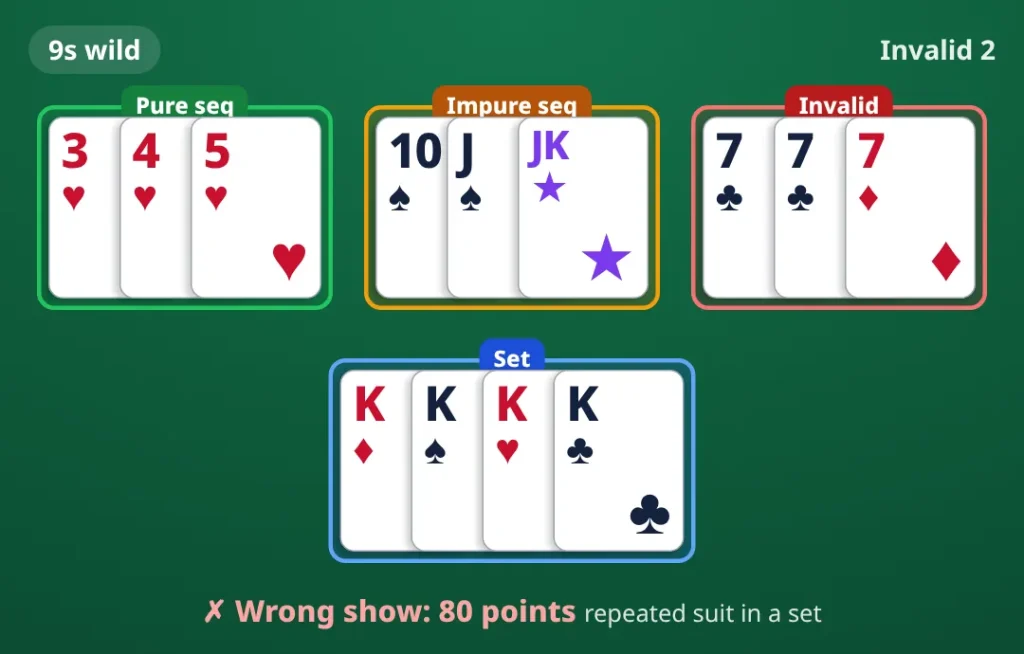
3♥ 4♥ 5♥ · 10♠ J♠ PJ · 7♣ 7♣ 7♦ · K♦ K♠ K♥ K♣
The two decks give you two 7♣, but a set needs different suits. Wrong show: 80. Painfully, the same cards as a losing hand would cost only 21: the 7s count, and everything else is protected. Declaring too early turned a 21-point hand into an 80-point one.
Invalid 3: K-A-2
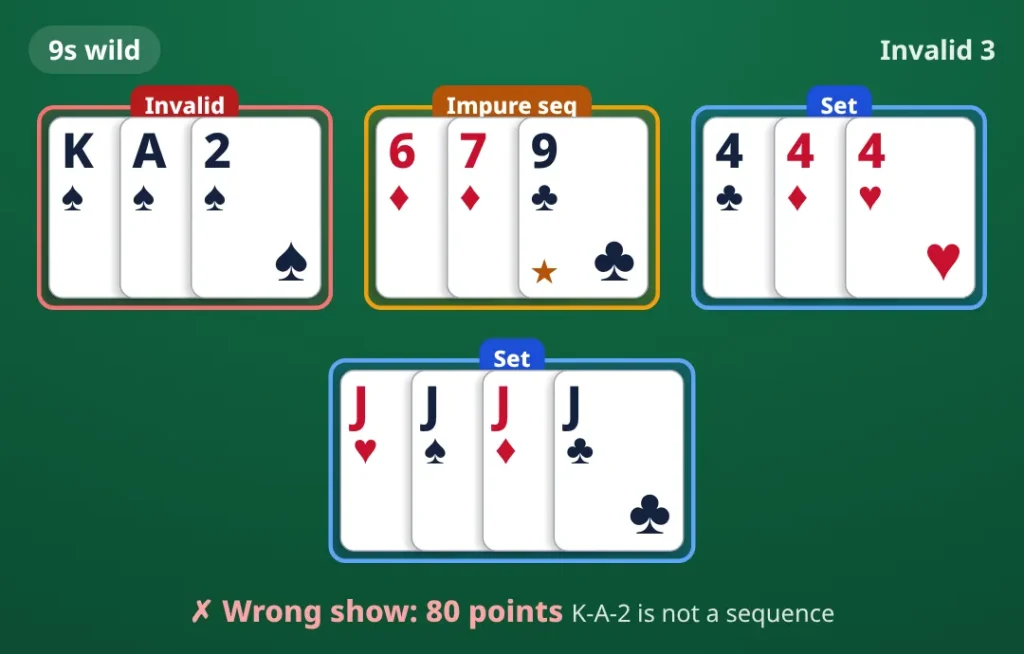
K♠ A♠ 2♠ · 6♦ 7♦ 9♣ · 4♣ 4♦ 4♥ · J♥ J♠ J♦ J♣
The Ace can be low or high but cannot wrap around, so K♠ A♠ 2♠ is not a sequence. Only the impure 6♦ 7♦ 9♣ is left, with no pure sequence. Wrong show: 80. As a losing hand: 80 (87 raw).
Invalid 4: one sequence and three sets
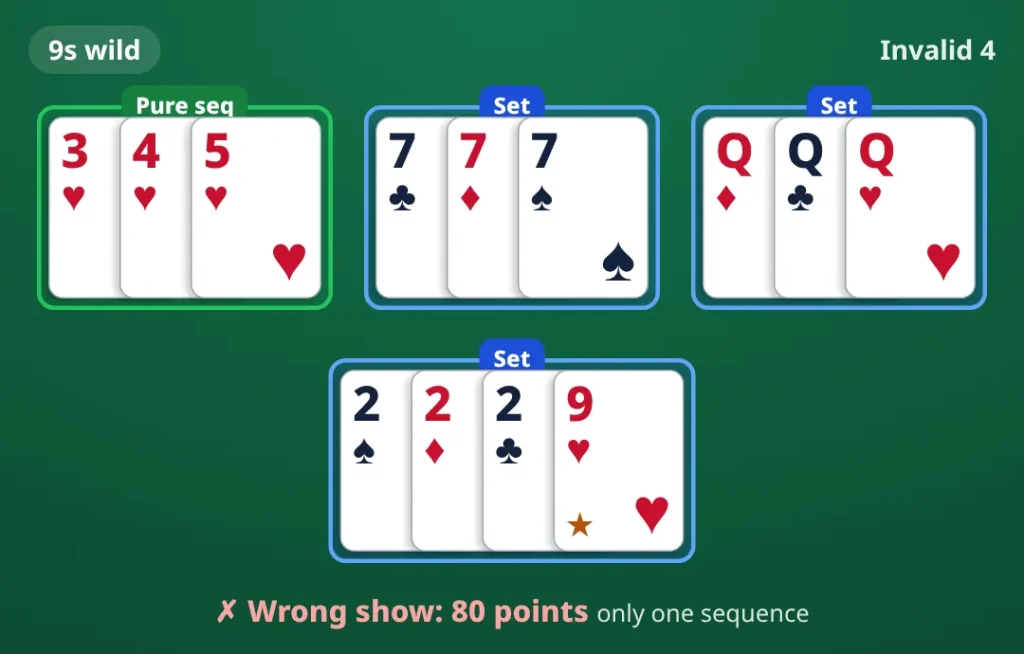
3♥ 4♥ 5♥ · 7♣ 7♦ 7♠ · Q♦ Q♣ Q♥ · 2♠ 2♦ 2♣ 9♥
Every card is grouped and there is a pure sequence, but there is only one sequence. Sets never replace the second sequence. Wrong show: 80. As a losing hand this costs 57: only the pure sequence is protected, and the sets count (the 9♥ joker counts 0).
Invalid 5: a five-card set
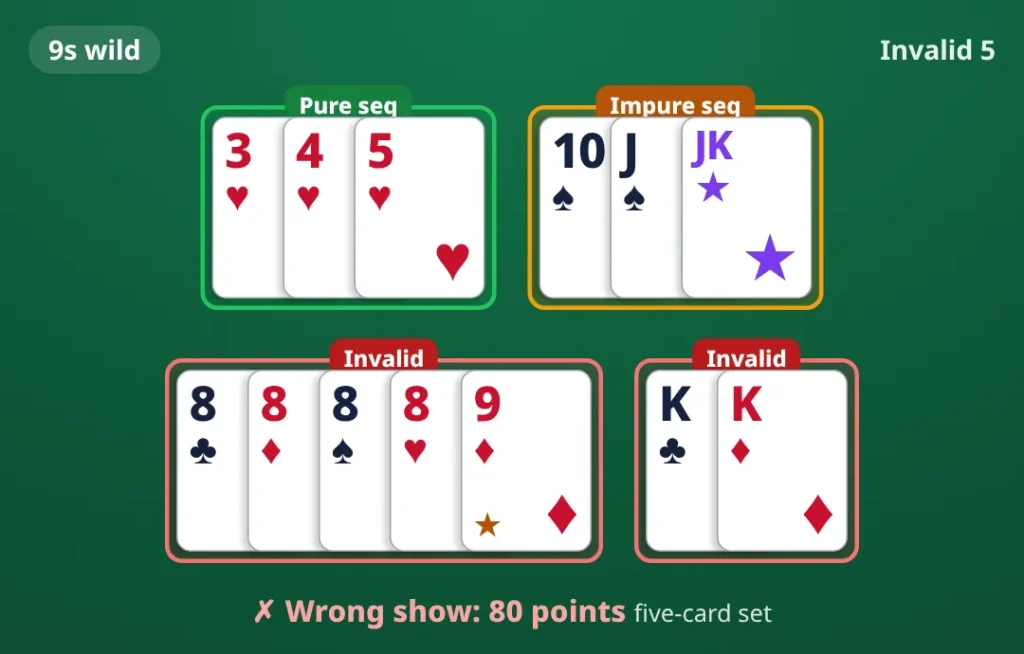
3♥ 4♥ 5♥ · 10♠ J♠ PJ · 8♣ 8♦ 8♠ 8♥ 9♦ · K♣ K♦
A set has at most four cards, and here the 9♦ joker has been added as a fifth. Wrong show: 80 as grouped. Yet the cards are complete: move the 9♦ to K♣ K♦ (a set of Kings with a joker) and the hand is valid. Counted as a loser in its best grouping, the hand is worth 0. The mistake was in the grouping, not the cards.
Invalid 6: one loose card
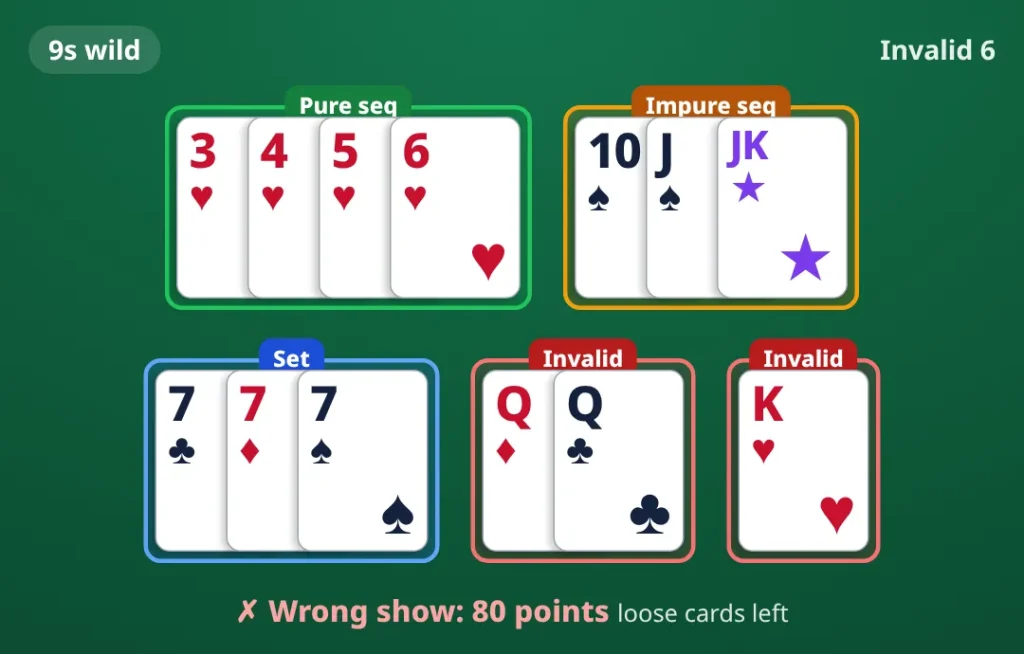
3♥ 4♥ 5♥ 6♥ · 10♠ J♠ PJ · 7♣ 7♦ 7♠ · Q♦ Q♣ · K♥
Q♦ Q♣ is only a pair, and the K♥ is alone. Wrong show: 80. As a losing hand: 30 (Q, Q, K).
Summary table
| Hand | Declared | Cost if someone else declared |
|---|---|---|
| Valid 1 to 4 | Valid, 0 | 0 |
| Invalid 1: no pure sequence | 80 | 80 |
| Invalid 2: repeated suit | 80 | 21 |
| Invalid 3: K-A-2 | 80 | 80 |
| Invalid 4: only one sequence | 80 | 57 |
| Invalid 5: five-card set | 80 | 0 |
| Invalid 6: loose cards | 80 | 30 |
The lesson from the last column: a wrong show is never cheaper than waiting. If you are unsure, play one more turn.
A 10-second checklist before you press Declare
- Is at least one group green (a pure sequence)? Look for no joker standing in for a missing card.
- Do you have two or more sequences in total (green or orange)?
- Does every set have 3 or 4 cards with no repeated suit?
- Does any run contain K-A-2? Split it.
- Is every card except the finish card in a group? There should be no red label.
In our Points Rummy game the status line (“Pure seq ✓ · Sequences 2/2”) and the colour of each group label check all of this as you move cards. The game still lets you declare a bad hand, though, exactly like a real table. For dropping instead of declaring, see When to drop in Points Rummy. For terms like First Life and wild joker, see the rummy glossary. To test any hand of your own, use the free rummy declare checker.
Jokers cause many wrong shows, especially the idea that a joker can make a sequence pure. Rummy joker strategy covers where jokers work and where they don’t.
FAQ
Is a sequence with the wild joker in its own place pure?
Yes. With 9s wild, 8♥ 9♥ 10♥ is a pure sequence, because the 9♥ is not standing in for any other card. If the 9♠ were used in place of the 9♥, it would be impure.
Can I declare with two impure sequences and a set?
No. At least one sequence must be pure. Two impure sequences plus sets is a wrong show, the most common one.
Can two identical cards be in the same set?
Not in two-deck 13-card rummy. 7♣ 7♣ 7♦ is invalid even with a joker added. Three identical cards only appear in three-deck variants.
What does a wrong show cost in Points Rummy?
80 points, the maximum for one hand. They come off your running total and go to the player who declares validly. In Pool Rummy 101 it is also 80 points added to your pool score, and in Deals Rummy it is 80 chips to the winner of the deal.
What is a wrong show in rummy?
A declaration that does not meet the rules: for example no pure sequence, fewer than two sequences, or a card outside every valid group. It costs a fixed penalty: 80 points in 13-card rummy and 120 in 21 Card Rummy.
How many points is a wrong show in Pool Rummy?
80 in both Pool 101 and Pool 201, added to your pool score. If that takes you to 101 (or 201) or more, you are out. See maximum points in rummy for the score at which each cost puts you out.
What happens to the hand after a wrong show?
In our games the player who made the wrong show drops out of that hand, their cards are shown face up, and the others play on until someone makes a valid declaration.
Can I take back a declaration?
Before you confirm, yes: the game asks “Declare?” and you can cancel. After you confirm, the result stands.