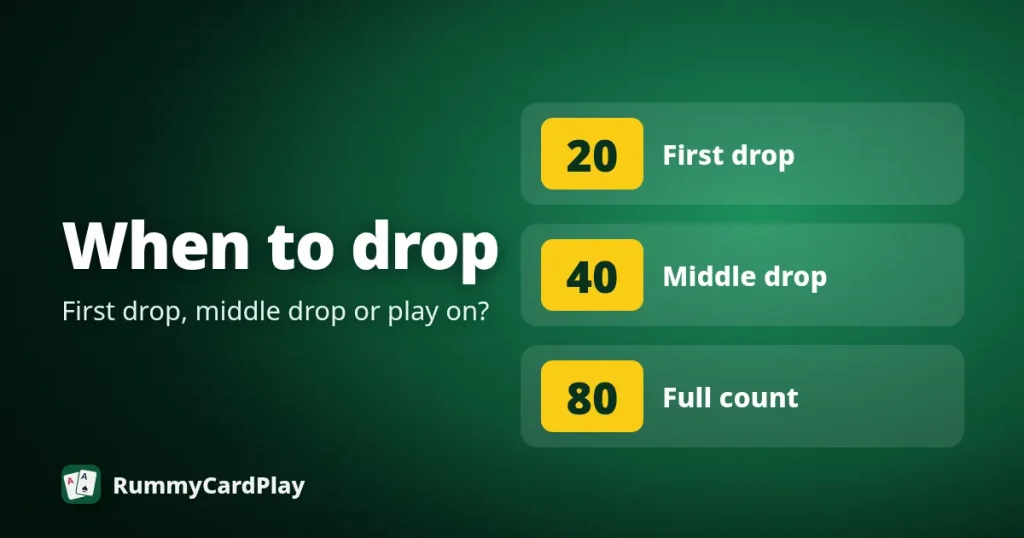
Dropping (also called packing) is the only move in 13-card Indian Rummy that caps your loss before the hand is over. In Points Rummy it costs 20 points before your first draw and 40 points after it, against a possible full count of 80. Most new players drop too rarely. A few drop far too often. This guide gives the numbers from 26,000 simulated hands, works through four real opening hands, and ends with a checklist. Every hand was counted by the engine behind our free Points Rummy game.
The rule in our game
- You can drop only at the start of your turn, before drawing.
- First drop: you have not drawn any card in this hand yet. It costs 20.
- Middle drop: you have drawn at least once. It costs 40.
- A wrong show costs 80, and the most a losing hand can cost is also 80.
- After dropping you sit out, and your 20 or 40 goes to whoever wins the hand.
Some family games charge 10 for a first drop (Pagat lists this home rule). Most modern rule sets, and this game, use 20 and 40.
What the numbers say
We let the “Hard” computer players from our games play 20,000 two-player and 6,000 six-player hands of Points Rummy with dropping switched off, so every opening hand was played to the end. Then we compared the average result of playing on with what a drop would have cost:
| Your hand at the first turn | Play on, 2 players | Play on, 6 players | First drop |
|---|---|---|---|
| Pure sequence already | 12 | 34.9 | −20 |
| No pure sequence, no joker | −31.7 | −62 | −20 |
| No pure sequence, 1 joker | −6.1 | −30.7 | −20 |
| No pure sequence, 2 or more jokers | 14.8 | 31 | −20 |
The figures are average points won or lost per hand, so a hand you win counts as a plus. Three things follow:
- No joker and no pure sequence: drop. Playing on cost more than the 20-point first drop at both table sizes, even when the hand had several connected cards.
- One joker, no pure sequence: it depends on the table. With two players, playing on (−6.1) did better than dropping. With six, it did clearly worse (−30.7), so drop.
- Two or more jokers: play on, with or without a pure sequence.
These are averages from computer players, not a promise about any one table. Human opponents play differently, and some of them drop, which changes what a win pays. The full method, sample sizes and a breakdown by connected cards are in our data study Drop or play on?
Four opening hands
All four hands have 7s wild. The counts were calculated by the game engine.
Hand A: drop (first drop, 20)
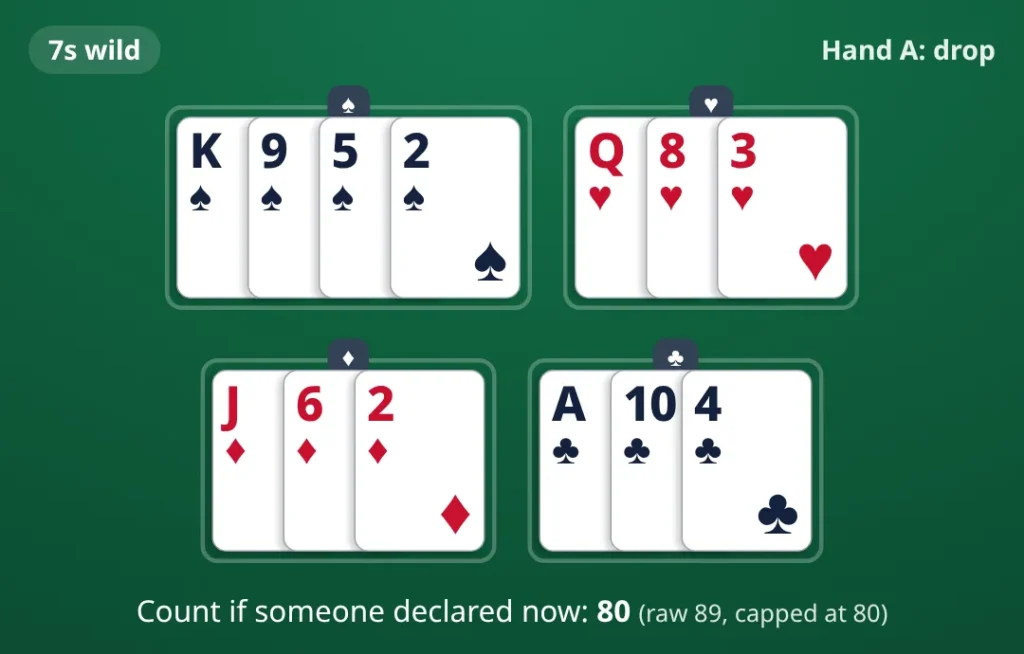
K♠ 9♠ 5♠ 2♠ · Q♥ 8♥ 3♥ · J♦ 6♦ 2♦ · A♣ 10♣ 4♣
No two cards of the same suit are within two ranks of each other. There is no joker, and the only pair is the two 2s. Getting a pure sequence would need at least two exact draws in one suit. The raw count is 89, which is 80 at the cap. In our simulations, two-player hands like this one (no joker, no pure sequence, almost no connected cards) averaged −38.4 when played out. Paying 20 now is the clear choice.
Hand B: play on
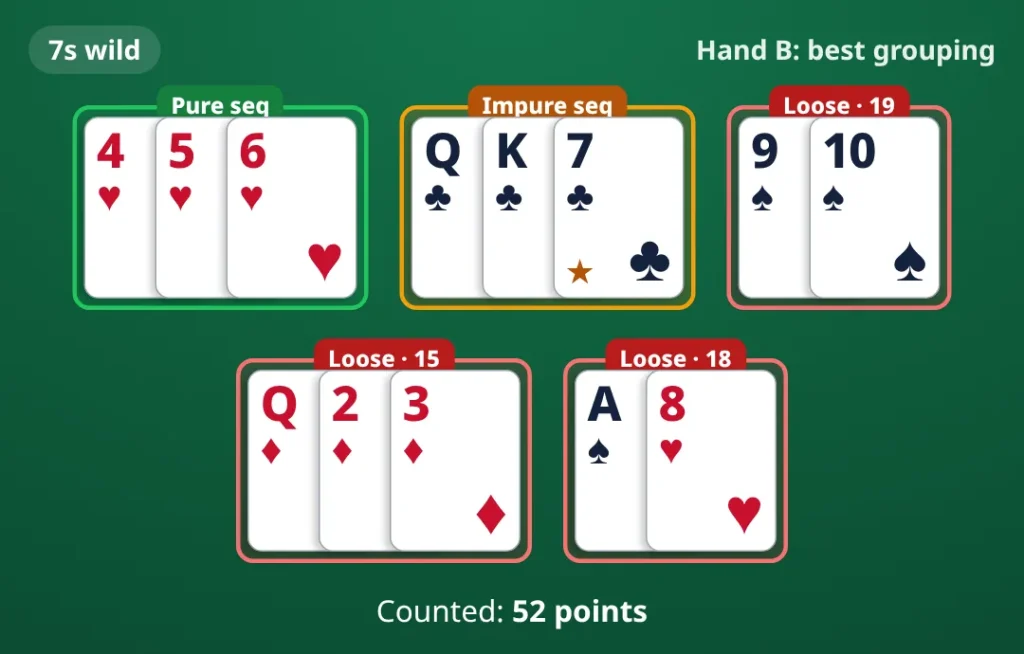
4♥ 5♥ 6♥ · 9♠ 10♠ · 7♣ · Q♦ Q♣ · 2♦ 3♦ · K♣ A♠ 8♥
The pure sequence is already there. The 7♣ is a joker, and it can turn Q♣ K♣ into an impure sequence: a second life on the deal. The engine counts this hand at 52 in its best grouping before you draw a single card. Also, 9♠ 10♠ and 2♦ 3♦ each need only one of two ranks to become another sequence. Never drop a hand like this.
Hand C: looks playable, but drop (first drop, 20)
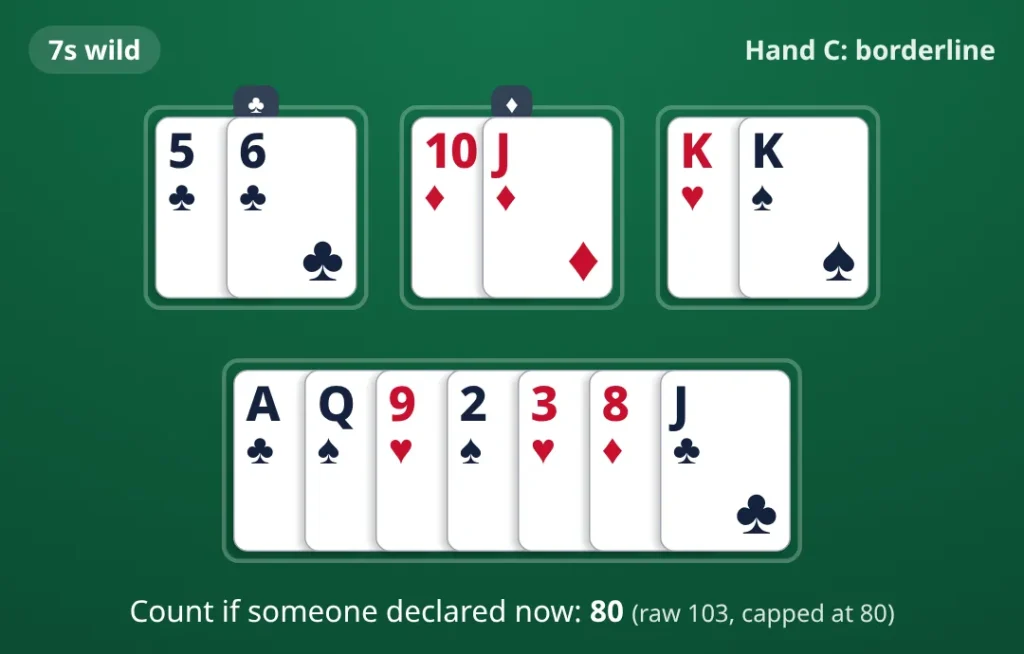
5♣ 6♣ · 10♦ J♦ · K♥ K♠ · A♣ Q♠ 9♥ 2♠ 3♥ 8♦ J♣
No joker and no sequence yet, raw count 103 (80 at the cap). The hand looks better than Hand A: there are two two-card runs. 4♣ or 7♣ (a 7♣ in its own place keeps the run pure) completes 5♣ 6♣, and 9♦ or Q♦ completes 10♦ J♦, so four ranks and eight physical cards would give you a first life.
It is still a drop. In our simulations, hands with no joker, no pure sequence and four or five connected pairs like this one averaged −32.4 with two players and −62.1 with six. Both are worse than the 20-point first drop. Connected cards help, but without a joker they do not help enough. Decide on the first turn, while the drop still costs 20.
Hand D: stalled in the middle (middle drop, 40)
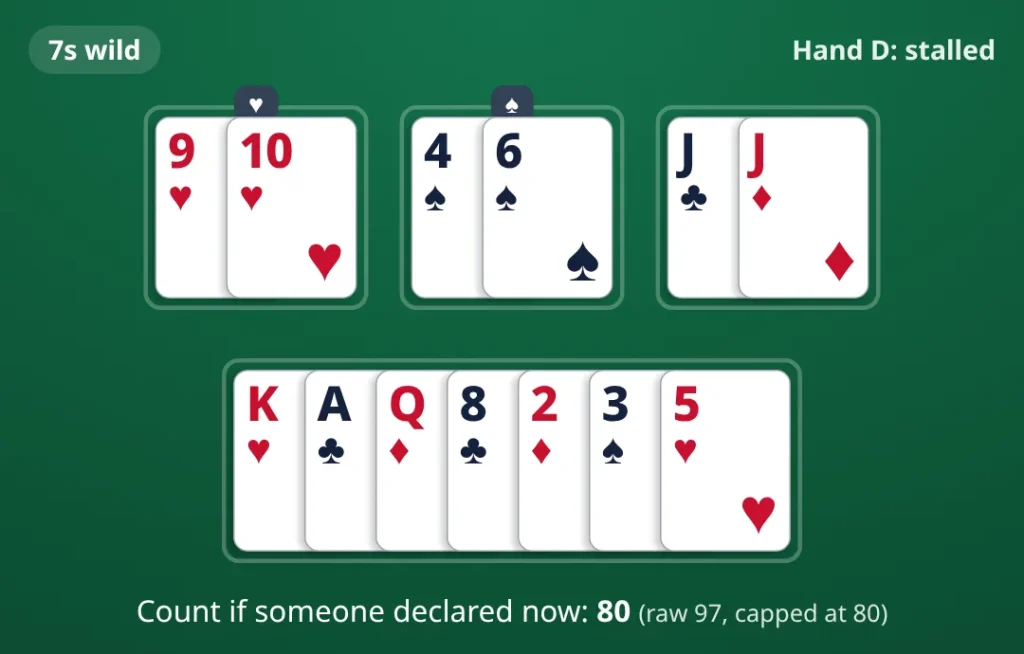
Several turns in, still holding: 9♥ 10♥ · 4♠ 6♠ · J♣ J♦ · K♥ A♣ Q♦ 8♣ 2♦ 3♠ 5♥
Still no pure sequence and no joker after several draws, and the count is 97 raw, so 80 if anyone declares. If the open pile shows that other players are picking up and keeping cards (check History), a declaration is probably close. A middle drop at 40 saves 40 points compared with being caught. Our simulations back this up: players who still had no pure sequence and no joker after three of their own turns averaged −39.3 by playing on in two-player games, about the same as the 40-point middle drop, and −69.4 at six-player tables, far worse. With one joker the picture was split: −15.3 with two players, but −47.9 with six. At a big table, take the middle drop.
A simple decision checklist
At your first turn, before drawing, count two things:
- Pure sequence: do you already have one? A wild card in its natural place counts.
- Jokers: printed jokers plus cards of the wild rank. If a printed joker was cut, count your Aces.
| What you hold | 2 players | 3 to 6 players |
|---|---|---|
| A pure sequence already | Play on | Play on |
| No pure sequence, 2 or more jokers | Play on | Play on |
| No pure sequence, 1 joker | Play on | First drop (20) |
| No pure sequence, no joker | First drop (20) | First drop (20) |
Connected cards (5♣ 6♣, 10♦ J♦) and lonely high cards still matter once you play on, but in our data they did not change these answers. The closest case was one joker with six or more connected pairs at a six-player table, which averaged −21.4: about a tie with the drop. Tables of three to five players were not simulated separately; the further you are from a two-player game, the more the six-player column applies.
In the middle of a hand, after about three of your own turns: if you still have no pure sequence and no joker, a 40-point middle drop is about break-even with two players and clearly cheaper at a six-player table. With one joker and no pure sequence at a big table, the middle drop is also the cheaper choice on average.
Common dropping mistakes
- Never dropping. Pride costs points: a first drop at 20 on a hand like Hand A saves around 60.
- Playing on because the cards look connected. Two-card runs without a joker, as in Hand C, still did worse than a first drop in our simulations.
- Dropping after drawing. Once you have drawn, the price doubles to 40. Decide before you touch the closed deck.
- Middle-dropping a hand with a pure sequence. Once your first life is down, your count usually falls fast. Example 1 on our Points Rummy rules page is a typical finished losing hand: 25 points.
- Declaring to “get it over with”. A wrong show costs 80, twice the middle drop. See 10 valid and invalid declaration examples.
Dropping in Pool and Deals Rummy
The numbers above are for Points Rummy, where a drop is just a smaller loss. In the other formats the cost of a drop changes:
- 101 Pool: drops cost 20 and 40, and you are out when your total reaches 101. Every drop eats into a limited budget, so players near the limit often play on with weaker hands. Our Pool Rummy strategy guide shows how to plan your drops at each score.
- 201 Pool: drops cost 25 and 50.
- Deals Rummy: points are settled in chips over a fixed number of deals. Some tables allow drops at 20 and 40. Our version has no drop at all: every deal is played out, so keeping your count low matters even more. See Deals Rummy strategy.
You can play all three free: Pool Rummy 101 (with a drop-budget table for every score), Pool Rummy 201 and Deals Rummy. The meanings of First Life, cut joker and full count are in our rummy glossary.
Dropping mistakes are collected in 12 common rummy mistakes, and every cap and limit is in one table in maximum points in rummy. How often a hand starts with a pure sequence is in rummy opening hand odds.
FAQ
How many points is a first drop in rummy?
20 points in Points and 101 Pool Rummy, and 25 in 201 Pool. Some home games use 10. You can only take a first drop before you draw any card.
What is a middle drop?
Dropping after you have drawn at least one card. It costs 40 points (50 in 201 Pool). You still have to do it at the start of a turn, before drawing.
Can I drop after drawing a card in this turn?
No. You must decide at the start of your turn. Once you have drawn, you have to discard, and you can drop at your next turn instead.
Is it better to drop or to play a bad hand?
If you have no pure sequence and no joker, drop. In our 26,000 simulated hands against Hard computer players, playing such hands out averaged −31.7 points with two players and −62 with six, against 20 for a first drop.
Should I play on with one joker and no pure sequence?
With two players, yes: those hands averaged −6.1, better than a 20-point drop. At a six-player table they averaged −30.7, so a first drop is cheaper.
Can I drop in Deals Rummy?
Not in our version: every deal is played to the end. Some tables allow drops in Deals, so check the rules before you play.