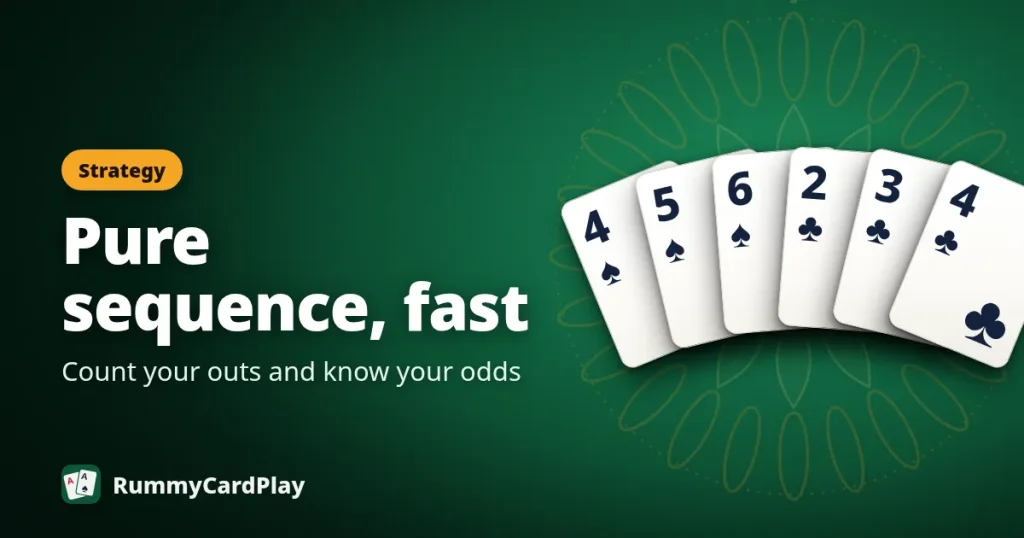
In 13-card Indian Rummy nothing counts until you have a pure sequence: three or more cards in a row of one suit, with no joker standing in. Without it you cannot declare, and if someone else declares you pay for all 13 cards, up to the 80 cap. This guide shows how to find the fastest route to that first life from the cards you are dealt, how to count your chances, and what to give up to get there. Every hand below was checked with the rules engine that runs our free Points Rummy game.
Why the pure sequence comes first
The rule is simple: a valid declaration needs two sequences, and at least one must be pure. What makes the pure sequence urgent is the scoring. If another player declares while you have none, every card in your hand counts, so even a hand full of sets and jokers can cost 80. Once the pure sequence is down, your second sequence protects the rest, and a typical losing count falls sharply.
Our own numbers show how often you start with it. In 10 lakh (one million) simulated deals, 36.6% of 13-card hands already held a pure sequence, and after the first draw that rose to 43.5%. In our simulated two-player games, 63.8% of players had a pure sequence by the end of their third turn, and 81.7% by their sixth. The full method is in our study on opening hand odds.
Step 1: list every pure-sequence chance
Before your first draw, look for every pair of cards in the same suit that could become a run:
- Connected pair (5♣ 6♣): completed by two ranks, 4♣ or 7♣. With two decks that is 4 physical cards.
- Gapped pair (5♣ 7♣): completed only by 6♣. That is 2 cards.
- Edge pair (A♣ 2♣ or Q♣ K♣): A♣ 2♣ needs 3♣ because K♣ A♣ 2♣ is not a sequence, so it has 2 cards. Q♣ K♣ can take J♣ or A♣, so it has 4.
- Three-card cluster (2♣ 3♣ 5♣): A♣ completes A♣ 2♣ 3♣ and 4♣ completes 2♣ 3♣ 4♣ 5♣. That is 4 cards, and you keep a spare.
- A wild card of its own suit in place. If 8s are wild, 7♦ 8♦ needs only 6♦ or 9♦ and stays pure, because the 8♦ is used as itself.
Add up the physical cards that would complete any of them. These are your outs. Then subtract any you can already see in the open pile or that another player has picked up.
A worked opening hand (8s wild)
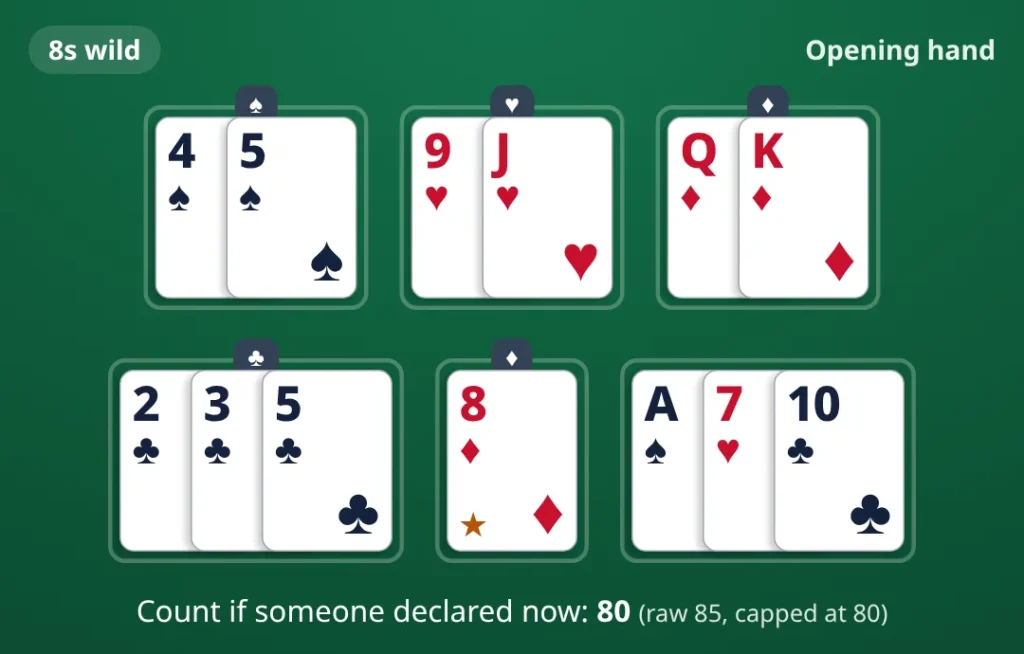
4♠ 5♠ · 9♥ J♥ · Q♦ K♦ · 2♣ 3♣ 5♣ · 8♦ · A♠ 7♥ 10♣
The engine counts this hand at 80 (85 raw, capped), because there is no pure sequence yet. The outs:
| Chance | Completed by | Physical cards |
|---|---|---|
| 4♠ 5♠ | 3♠ or 6♠ | 4 |
| 9♥ J♥ | 10♥ | 2 |
| Q♦ K♦ | J♦ or A♦ | 4 |
| 2♣ 3♣ 5♣ | A♣ or 4♣ | 4 |
| Total | 14 |
The 8♦ does not help here: it is a joker, so any run it fills becomes impure. Keep it for the second sequence.
Step 2: know your odds
At the start of a two-player hand you cannot see 91 cards: 106 in two decks with two printed jokers, minus your 13, the cut card and the first open card. If only closed-deck draws are counted, the chance of hitting at least one out is roughly:
| Outs | Within 3 draws | Within 5 draws | Within 8 draws |
|---|---|---|---|
| 2 | 6.5% | 10.7% | 16.9% |
| 4 | 12.8% | 20.5% | 31.2% |
| 8 | 24.4% | 37.6% | 53.6% |
| 14 | 39.8% | 57.5% | 75.2% |
The lesson: a single gapped pair is a poor plan, and four separate chances are a good one. Keep several different chances alive in the first few turns rather than committing to the prettiest one. The open pile adds to this: a card your opponent throws that completes a run is yours to pick up.
Step 3: what to throw while you wait
- Lonely high cards first. An A, K, Q, J or 10 with no partner costs 10 points if you are caught. In the hand above, A♠, 10♣ and 7♥ are the first candidates.
- Then the weakest chance. When you have to break something, break the 2-card chance (9♥ J♥), not a 4-card one.
- Never the joker, never a card that is part of two chances. In 2♣ 3♣ 5♣ every card works with every other one.
- Low cards are cheap to keep. 2♣ and 3♣ cost almost nothing if you are caught, so they can wait longer than a lone King.
Three turns later
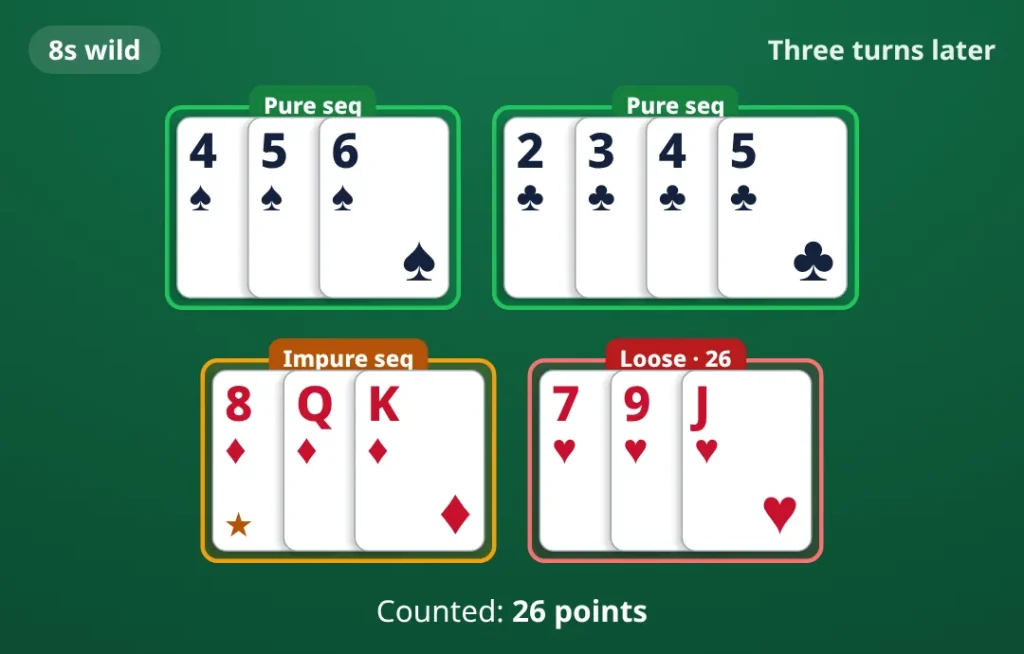
4♠ 5♠ 6♠ · 2♣ 3♣ 4♣ 5♣ · 8♦ Q♦ K♦ · 7♥ 9♥ J♥
Turn 1: drew 6♠, threw A♠. Turn 2: drew K♣, threw it straight back. Turn 3: drew 4♣, threw 10♣. Two of the four chances came in, so there are now two pure sequences, and the joker turns Q♦ K♦ into a third sequence. The engine counts this hand at 26, down from 80.
It is also one card from a show. The engine finds these winning draws: a 10♥ completes 9♥ 10♥ J♥ (throw the 7♥). Any 8 or printed joker fills 7♥ _ 9♥ or 9♥ _ J♥. And A♦ or J♦ completes Q♦ K♦ on its own, which frees the 8♦ joker to fill the hearts. With the cut card and your own 8♦ out of the way, that is about 14 live cards: two 10♥, six 8s, two printed jokers, two A♦ and two J♦. Jokers are weak for your first sequence but excellent for your last one.
Common pure-sequence mistakes
- Using a joker in your first run. 9♥ PJ J♥ is a sequence, but not a pure one. Hold the joker for the second sequence or a set.
- Counting K A 2. Q K A is a sequence, K A 2 is not, so A♣ 2♣ has fewer outs than it looks.
- Breaking a connected pair for a gapped one. 4 outs beat 2.
- Picking from the open pile for a set before you have a pure sequence. Sets do not protect anything until both sequences are in place.
- Declaring with a “pure” run that has a wild card out of place. See valid vs invalid declarations for checked examples, or test your hand in the declare checker.
Practise it
- Most days, the daily rummy puzzle asks you to find a discard or spot a missing pure sequence.
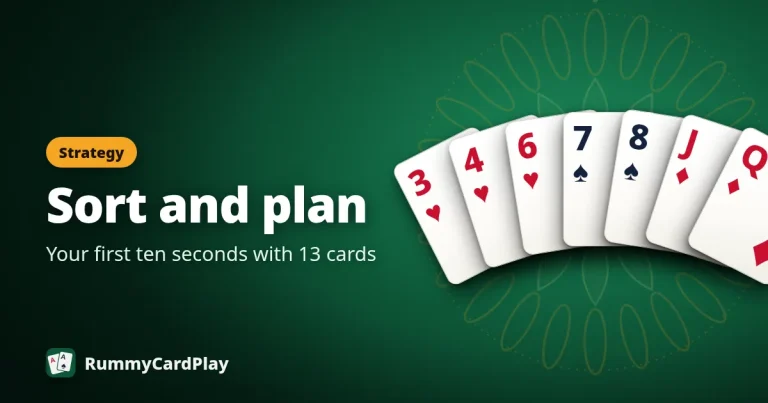
- Read how to sort and plan your opening hand for the next step, and when to drop for what to do when there is no chance at all.
- Then play a few hands of free Points Rummy and count your outs before every draw.
Jokers help every group except the pure sequence, so read rummy joker strategy next, and check 12 common rummy mistakes for the errors that cost a pure sequence.
FAQ
What is a pure sequence in rummy?
Three or more consecutive cards of the same suit, with no joker used as a substitute, such as 4♠ 5♠ 6♠. A wild card used as itself (7♥ in 5♥ 6♥ 7♥ when 7s are wild) still makes it pure.
Can a pure sequence have more than three cards?
Yes. 3♥ 4♥ 5♥ 6♥ is a pure sequence of four. Longer runs are useful when you have spare cards in a suit.
Can I make a pure sequence with Q K A?
Yes, Q K A of one suit is a valid sequence. K A 2 is not, because the Ace cannot link King and 2.
How many outs do I need before I should drop?
Jokers matter more than outs. In our simulations, hands with no pure sequence and no joker did better dropping at every table size, even with several pure-sequence chances; with one joker, playing on paid only in two-player games. Our drop data study has the numbers, and when to drop has a checklist.