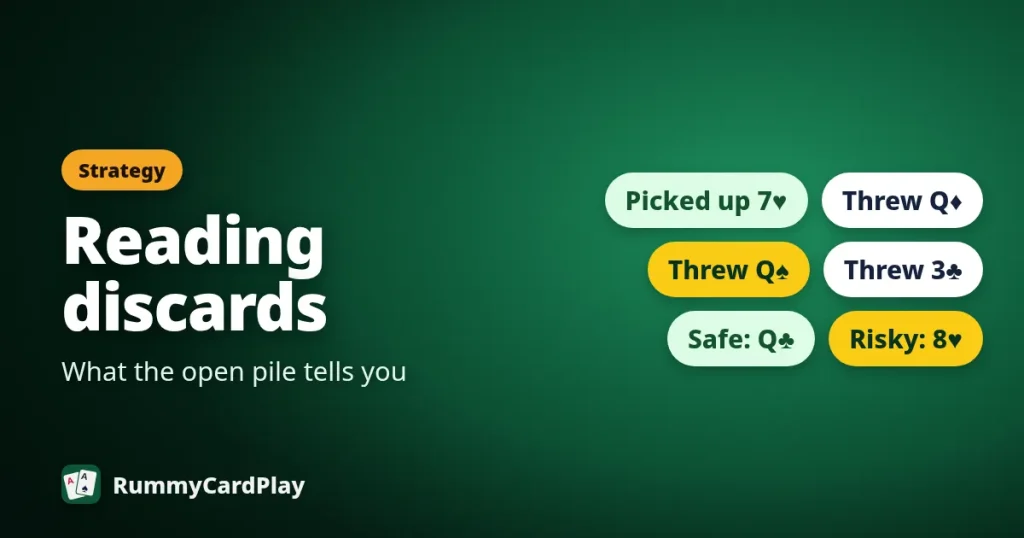
Every card your opponents pick up or throw away tells you something about their hand. Reading those signals lets you avoid feeding them the card they need, choose safer discards, and judge when someone is close to declaring. This guide explains what each kind of move usually means in 13-card Indian Rummy, then walks through a real decision with a hand checked by our rules engine.
Why discards matter
In a two-deck game most of the cards are hidden, but two things are public: every card thrown on the open pile, and every time a player takes the top card of the open pile instead of drawing blind. A player who keeps picking from the open pile is collecting. A player who keeps throwing high cards early is clearing a weak hand. Neither is proof, but together they shift the odds.
Players often say this is the hardest part to do on a phone. In one feedback thread for a Rummy 500 app, a player wrote that without a visible discard history the “only way is to try to remember” (Reddit, r/digitalcards). Our games keep a History button for exactly this reason: it lists the last 30 moves, including who took from the open pile.
What each move usually means
| You see | It usually means | What to do |
|---|---|---|
| A player picks up a card from the open pile | They have two cards that it completes or nearly completes: a run in that suit or a set of that rank | Do not throw that card’s neighbours in the same suit (one or two ranks away), or the same rank in another suit |
| A player throws a high card early (A, K, Q) | They are clearing lonely high cards, as you should too | Neutral. It says little about their plan |
| A player throws two cards of the same rank | They are not collecting a set of that rank | Other cards of that rank are safer to throw |
| A player throws a card next to one they threw before (Q♦ then J♦) | They are not building runs in that part of the suit | Cards in that area are safer |
| A player stops picking from the open pile and draws blind every turn | Their hand is set; they are waiting for one or two cards | They may be close. Count your hand and think about a middle drop if your count is high |
| A player throws a joker | Very rare. Usually a bluff or a mistake | Do not read too much into it |
Jokers can never be picked from the open pile in our games, so a thrown joker is simply gone.
A worked decision (10s wild)
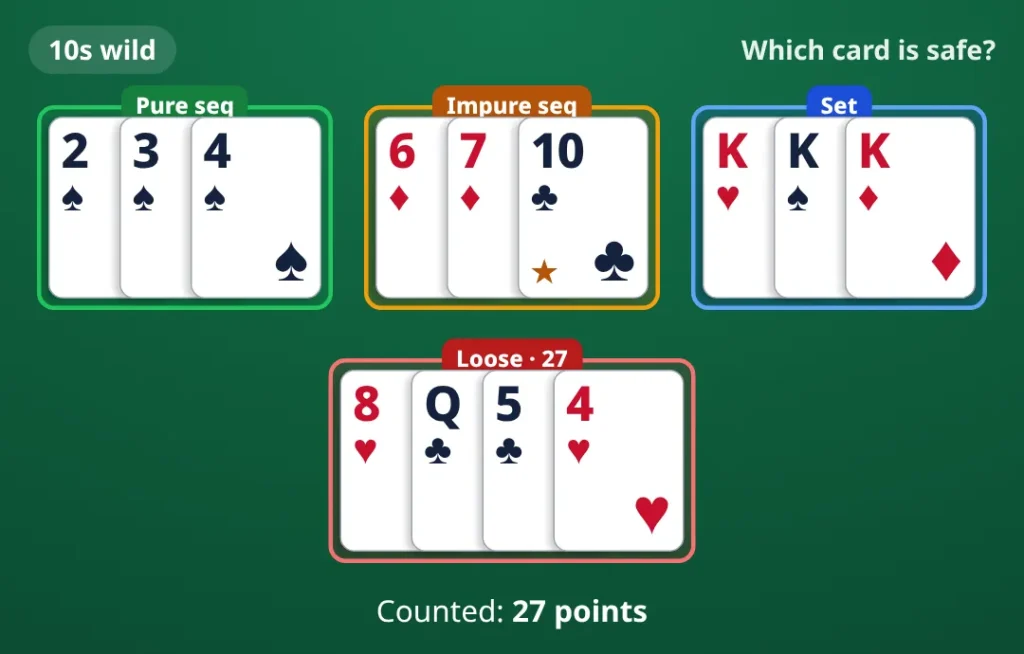
2♠ 3♠ 4♠ · 6♦ 7♦ 10♣ · K♥ K♠ K♦ · 8♥ Q♣ 5♣ 4♥
You have a pure sequence, a second sequence (the 10♣ is a joker) and a set of Kings. If someone declared now, the engine would count only the four loose cards: 27. You draw the 9♠ from the closed deck, which does not help, so you must throw one of five cards: 9♠, 8♥, Q♣, 5♣ or 4♥.
Your opponent’s last four turns, from History:
| Turn | They took | They threw |
|---|---|---|
| 1 | closed deck | A♦ |
| 2 | 7♥ from the open pile | Q♦ |
| 3 | closed deck | Q♠ |
| 4 | closed deck | 3♣ |
How to read it:
- The 7♥ pick-up is the loudest signal. They hold cards near it in hearts (5♥ 6♥, 6♥ 8♥, 8♥ 9♥) or two other 7s. Throwing the 8♥ risks completing their run. The 4♥ is a smaller risk; 4♥ 5♥ 6♥ 7♥ is possible.
- Q♦ then Q♠ thrown: they are not collecting Queens. The Q♣ is a fairly safe throw, and it is also your most expensive loose card (10 points).
- 3♣ thrown: low clubs are probably not in their plans, so the 5♣ is reasonably safe too.
- The 9♠ you just drew: spades near 9 have not appeared at all, so it carries some risk.
Decision: throw the Q♣. It is both the safest card and the one that costs you most if you are caught. Next turn, throw the 9♠ or the 5♣ before the 8♥. Keeping the 8♥ costs you 8 points if they declare, while handing them a run could end the hand at once.
Building your own read
- Check History every two or three turns, not only when you are stuck. It takes a second.
- Note every open-pile pick-up. These are the only moves that show what a player wants.
- Track Queens and Kings. High cards that come out early are usually being cleared, and they tell you which high sets are not being built.
- Count the jokers you have seen. If the cut card’s rank has already appeared several times on the open pile, fewer jokers are left for everyone.
- Watch yourself too. If you pick up from the open pile, your opponents can see it. Taking a card only to complete a set when you have no sequences yet gives information away for little gain.
Reading discards in Pool and Deals
In Pool and Deals Rummy the same signals apply, but the stakes of reading them change. A player near the elimination score in Pool Rummy often plays more cautiously, which makes their early throws less informative. In Deals Rummy no one can drop, so every player keeps playing and the discard pile carries more information over a hand.
Practise
Play a few hands of free Points Rummy and press History before each discard. The daily rummy puzzle trains the counting half of the decision, and how to sort and plan your opening hand covers the first discards of a hand.
FAQ
What does it mean when an opponent picks a card from the open pile?
That card fits their hand: usually it completes or nearly completes a run in that suit or a set of that rank. Avoid throwing its neighbours in the same suit and the same rank in other suits.
What is a safe discard in rummy?
A card that is unlikely to help anyone, usually one of the same rank as cards your opponents have thrown, or next to their earlier discards in the same suit. No discard is completely safe.
Can computer players see my cards?
Not in our games. The computer players decide using only their own hand, the wild joker and the cards everyone can see on the open pile, and all hands are shown face up after each hand so you can check.
Should I hold a card my opponent needs even if it is useless to me?
Often, yes, if it is low in value. Holding an 8 costs at most 8 points if someone declares; giving away a card that completes their hand can cost you the whole hand.