Play Pool Rummy 101 free in your browser, against 1 to 5 computer players. The cards and melds are the same as in 13-card Points Rummy, but the game runs over many hands. Your points add up, and the first time your pool score reaches 101 you are out. The last player left wins. Tap the table above to start. To play in Hindi, tap हिं at the top of the table.
Pool Rummy 101 at a glance
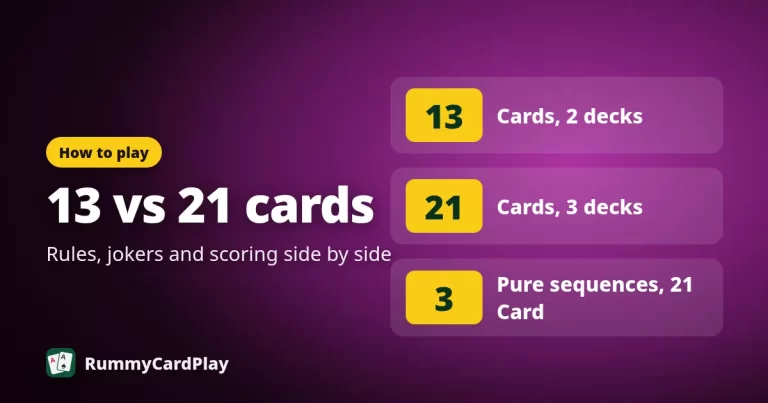
- 13 cards each from two decks with two printed jokers (106 cards), with a wild joker turned up every hand.
- You against 1 to 5 computer players, on Easy, Medium or Hard.
- After each hand, losers add their count to their pool score. The winner of the hand adds 0.
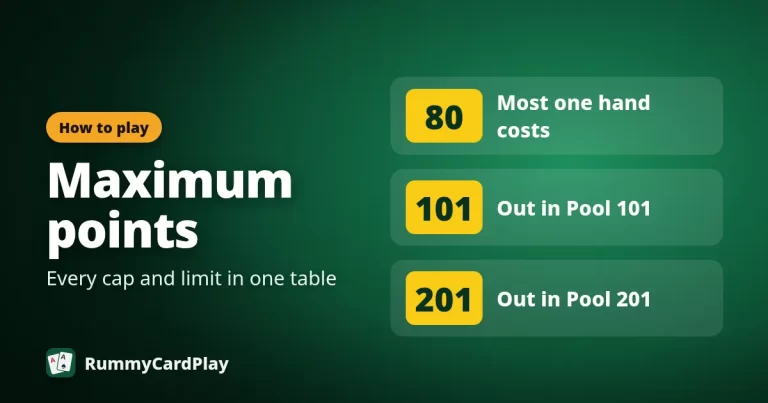
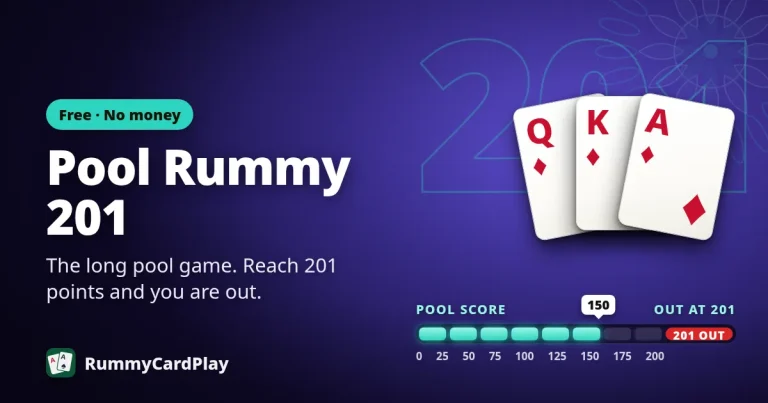
- Reach 101 or more and you are out. 100 is still in.
- First drop 20, middle drop 40, wrong declaration 80. No hand ever costs more than 80.
- No rejoining and no splitting: the pool is played to the end, and the last player in wins.
- Free: no money, no sign-up, no download. Your pool is saved on your phone, so you can close the tab and carry on later.
How to play Pool Rummy 101
Pool Rummy is the elimination format of Indian Rummy. Each hand is played exactly like a hand of Points Rummy: same deal, same jokers, same declaration rules. The only change is what happens to your points afterwards. Everything below is what the game on this page enforces.
Every hand
- Everyone still in the pool gets 13 cards. A card is turned up as the wild joker, one card starts the open pile, and the rest form the closed deck.
- On your turn, draw from the closed deck or the open pile, then discard one card. Jokers can never be picked up from the open pile.
- To declare you need at least two sequences, one of them pure, with every other card in a valid sequence or set.
- The losers’ cards are counted in their best grouping: J, Q, K and Ace 10, number cards face value, jokers 0. Without a pure sequence every card counts, up to 80.
If any of that is new, the Points Rummy rules explain each step with pictures, and the guide to valid and invalid declarations shows ten checked hands.
The pool score
After every hand, each loser’s count is added to their pool score. The winner adds nothing. The score bar at the top of the table shows yours as, for example, 44/101, and each computer player’s box shows theirs. A low score is good.
| What happened in the hand | Added to your pool score |
|---|---|
| You declared and won the hand | 0 |
| You lost with cards left in your hand | Your count (at most 80) |
| First drop (before your first draw) | 20 |
| Middle drop (after you have drawn) | 40 |
| Wrong declaration | 80 |
Elimination
The moment your pool score reaches 101 or more, you are out of the pool. Two or more players can go out in the same hand. The next hand is dealt only to the players still in, and the deal moves to the next player still in. When only one player is left, that player wins the pool.
A computer player who goes out has a red OUT banner on the result screen and their row fades. The result screen also shows how many first drops you can still afford before you would reach 101.
When you are out
If you are eliminated while two or more computer players are still in, the computer players finish the pool on their own, in a fraction of a second, and the winner screen shows the final standings. You don’t have to watch the hands you are no longer part of.
What this version leaves out
- Rejoin. Some versions let a player who has just gone out re-enter the pool at the highest remaining score. This version has no rejoin: when you are out, the pool is decided without you.
- Split. Some versions let the last players agree to end the pool early. This version has no split: the pool is always played to one winner.
- 61 Pool. The r/cardgames thread cited below also mentions a shorter 61-point pool. This site offers 101 and 201.
A worked example: three hands of Pool 101
Here is a short pool between you and two computer players, Asha and Ravi. Each hand was checked with the game’s own rules engine: the counts below are the counts the game gives, in the best grouping of each hand. 5s are wild in all three hands.
Hand 1: you lose with 24
Asha declares. Your hand: A♠ 2♠ 3♠ 8♦ 9♦ 10♦ J♦ 5♥ 6♥ 6♣ Q♥ 4♦ K♣. Ravi doesn’t like his opening cards and takes a first drop.
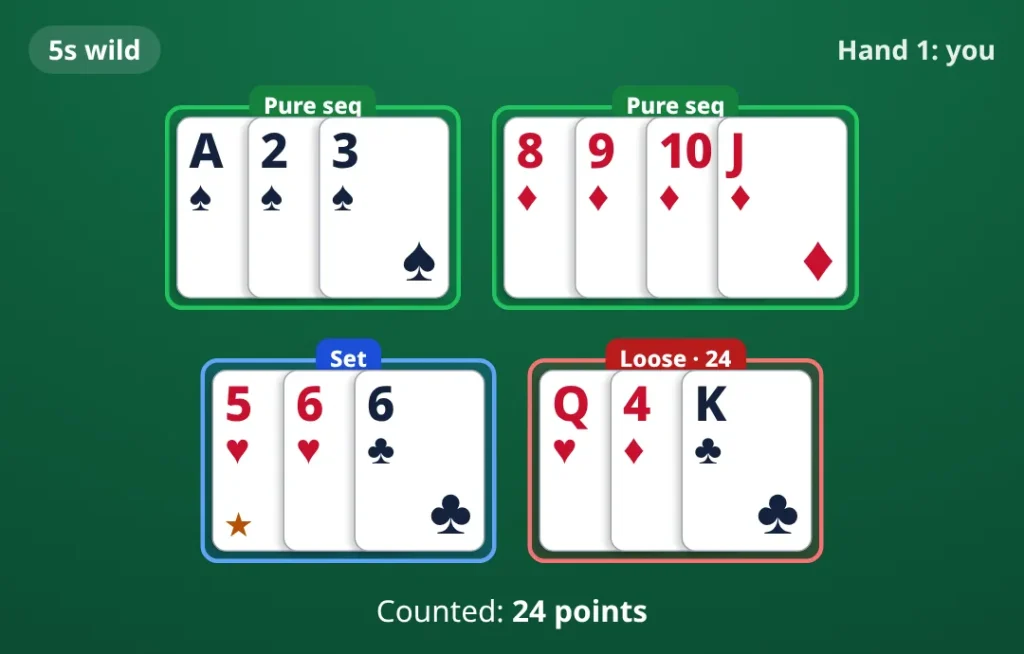
You have two pure sequences, A♠ 2♠ 3♠ and 8♦ 9♦ 10♦ J♦, so your other groups are protected. The 5♥ is a wild joker that completes the set 6♥ 6♣ 5♥. Only Q♥, 4♦ and K♣ count: 10 + 4 + 10 = 24.
| After hand 1 | You | Asha | Ravi |
|---|---|---|---|
| Added | 24 | 0 | 20 (first drop) |
| Pool score | 24 | 0 | 20 |
Hand 2: you declare
You declare this time. Asha is caught with A♥ Q♥ K♥ 5♣ 7♠ 8♠ 10♠ 10♥ 10♣ 2♦ 3♣ 4♣ 9♣. Ravi had drawn a few times before giving up, so his drop is a middle drop.
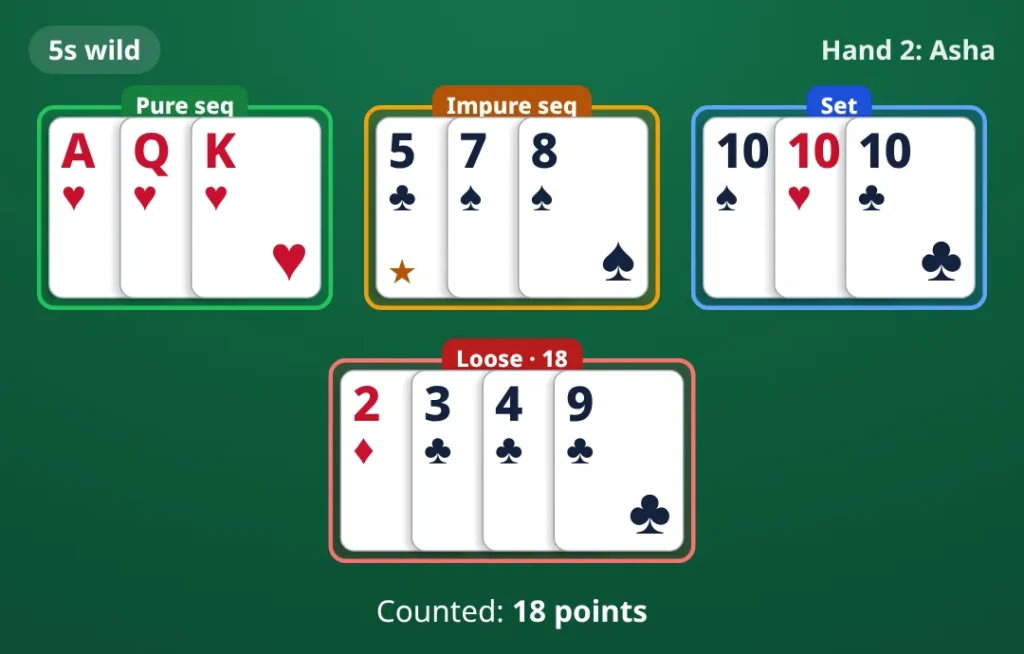
Asha’s Q♥ K♥ A♥ is a pure sequence (the Ace can sit above the King). The wild 5♣ fills the gap in 7♠ 8♠ for an impure sequence, which also lets the set of 10s count as a meld. Her 2♦, 3♣, 4♣ and 9♣ add up to 18. She could have used 3♣ 4♣ 5♣ as a pure sequence instead, but then 7♠ and 8♠ would both be loose and she would pay 26. The game always counts the cheaper grouping.
| After hand 2 | You | Asha | Ravi |
|---|---|---|---|
| Added | 0 | 18 | 40 (middle drop) |
| Pool score | 24 | 18 | 60 |
Hand 3: Ravi goes out
Asha declares again. Ravi plays on and is caught holding K♠ Q♠ 9♥ 9♣ 9♠ 5♦ J♦ J♣ A♣ 7♥ 4♠ 2♥ 8♣. You take a first drop.
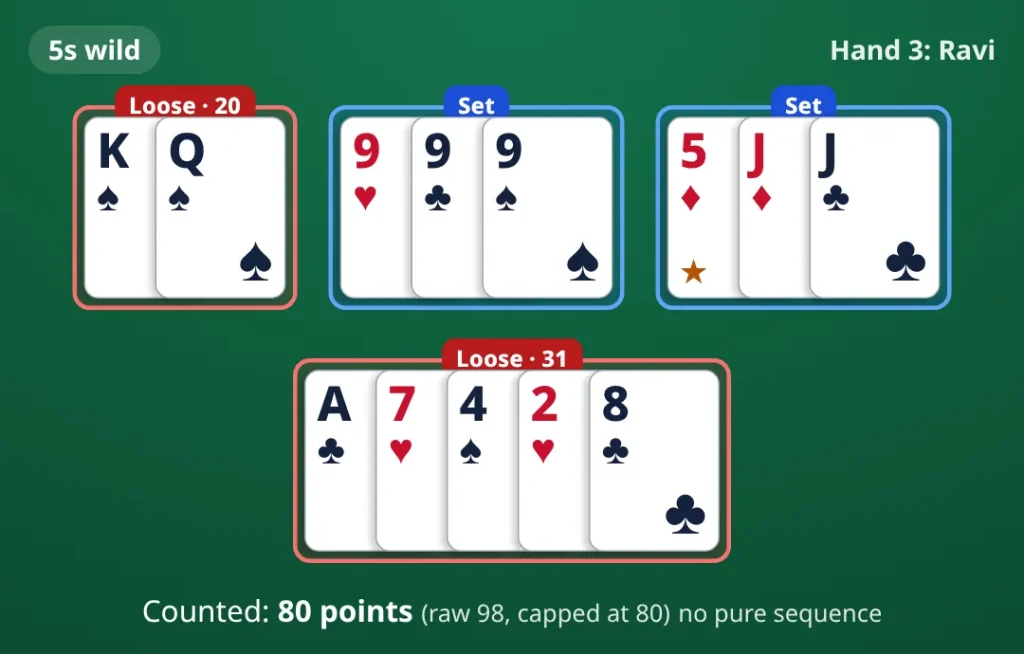
Ravi has a set of 9s and a joker with two Jacks, but no sequence at all, so nothing is protected. His cards add up to 98, capped at 80. That takes him from 60 to 140, and he is out.
| After hand 3 | You | Asha | Ravi |
|---|---|---|---|
| Added | 20 (first drop) | 0 | 80 |
| Pool score | 44 | 18 | 140, out |
The pool goes on as a two-player game between you and Asha. At 44, you can afford two more first drops (64, then 84). Asha, on 18, can afford four.
What Ravi could have done. On 60, his drop budget was tight but real. A first drop would have taken him to 80, still in, with one more first drop left. Even a middle drop would have put him on exactly 100, still in. Playing on with a hand that had no sequence risked the full 80, and that was the hand that knocked him out.
Your drop budget
In Points Rummy a drop is just a smaller loss. In Pool 101 every drop uses up part of a fixed budget of 100 points. This table shows what you can still afford at each pool score.
| Your pool score | First drops (20) left | Middle drop (40) still safe? | Full count (80) still safe? |
|---|---|---|---|
| 0 | 5 | Yes | Yes |
| 1 to 20 | 4 | Yes | Yes |
| 21 to 40 | 3 | Yes | No |
| 41 to 60 | 2 | Yes | No |
| 61 to 80 | 1 | No | No |
| 81 to 100 | 0 | No | No |
Two things stand out. From 21 points on, one bad hand played to the end can knock you out. From 81, even a first drop knocks you out, so you have to play every hand. Opponents in that zone are highlighted on the table, and the drop screen warns you before a drop that would end your pool.
Pool Rummy 101 strategy
The general Points Rummy strategy applies to every hand: build the pure sequence first, keep middle cards, use History to track the open pile. These tips are about the pool itself.
1. Spend drops early, while they are cheap
A first drop costs 20, and a hopeless hand played out often costs 60 to 80. Early in the pool, with four or five drops in hand, dropping a hand with no pure sequence and no joker is rarely a mistake. Read our guide to when to drop for four real opening hands.
2. Count drops, not points
A score of 44 sounds safe, but it means two first drops left. Think of your score as a number of drops remaining: it tells you how many bad hands you can still fold.
3. Don’t spend your last drop on a borderline hand
Once you have one first drop left, keep it for a truly hopeless deal. Play borderline hands on, and shed high cards early so that a loss costs 30 rather than 70.
4. Above 80, play to win or play small
From 81, any drop puts you out, so it no longer helps. Throw Kings, Queens and Aces that aren’t working early, and keep low cards. A loss of 15 can keep you in, a loss of 80 cannot.
5. Watch who can’t drop
A highlighted opponent (within one drop of 101) has to play every hand out. They can’t fold a bad hand, so they will often be caught with a count, but they also stay in every hand to the end. Discard carefully around them, especially middle cards they might need.
6. Know when the middle drop is worth 40
If you have drawn a few times and the hand has fallen apart, a middle drop costs 40 for sure. Playing on risks up to 80. If 40 keeps you in and 80 would not, drop. In the example above, Ravi on 60 would have stayed in with a middle drop.
7. Heads-up endgames are different
With only two players left, every hand has a single winner and a single loser, and the gap in scores matters most. If you lead by 60 or more, play safe and drop poor hands. If you are behind, you need a few hands where your opponent gets caught for a big count, which means taking more risks.
Going deeper: our Pool Rummy strategy guide covers each stage of a pool, and Pool 101 vs 201 in numbers shows how long pools last. The score at which one hand or one drop puts you out is in maximum points in rummy.
Common Pool 101 mistakes
- Playing every hand to the end. The same bad hand that costs 60 in Points Rummy can end your pool here.
- Dropping out of habit near the limit. At 81 or more, a drop is an elimination. The game warns you, but plan for it.
- Forgetting that 101 means out, not 102. A score of 100 is still in. 101 is out.
- Treating the middle drop as a failure. At the right score it is the cheapest way to survive a hand that went wrong.
- Keeping high cards for too long when your score is high. Late in a pool, the count of a losing hand matters more than in Points Rummy.
- Declaring without a pure sequence. A wrong show costs 80, and in Pool 101 that can be the whole pool.
What players ask about Pool and Deals
We read public discussions about pool rummy to see what confuses players. Everything here is paraphrased from the linked sources.
- Which formats exist? A question on r/cardgames about online rummy variants lists Pool in 61, 101 and 201 versions and Deals played over 2, 3, 4 or 6 deals. This site has the two most common pool limits, 101 and 201, and Deals over 2 or 3 deals.
- When exactly are you out? Wikipedia’s Indian Rummy article describes Pool Rummy as a game where players are eliminated once their score crosses the preset limit. Tables word this differently, so here is our exact rule: out at 101 or more. 100 is still in.
- Remembering discards. In an r/digitalcards thread about a free Rummy 500 game, one commenter asked to see the discard pile instead of having to remember it. Over a long pool this matters even more. Here, the History button lists the last 30 moves, including who picked up which open card.
Prefer Hindi? Read the Pool Rummy 101 rules in Hindi.
Features of this Pool Rummy 101 game
- Running pool scores: your score out of 101 is always in the top bar, and every opponent’s score is shown on their box. Opponents within one drop of 101 are highlighted.
- Drop warnings: the drop screen shows what your score will be after the drop, and warns you in red if the drop would put you out.
- Elimination and winner screens: a short animation marks every player who goes out, and the winner screen lists everyone’s final score and the hand in which they went out.
- English or Hindi: the हिं / EN button switches every button, message, the help screen and screen-reader labels.
- Colour-coded groups: green for a pure sequence, orange for an impure sequence, blue for a set and red for an invalid group.
- Discard history: the last 30 moves, including who picked up which card from the open pile.
- Fair play: cryptographic shuffle, computer players that see only what a person at the table could see, and every hand shown face up at the end.
- Resume and offline: your pool is saved on your phone after every move. Close the tab, reload, or lose your connection and the pool carries on where you left it. Add the game to your Home screen to play offline.
- Free: no sign-up, no ₹ entry fee, no cash prize and no ads interrupting a hand. Pool scores are just a score.
Our testing
We don’t claim to be pool champions. Here is what we measured, with the date and the size of each test.
- Rules check, 1,000 complete pools of computer players (2 to 6 players, mixed levels, 4,796 hands in total), run on 9 October 2026. An automatic checker verified every hand (all 106 cards accounted for, every losing hand re-scored, no count above 80, no joker taken from the open pile) and every pool (scores equal to the sum of the hands, a player out exactly when the score reached 101, no eliminated player dealt in again, exactly one winner). It found 0 rule violations.
- How long a pool lasts: on average 4.1 hands with 2 players, 5.0 with 4 and 5.1 with 6. The longest pool took 15 hands. None of the 3,000 eliminations came from a drop: the computer players never drop when the drop itself would put them out.
- Difficulty levels, measured over 3,600 complete two-player pools (1,200 per pairing, seats alternated): Hard beat Medium in 60.8% of pools (±1.4), Medium beat Easy in 91.5% (±0.8) and Hard beat Easy in 94.3% (±0.7). A two-player pool lasted 3.7 to 4.6 hands on average, depending on the pairing. Single-hand gaps add up over a pool, which is why the levels are further apart here than in Points Rummy.
- Browser tests play the real game page: the 0/101 score bar, a first drop adding 20, the drops-left line, an opponent being eliminated, a reload in the middle of a pool without losing or double-counting a hand, your own elimination with the computer players finishing the pool, and the winner screen in English and Hindi.
- How the computer players use the pool score: Medium and Hard take first drops on very weak hands, and never take a drop that would put them out. Easy never drops. None of the levels takes a middle drop, so that penalty is checked by the browser tests instead.
Pool Rummy 101 FAQ
Is this Pool Rummy 101 game free?
Yes. There is no entry fee, no deposit and no prize. Pool scores are only a score, stored on your own device.
At what score am I out in Pool 101?
At 101 or more. A pool score of 100 is still in. The game shows your score out of 101 at the top of the table.
How much does a drop cost in Pool 101?
20 points for a first drop, before you have drawn any card in the hand, and 40 for a middle drop after that. A wrong declaration costs 80, and so does the worst possible losing hand.
How many drops can I take?
At the start, five first drops: 5 × 20 = 100 keeps you in, a sixth would reach 120. The result screen shows how many first drops you can still afford after each hand.
What happens when I’m eliminated?
If two or more computer players are still in, they finish the pool on their own straight away and the winner screen shows the final standings. You can then start a new pool.
Can I rejoin after I’m out?
No. Once you are out, the pool simply continues without you.
Can the last players split the pool?
No. The pool is always played until one player is left.
How long does a game of Pool 101 take?
Usually a handful of hands. In our tests, a two-player pool averaged 4.1 hands and a six-player pool 5.1 hands.
What is the difference between Pool 101 and Pool 201?
The limit and the drop costs. Pool Rummy 201 knocks you out at 201, with a 25-point first drop and a 50-point middle drop, so pools last longer. The card rules are the same.
How is Pool Rummy different from Deals Rummy?
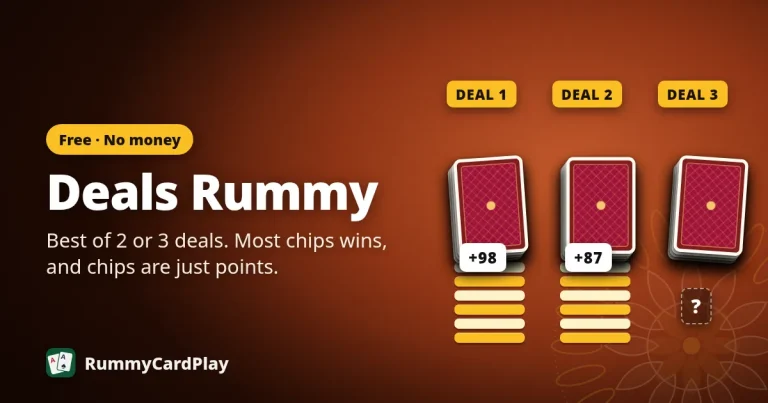
In Pool you collect points and try to stay under the limit. In Deals Rummy you play a fixed 2 or 3 deals for chips, there is no drop, and the most chips at the end wins.
What if I close the tab in the middle of a pool?
Your pool is saved after every move. Open the game again and you are back in the same hand with the same scores. Starting a new game ends the old pool.
Can I play Pool Rummy 101 in Hindi?
Yes. Tap हिं at the top of the table. Every button, message and the help screen switch to Hindi, and the game remembers your choice.