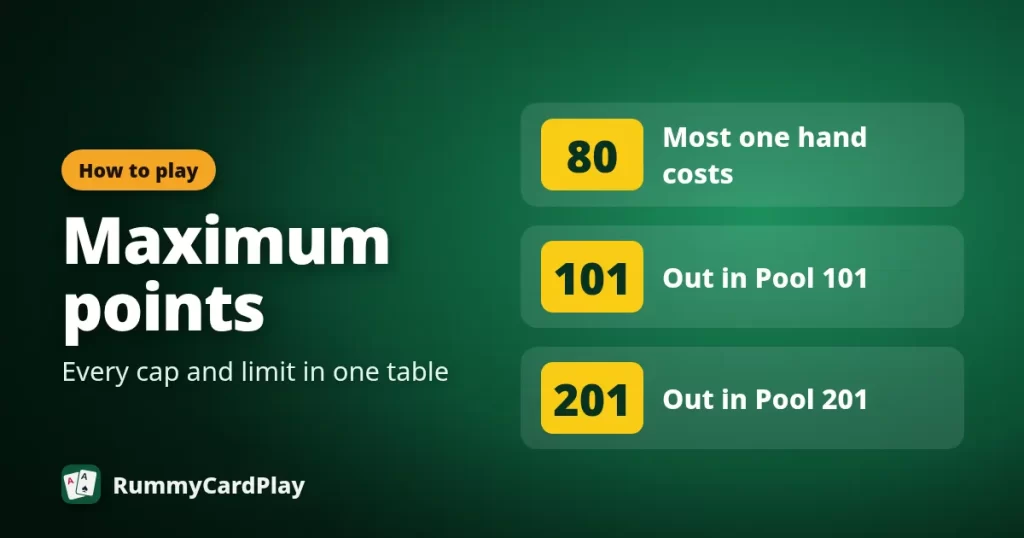
In 13-card Indian Rummy the most a single hand can cost you is 80 points. That is true whether you lose with a handful of high cards, make a wrong show or are caught with no pure sequence. “Maximum points” can also mean the score that knocks you out of a pool (101 or 201) or the cap in 21 Card Rummy (120), so this page lists every limit in one place, as used by our free games, with the reasons and some numbers from our simulations.
The quick answer
| Format | Most one hand can cost | Other limits |
|---|---|---|
| Points Rummy (13 cards) | 80 | First drop 20, middle drop 40, wrong show 80 |
| Pool Rummy 101 | 80 | Out at 101 or more. 100 is still in |
| Pool Rummy 201 | 80 | Out at 201 or more. Drops 25 and 50 |
| Deals Rummy | 80 chips per deal | Everyone starts with 80 × the number of players |
| 21 Card Rummy | 120 | First drop 30, middle drop 70, wrong show 120 |
| Gin Rummy | No fixed cap | Match ends at 100 points; knock at 10 or less |
Why 80 in 13-card rummy
Without a cap, a hand full of Kings and Queens could cost 130 points. The cap keeps one bad hand from deciding everything, and it is set at the same figure as a wrong show: a loser never pays more than a wrong declaration. Card values are A, K, Q, J and 10 = 10 each, 2 to 9 at face value, jokers 0 (the scoring guide has the full rules).
Here is a hand that hits the cap. The wild joker is 5, so all 5s are jokers:
K♠ K♥ Q♦ Q♣ J♠ J♥ 10♦ 10♣ 9♠ 9♦ 8♥ 7♣ 4♠
The hand has no pure sequence and no valid group at all, so every card counts: 117 points on the cards. Our rules engine counts it as 80, because 80 is the most any hand can cost.
The cap matters for decisions too. Once a hand without a pure sequence is already worth 80 or more, extra high cards cost you nothing further, so the only way to save points is to make a pure sequence. See when to drop for the numbers on dropping instead.
How often does a hand actually reach 80?
Often enough to plan for it. In our simulated games between computer players (26,000 complete hands), 15.9% of losing hands paid the full 80 with two players, and 23.7% with six. The average losing hand cost 39.7 points at a two-player table and 47.8 at a six-player table.
Before anyone draws, it is even more common: if someone declared before your first move, 47.2% of dealt hands would pay the full 80 (from 10 lakh simulated deals). Method and tables are in Rummy opening hand odds and Do jokers win rummy hands?
Maximum points in Pool Rummy: when one hand ends your game
A pool game adds your hands together and removes you at the limit, so the maximum that matters is how much you can afford. The highest score you can hold and still be in is 100 in Pool 101 and 200 in Pool 201. The table shows from which score each cost puts you out.
| Cost | Pool 101: you are out from | Pool 201: you are out from |
|---|---|---|
| A worst-case hand or a wrong show (80) | 21 | 121 |
| Middle drop (40 in Pool 101, 50 in Pool 201) | 61 | 151 |
| First drop (20 in Pool 101, 25 in Pool 201) | 81 | 176 |
So at 81 in Pool 101, even a first drop ends your game, and at 21 any 80-point hand does. This is why pool play is a budget exercise: see Pool Rummy strategy for the drop budget at each score and Pool Rummy 101 vs 201 in numbers for how long pools last.
Deals Rummy: chips instead of points
In Deals Rummy the winner of a deal collects every loser’s count as chips, and each loser pays at most 80. Everyone starts with 80 × the number of players (160 each with 2 players, 480 each with 6), and the total number of chips never changes. Chips are only a score here. There is no drop, so a bad hand has to be played out: the Deals strategy guide shows how to lose small.
21 Card Rummy: a cap of 120
With 21 cards in hand, the cap is 120: a first drop costs 30, a middle drop 70 and a wrong show 120. Value cards are settled separately and can add much more for the player who holds them: a marriage is worth 100, and two marriages 300. If you are new to the bigger game, 21 Card Rummy tips explain how to plan three pure sequences, and 13 card vs 21 card rummy compares the two side by side.
Gin Rummy
Gin has no 80 or 120 cap. The knocker scores the difference in deadwood, with a bonus of 25 for gin or for an undercut, and the match ends when someone reaches 100 points. After that, a box bonus of 25 per hand won and a game bonus of 100 are added. Details are on the Gin Rummy page, and the Gin strategy guide covers when to knock.
Other tables, other caps
Rule sets differ. Pagat’s description of Indian Rummy describes a first drop of 10 points and a middle drop of 40, and does not mention an 80 cap. The 80 cap, the 20/40 drops and the 80-point wrong show are what most modern 13-card rule sets use and what our games, the rummy points calculator and every guide here use. When you play with real cards, agree the cap and the drop values before the first deal.
FAQ
What is the maximum points in rummy?
In 13-card Points, Pool and Deals Rummy, 80 points for one hand. That includes a wrong show, which costs the same 80. In 21 Card Rummy the maximum for a hand is 120. Some home games use other limits, so agree them before you start.
Can you lose more than 80 points in one hand of rummy?
Not in our games. A losing hand is counted at its best grouping and capped at 80 (120 in 21 Card Rummy). In Pool Rummy your running total can pass 100 or 200, but that only means you are out.
What is the maximum score in Pool Rummy 101 and 201?
You are out at 101 or more in Pool 101 and at 201 or more in Pool 201, so the highest score you can hold and still be in is 100 or 200. One hand never adds more than 80.
What happens when you reach exactly 101 in Pool Rummy?
You are out. In our Pool 101 game 100 is still in and 101 or more is out. Some tables word this differently, so check the rule when you play with real cards.
Is the wrong show penalty the same as the maximum?
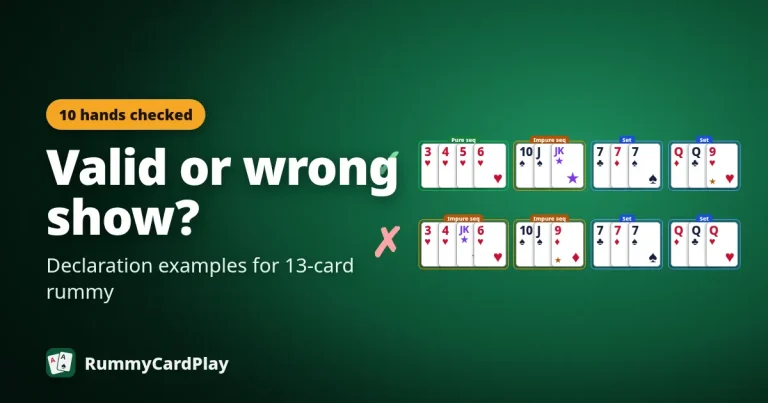
Yes, in 13-card rummy. A wrong show costs 80, which is also the most a losing hand can cost. That is why it is better to count your hand and check your groups before pressing Declare: see valid vs invalid declarations.
Do jokers count towards the maximum?
No. Printed jokers and wild jokers count 0 themselves, and a joker can complete a group so that the group’s other cards stop counting too (once you hold a pure sequence and a second sequence).