Gin Rummy is the two-player cousin of Indian Rummy: ten cards each, no jokers, and the hand ends when someone knocks with 10 or less deadwood or goes gin with none. Most of the skill is in one recurring decision: knock now, or keep drawing for gin? This guide works through that decision with real hands checked by the Gin engine in our free Gin Rummy game, then covers discards and defence. The rules we play by (knock at 10, gin and undercut bonus 25, game to 100) are on the game page.
Deadwood: the number that matters
Deadwood is every card not in a meld (a run of three or more in one suit, or a set of three or four of a rank). Ace counts 1, 2 to 10 their number, and J, Q, K count 10. Unlike Indian Rummy, the Ace is low only: A 2 3 is a run, Q K A is not.
Every turn, after you discard, ask: what is my deadwood now? If it is 10 or less you may knock. The lower it is, the safer the knock.
Knock or wait for gin?
A low knock (deadwood 2)
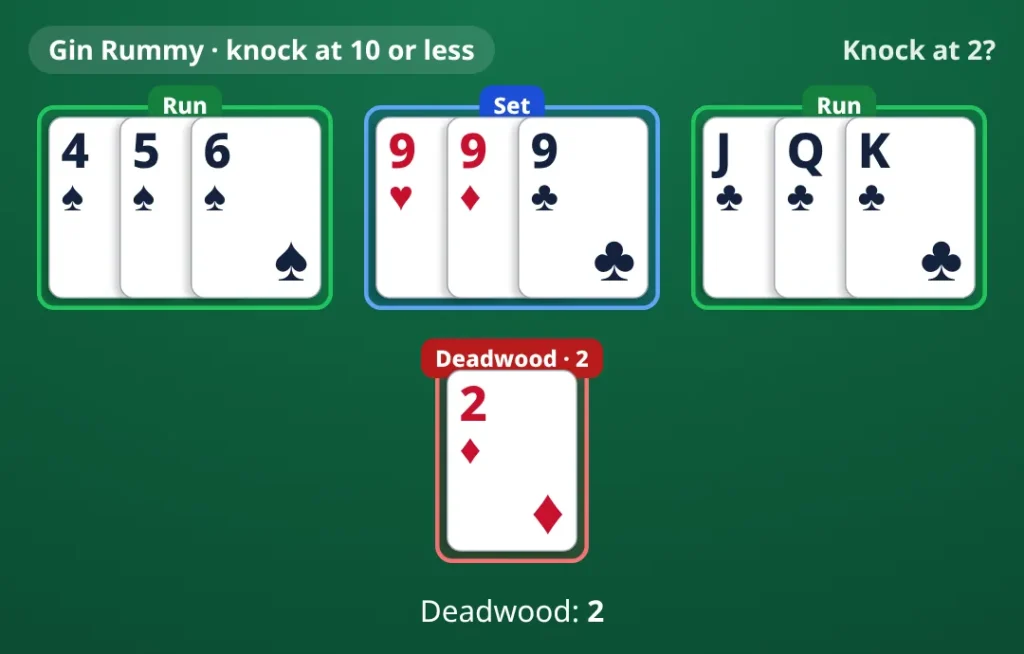
4♠ 5♠ 6♠ · 9♥ 9♦ 9♣ · J♣ Q♣ K♣ · 2♦
Three melds and a lone 2♦: deadwood 2. You can knock now. Or you can wait: the engine finds exactly four cards that would give you gin (throwing the 2♦): 3♠, 7♠, 9♠ and 10♣.
How likely is that? In the middle of a hand you typically cannot see around 31 cards (the closed deck and your opponent’s hand). With 4 gin cards among them, the chance of drawing one is about 13% per turn, 35% within three turns and 53% within five. Meanwhile your opponent is drawing too, and may knock first.
Knock now is usually right. A knock at 2 can only be undercut if your opponent’s deadwood after laying off is 2 or less, which is rare unless they are close to gin themselves. Waiting gains you 25 points and protection from an undercut, but only about one time in three over the next three turns.
Wait is reasonable only very early in the hand, when your opponent has had few turns to improve, or when their discards suggest they are far from knocking.
A knock at the limit (deadwood 10)
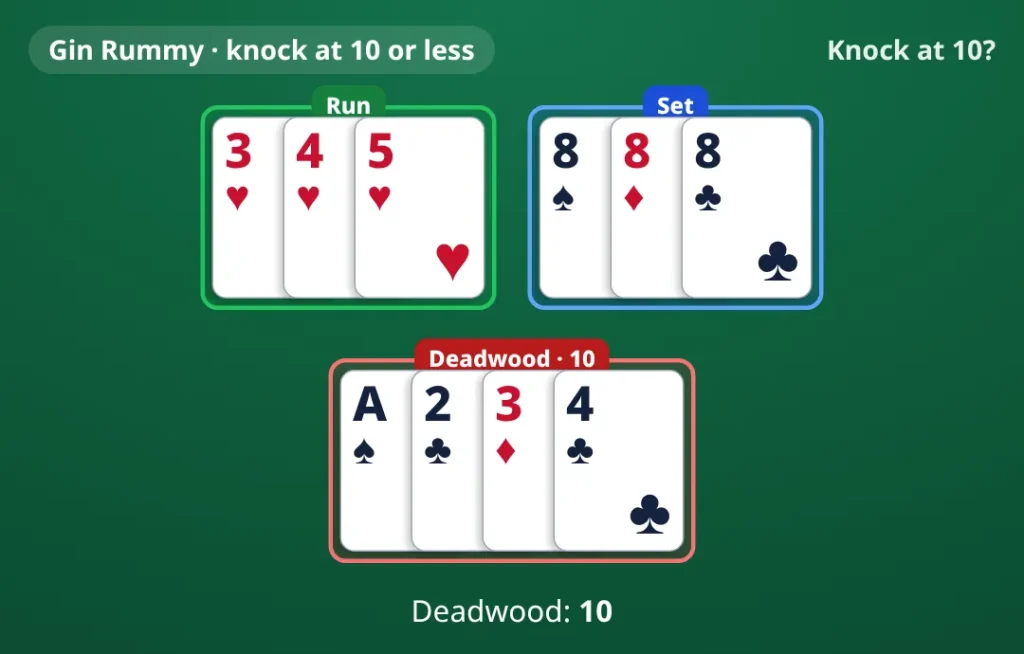
3♥ 4♥ 5♥ · 8♠ 8♦ 8♣ · A♠ 2♣ 3♦ 4♣
Two melds and four small loose cards: deadwood 10, the most you can knock with. No single card gives gin. Should you knock?
- For: your loose cards are all low, so a few draws are unlikely to cut much. A knock now scores the difference if your opponent holds more than 10.
- Against: a defender can lay off cards on your melds (2♥ or 6♥ on the hearts, the 8♥ on the 8s), which cuts their deadwood. At 10, any defender who gets to 10 or below after laying off undercuts you, scoring the difference plus 25.
Our rule of thumb: knock at 10 early in the hand, when your opponent has had little time to build melds. Late in the hand, when they have been picking up from the discard pile, wait for a lower count or a cleaner knock. The Gin Rummy page has a worked undercut showing how quickly the bonus swings a hand.
Discards
- Throw high deadwood first. A lone King costs 10 if your opponent knocks; a lone 2 costs 2.
- Do not feed a pick-up. If your opponent took the 7♥ from the discard pile, keep the 6♥, 8♥ and other 7s if you can. The same reading skills as in Indian Rummy apply; see reading discards.
- Throw cards your opponent has already thrown a neighbour of. If they discarded the 9♣, the 10♣ and 8♣ are safer.
- Late in the hand, safety beats speed. When the closed deck is getting short, a safe discard is often worth more than a small deadwood cut. If only two cards are left in the closed deck and nobody has knocked, the hand is a draw.
Defence
When your opponent knocks, you lay out your melds and lay off any loose cards that fit theirs. Before that moment, prepare:
- Keep low cards when you are far from knocking. A hand of 2s and 3s is hard to beat by much.
- Watch their melds form. Cards that extend a meld your opponent is likely to show are free deadwood reductions if they knock.
- Remember the undercut. If your deadwood after laying off is equal to or lower than theirs, you score the difference plus 25, so a careful defensive hand can turn a knock around.
Playing a match to 100
- Every hand you win adds a box bonus of 25 at the end of the match, so winning many small hands is worth more than the hand scores suggest.
- The game bonus of 100 goes to the first player to 100 points. Near the end, a gin (25 plus the opponent’s deadwood) can close a match in one hand.
- Our version leaves out Big Gin and Oklahoma Gin. If your group plays them, Pagat’s Gin Rummy rules describe the variations.
FAQ
When should you knock in Gin Rummy?
Usually as soon as you can with a low count: a knock at 2 to 5 is rarely undercut. With 8 to 10 deadwood, knock early in the hand, but be more careful later when your opponent has had time to build melds.
Is it better to go for gin?
Only when you are very close and early in the hand. Gin is worth 25 plus your opponent’s deadwood and cannot be undercut, but waiting gives your opponent time to knock first.
What is an undercut in Gin Rummy?
When the defender’s deadwood, after laying off, is equal to or lower than the knocker’s. The defender then scores the difference plus 25 in our game.
Is the Ace high or low in Gin Rummy?
Low only. A 2 3 is a run; Q K A is not. The Ace counts 1 point as deadwood.