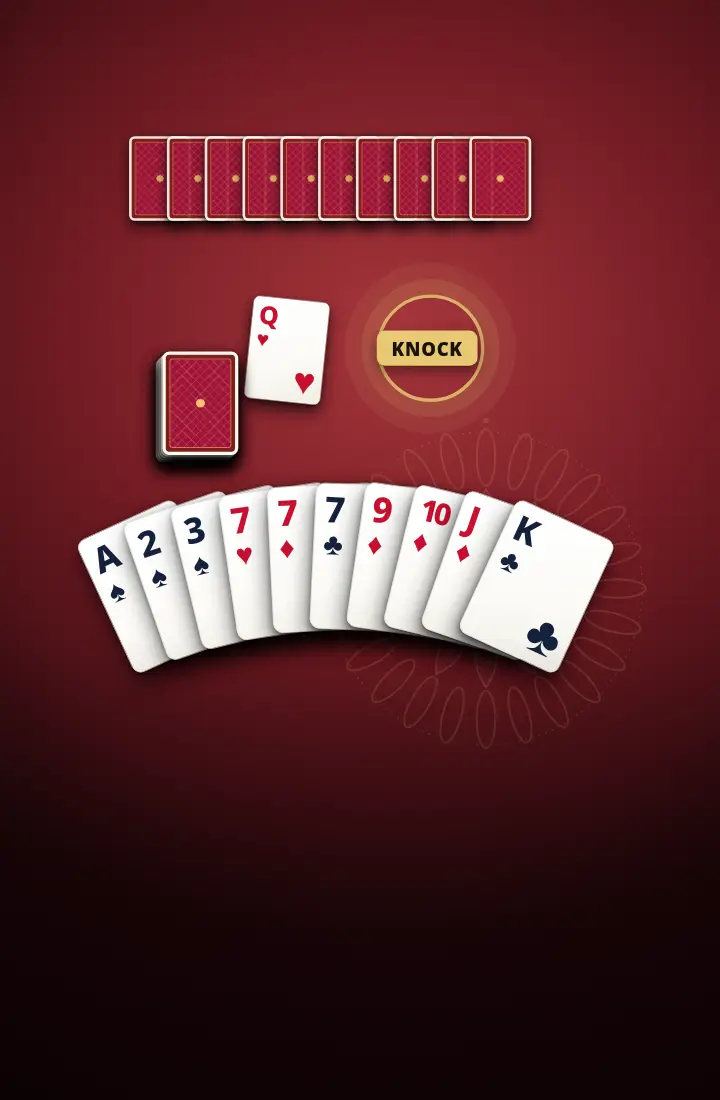
Play Gin Rummy free in your browser, head to head against the computer on Easy, Medium or Hard. It is classic two-player Gin: 10 cards each, knock with 10 or less deadwood, and the first to 100 points wins the match. Points are just a score kept on your phone. Tap the table above to start, or tap हिं to play in Hindi.
Gin Rummy at a glance
- 2 players: you against one computer player. One 52-card deck, no jokers, 10 cards each.
- Melds are runs (3+ in a row of one suit, Ace low) and sets (3 or 4 of a rank). Everything else is deadwood.
- Knock with 10 or less deadwood. Gin (0 deadwood) scores a 25 bonus. An undercut scores a 25 bonus too.
- First to 100 wins the match, then a box bonus of 25 per hand won and a game bonus of 100 are added.
- Free: no money, no sign-up, no download. Points are only a score.
The Gin Rummy rules used in this game
Gin has many scoring versions. This game uses the one with 25-point bonuses described by Wikipedia and Britannica, which the rules used in Gettysburg College’s Gin Rummy AI competition call the most common in North American play. Every line below is enforced by the game and checked by its tests.
Cards and the deal
- One standard 52-card deck, no jokers. Each player gets 10 cards. The deal alternates between you and the computer.
- The next card is turned face up as the upcard. The non-dealer may take it or pass, then the dealer may take it or pass. If both pass, the non-dealer draws from the closed deck and play carries on as normal.
- On each turn you draw one card (from the closed deck or the open pile) and discard one. You can’t throw back the card you just took from the open pile.
Melds and deadwood
- Run: 3 or more cards in a row of one suit. The Ace is low only: A-2-3 is a run, Q-K-A is not.
- Set: 3 or 4 cards of the same rank.
- Deadwood is every card that isn’t in a meld. J, Q and K count 10, Ace 1, and 2 to 10 their face value. The game always counts your best arrangement.
Knock, gin and undercut
- After drawing, you may knock if your deadwood, after your discard, is 10 or less. Your melds are laid out.
- The other player, the defender, then lays off deadwood cards that fit your melds, and lays out their own melds.
- If your deadwood is lower, you score the difference.
- Undercut: if the defender’s deadwood is equal to or lower than yours, the defender scores the difference plus 25. A tie is an undercut.
- Gin: knocking with 0 deadwood. You score 25 plus all the defender’s deadwood, the defender can’t lay off, and a gin can’t be undercut.
- Draw: if only 2 cards are left in the closed deck and nobody has knocked, the hand ends with no score, and the deal passes as usual.
The match
- The first player to reach 100 points ends the match.
- Then each player adds a box bonus (also called a line bonus) of 25 for every hand they won, and the winner adds a game bonus of 100. The bonuses don’t count towards reaching 100.
- The result screen shows both final scores and the winning margin.
Not used in this game
- Big Gin (gin with all 11 cards), shutout doubling (when the loser scored nothing) and Oklahoma Gin (knock limit set by the upcard).
- Other bonus sizes. Pagat gives a gin bonus of 20, an undercut bonus of 10 and a box bonus of 20, and the Gettysburg rules note that 20 and 10 are the UK figures. Wikipedia adds that in early official rules the undercut bonus was 10 and a tie wasn’t an undercut.
Worked examples: knock, undercut and gin
Every deadwood count and lay-off below comes from the game’s own rules code.
Your knock
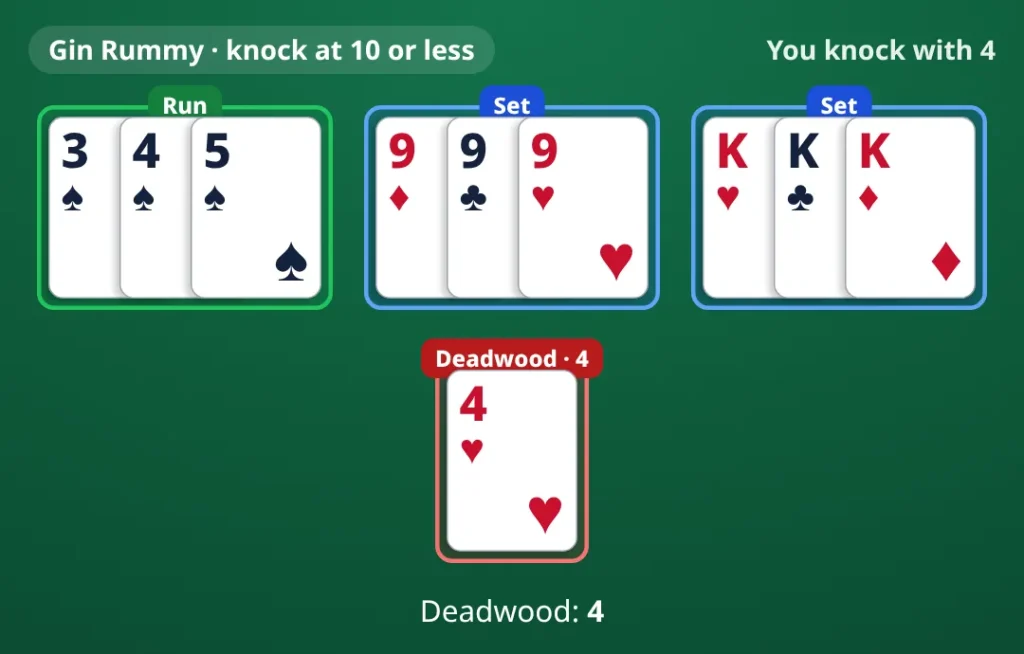
You hold 3♠ 4♠ 5♠ 9♦ 9♣ 9♥ K♥ K♣ K♦ 4♥ after your discard: a run, two sets and the 4♥. You knock with 4 deadwood.
Defender A: you win the hand
Defender A holds Q♠ Q♦ Q♣ 5♥ 6♥ 7♥ 9♠ 2♦ 6♣ J♦. The 9♠ is laid off on your set of 9s. Left over: 2♦ 6♣ J♦ = 18.
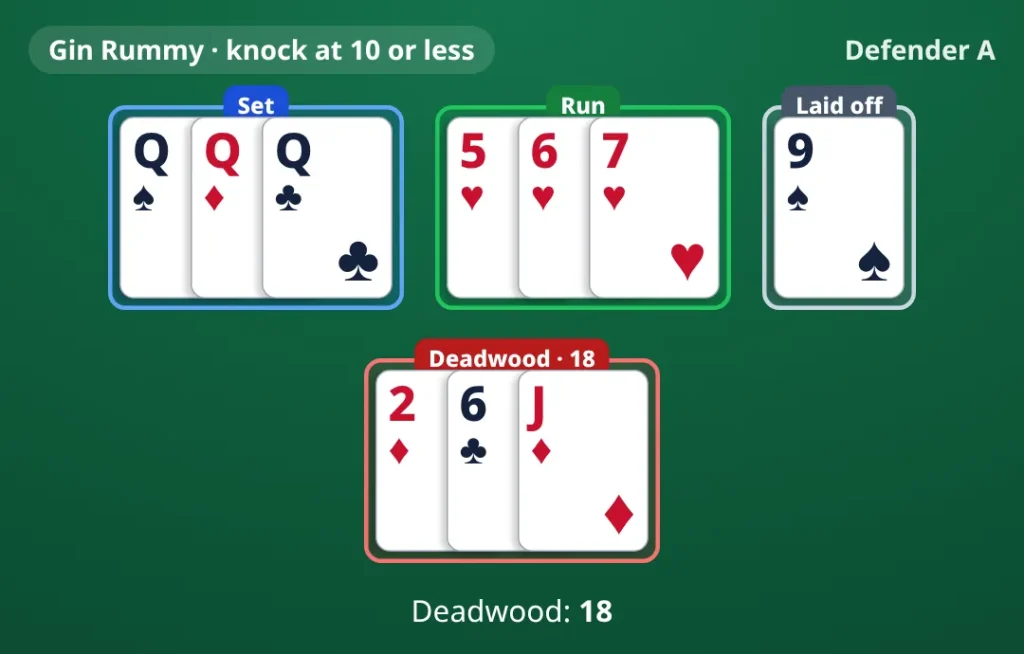
You score 18 − 4 = 14.
Defender B: undercut
Against the same knock, defender B holds Q♠ Q♦ Q♣ 5♥ 6♥ 7♥ 2♠ 6♠ 9♠ A♦. The 2♠ and 6♠ extend your run to 2♠ – 6♠, and the 9♠ joins your 9s. Only the A♦ is left: 1.
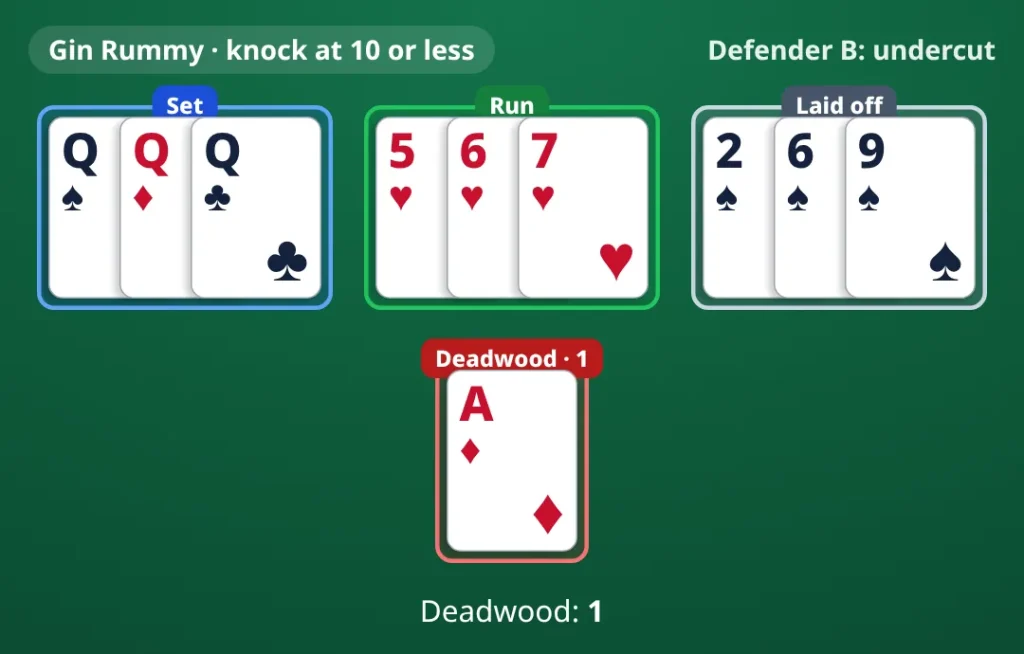
Defender B’s 1 is lower than your 4, so it’s an undercut: B scores 4 − 1 + 25 = 28, and you score nothing.
Gin
Now you hold 3♠ 4♠ 5♠ 6♠ 9♦ 9♣ 9♥ K♥ K♣ K♦ after your discard: no deadwood at all.
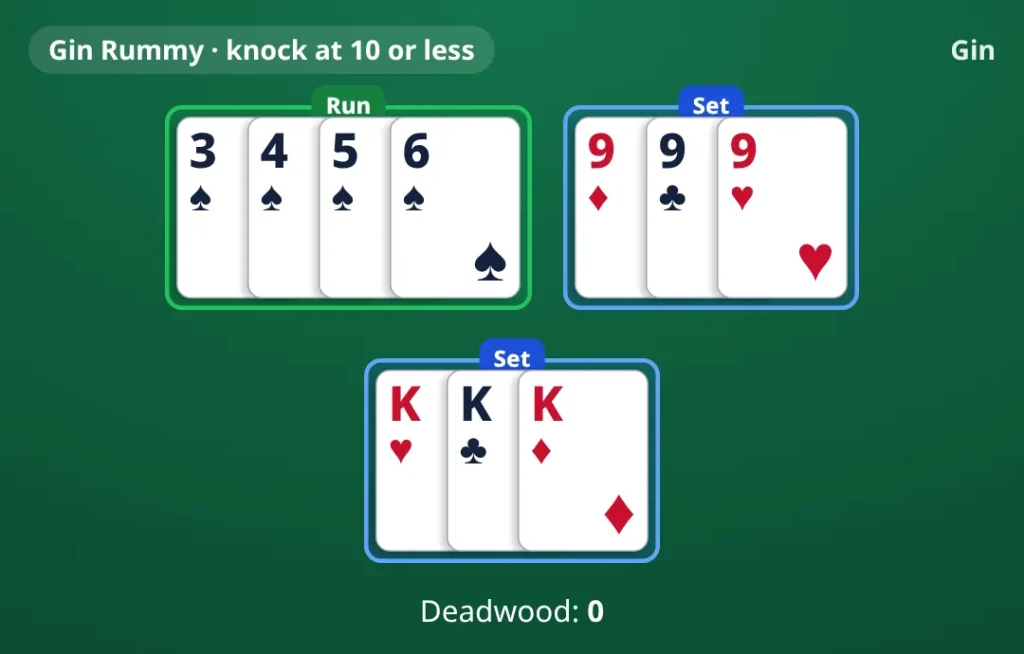
Against a hand of Q♠ Q♦ Q♣ 5♥ 6♥ 7♥ 2♠ 7♠ 9♠ A♦, nothing can be laid off on a gin, so the defender’s deadwood stays 2 + 7 + 9 + 1 = 19. You score 25 + 19 = 44. Laying off would have brought it down to 1.
End of a match
Say you reach 100 first with 108 points from 4 hands won, and the computer has 61 from 3 hands won. Your final score is 108 + 4 × 25 + 100 = 308, the computer’s 61 + 3 × 25 = 136, and you win by 172.
Gin Rummy strategy
1. Knock early with a low count
A knock with 10 or less often wins the hand before your opponent is ready. Waiting for gin can earn the 25 bonus, but every extra turn gives the other player a chance to knock first or to get low enough to undercut you. In our test matches, about 1 knock in 18 was undercut overall, and about 1 in 12 when two strong players met, so a 9 or 10 knock against a player who has been picking up cards is the risky one.
2. Watch out for an undercut late in the hand
The longer the hand goes, the lower the other player’s deadwood is likely to be. Late in a hand, a knock with 8, 9 or 10 is riskier than the same knock early on.
3. Get rid of high deadwood first
A King or Queen that isn’t in a meld costs 10 when the other player knocks. Low cards are cheap to hold and easier to lay off.
4. Think about what you throw
Your opponent picks from the open pile only when a card helps. Note what they take: a 7♥ picked up means 6♥, 8♥ and the other 7s are worth holding back. The History button lists the last 30 moves.
5. Count the closed deck
At 2 cards left the hand is a draw. When the deck is nearly empty and you can’t knock, keep your deadwood low so a late knock against you costs little.
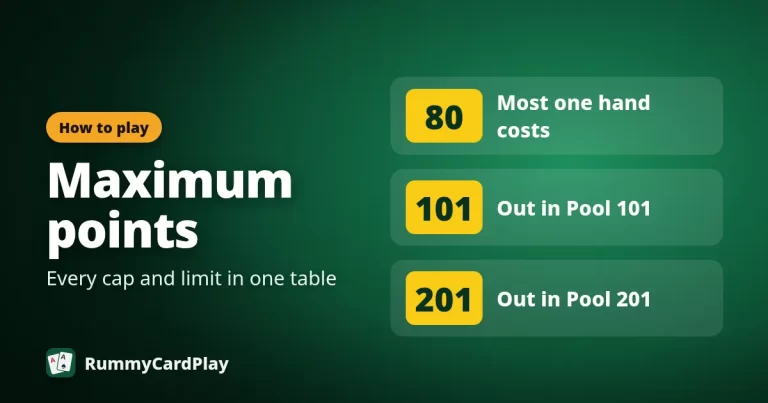
Going deeper: Gin Rummy strategy works through the knock-or-gin decision with real hands. Looking at the other formats? Maximum points in rummy lists the caps and limits of every game here.
Common Gin Rummy mistakes
- Treating Q-K-A as a run. In Gin the Ace is low only.
- Knocking without counting the lay-offs. Cards the defender can add to your melds come off their deadwood, and that can turn your knock into an undercut.
- Forgetting that a tie is an undercut. With equal deadwood, the defender scores 25.
- Holding high cards for too long. Each one costs 10 if the other player knocks.
- Waiting for gin with a knockable hand late in the deck. Knock while you’re ahead.
What players ask about Gin Rummy
Paraphrased from public sources, with links.
- Is a tie an undercut? In an r/cardgames thread the asker couldn’t find the answer on rules sites, and the replies disagreed: one said a tie goes to the defender, another that they had always played it differently. In this game a tie is an undercut, as in Wikipedia’s and Britannica’s rules.
- How big are the bonuses? It depends on whose rules you follow. Pagat uses 20 for gin and 10 for an undercut, and Wikipedia gives 25 for both. This game uses 25 for gin, undercut and each box.
- Can the defender lay off after a gin? No. Wikipedia and Britannica agree, and so does this game: a gin hand can’t have cards laid off on it and can’t be undercut.
- Keeping track of discards. In an r/digitalcards thread about a free rummy game, one commenter asked to see the discard pile instead of remembering it. Here the History button lists the last 30 moves.
Prefer Hindi? Read the Gin Rummy rules in Hindi.
Features of this Gin Rummy game
- Head to head against a computer player on Easy, Medium or Hard.
- Knock and Pass buttons: Knock lights up when your deadwood is 10 or less, and Pass declines the upcard.
- Live deadwood: runs green, sets blue, deadwood red, with a line under your cards showing your lowest possible deadwood.
- Clear results: both hands face up, cards laid off shown in grey, and the score worked out step by step.
- Match scoreboard with points, box bonus, game bonus and the final margin.
- English or Hindi, switchable at any time with हिं / EN.
- Discard history of the last 30 moves.
- Fair play: cryptographic shuffle, a computer player that sees only public cards, both hands revealed after each hand.
- Resume and offline: the match is saved after every move, and the game works offline once added to your Home screen.
- Free: points have no money value. No ₹ deposit, no prize, no ads during a hand.
Our testing
- Rules check: 3,000 complete computer-vs-computer matches (18,364 hands) were checked hand by hand by a separate checker: knocks at 10 or less, deadwood sums, melds, lay-offs, scores for knock, gin and undercut, every card in both hands accounted for, a dead hand only when the stock is down to 2 cards, and the final box and game bonuses. It found 0 violations.
- How hands end: 87.3% of hands ended in a knock that scored, 7.6% in gin, 5.0% in an undercut and 0.07% as a dead hand (13 out of 18,364).
- Difficulty levels: 1,000 complete matches to 100 per pairing, with a random first dealer: Hard beat Medium in 64.4% of matches (±1.5), Hard beat Easy in 95.5% and Medium beat Easy in 93.2%.
- Browser tests check the upcard pass, the Knock and Pass buttons, a knock scored as the difference, an undercut after lay-offs, a gin ending the match with box and game bonuses, the Hindi switch, offline play, and that a reload restores the match.
Gin Rummy FAQ
Is Gin Rummy free here?
Yes. There is no money, no sign-up and no download. Points are a score kept on your own device, and you can’t buy, win or cash out anything.
When can I knock?
After you draw, if your deadwood is 10 or less once you’ve discarded. Select the card to discard and press Knock.
What is gin worth?
25 points plus all your opponent’s deadwood. They can’t lay off cards on your melds, and a gin can’t be undercut.
What is an undercut?
When the defender’s deadwood, after laying off, is equal to or lower than the knocker’s. The defender scores the difference plus 25.
Is the Ace high or low?
Low only. A-2-3 is a run, Q-K-A is not. An Ace counts 1 as deadwood.
How long is a match?
Until one player reaches 100 points. That usually takes 5 to 7 hands. Then the box bonus (25 per hand won) and the game bonus (100) are added.
Can I play with more than two players?
No. Gin Rummy is a two-player game. For 2 to 6 players, try Points Rummy or 21 Card Rummy.
What if I close the browser mid-match?
The match is saved after every move. Open the game again and carry on. Starting a new game ends the old match.
Can I play Gin Rummy in Hindi?
Yes. Tap हिं at the top of the table, and the game remembers your choice.