Play Pool Rummy 201 free in your browser, against 1 to 5 computer players. It is the long version of pool rummy: 13-card Indian Rummy over many hands, where your points add up and a pool score of 201 puts you out. Drops cost a little more than in Pool 101, but you have twice the room, so a pool lasts longer and rewards patience. Tap the table above to start, or tap हिं to play in Hindi.
Pool Rummy 201 at a glance
- 13 cards each from two decks with two printed jokers (106 cards), with a wild joker every hand.
- You against 1 to 5 computer players, on Easy, Medium or Hard.
- Losers add their count to their pool score after each hand. The winner of the hand adds 0.
- Reach 201 or more and you are out. 200 is still in. The last player left wins.
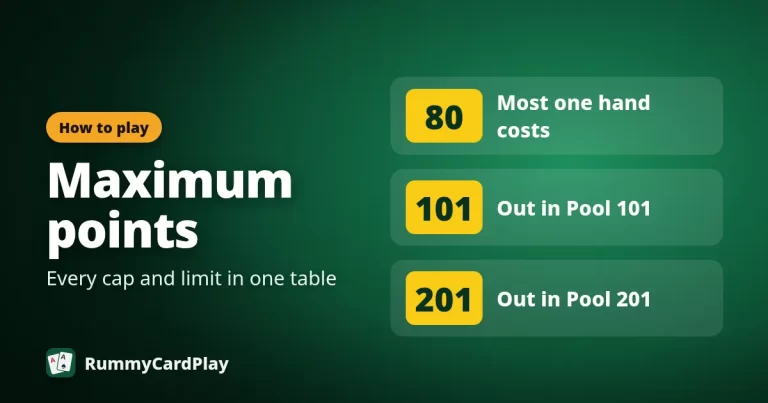
- First drop 25, middle drop 50, wrong declaration 80. No hand costs more than 80.
- No rejoining and no splitting.
- Free: no money, no sign-up, no download. Your pool is saved on your phone.
How to play Pool Rummy 201
Every hand is a normal hand of 13-card Indian Rummy, played exactly as in Points Rummy: draw, discard, and declare with at least two sequences, one of them pure. Losing hands are counted in their best grouping (J, Q, K and Ace 10, number cards face value, jokers 0, at most 80). What changes is the scorekeeping across hands.
Pool score and elimination
- After every hand, each loser’s count is added to their pool score. The winner adds 0.
- At 201 or more you are out. Two players can go out in the same hand.
- The next hand is dealt only to the players still in. When one player is left, the pool is over.
- If you are out and two or more computer players are still in, they finish the pool on their own and the winner screen shows the standings.
Drops cost more in Pool 201
| Pool 101 | Pool 201 | |
|---|---|---|
| Out at | 101 or more | 201 or more |
| First drop | 20 | 25 |
| Middle drop | 40 | 50 |
| Wrong declaration | 80 | 80 |
| Full count (maximum loss) | 80 | 80 |
| First drops affordable from 0 | 5 | 8 |
| Full counts survivable from 0 | 1 | 2 |
The higher drop costs are the standard values for 201 pools, and they make a drop a bigger decision. The higher limit means a single bad hand can’t end your pool early: from 0, you can be caught for a full 80 twice and still be in on 160.
What this version leaves out
There is no rejoin after elimination and no splitting of the pool. Every pool is played until one player is left.
A worked example: a hand at 150
Pool 201 is decided late, when scores are high and the room for mistakes is small. Here is one hand, checked with the game’s rules engine.
A hand at 150
You are on 150 after several hands. 8s are wild. Asha declares while you hold 4♦ 5♦ 6♦ 7♣ 8♠ 9♣ 10♣ 2♠ 3♠ K♠ A♥ K♥ Q♦.
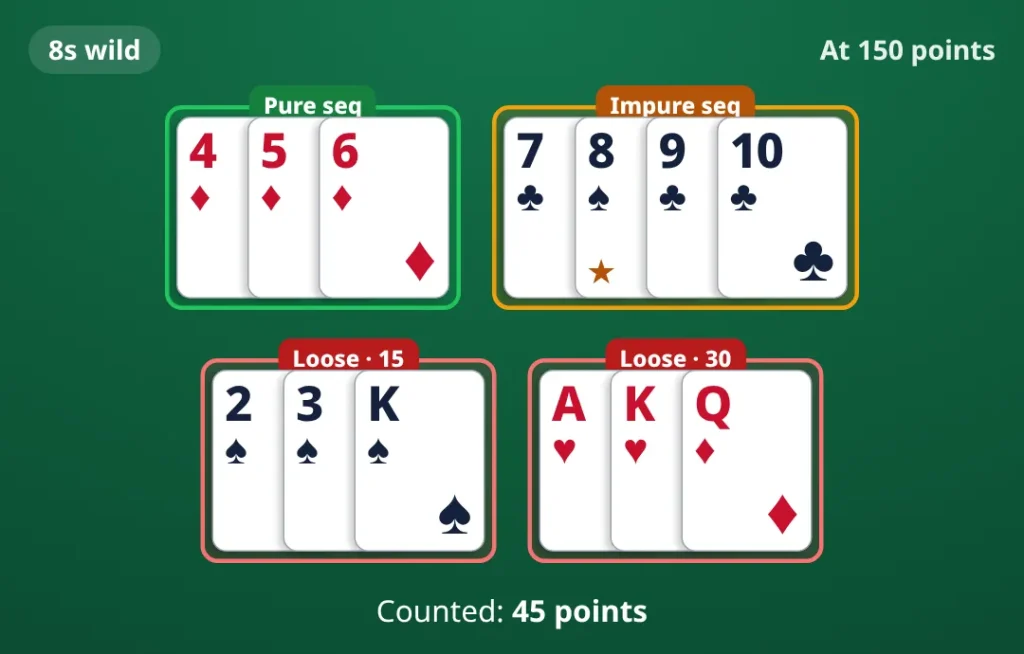
You have a pure sequence (4♦ 5♦ 6♦) and an impure one, with the wild 8♠ standing in for the 8♣ in 7♣ 8♠ 9♣ 10♣. That gives you the two sequences you need, so only the loose cards count: 2 + 3 + 10 + 10 + 10 + 10 = 45. Your pool score goes from 150 to 195.
Compare your other options in this hand:
| Your choice at 150 | New pool score | First drops left after |
|---|---|---|
| First drop at the start | 175 | 1 |
| Middle drop after a few draws | 200 (still in) | 0 |
| Play on and lose with this hand (45) | 195 | 0 |
| Play on and get caught without a pure sequence (80) | 230: out | – |
| Play on and declare | 150 | 2 |
The hand was worth playing: two sequences early meant the worst case was a count in the 40s, and a couple of good draws would have let you declare. Four of the six loose cards are 10-pointers, though. Throwing the K♠ and the K♥ a few turns earlier would have cut the count to 25, leaving you on 175 instead of 195.
Your drop budget in Pool 201
| Your pool score | First drops (25) left | Middle drop (50) still safe? | Full count (80) still safe? |
|---|---|---|---|
| 0 | 8 | Yes | Yes |
| 1 to 25 | 7 | Yes | Yes |
| 26 to 50 | 6 | Yes | Yes |
| 51 to 75 | 5 | Yes | Yes |
| 76 to 100 | 4 | Yes | Yes |
| 101 to 120 | 3 | Yes | Yes |
| 121 to 125 | 3 | Yes | No |
| 126 to 150 | 2 | Yes | No |
| 151 to 175 | 1 | No | No |
| 176 to 200 | 0 | No | No |
Up to 120 points, no single hand can knock you out. That’s a big difference from Pool 101, where the same is only true up to 20. In the game, the result screen shows your drops left after every hand. Opponents within one first drop of 201 (176 or more) are highlighted, and the drop screen warns you before a drop that would put you out.
Pool Rummy 201 strategy
The card play is the same as in Points Rummy and the Pool 101 tips on drop budgets still apply. These points are about what makes 201 different.
1. Early on, play more hands out
From 0 to 120 you can’t be knocked out by one hand, so you can play more hands out than in Pool 101. A hand with a pure sequence or two jokers is worth playing, and so is a one-joker hand at a two-player table. Hands with no pure sequence and no joker are different: in our Points Rummy simulations they averaged −31.7 points with two players and −62 with six when played out, more than even a 25-point drop. Keep the first drop for those, and for one-joker hands at a full table (−30.7). Details are in Drop or play on? and our Pool Rummy strategy guide.
2. Shed high cards as soon as they stop helping
Over 8 or 9 hands, the difference between losing with 25 and losing with 60 adds up to the whole pool. Kings, Queens, Jacks and Aces that aren’t part of a group cost 10 points each every time someone else declares.
3. Middle drops have a narrow window
A middle drop costs 50, which is only 30 less than the worst case. It makes sense when the hand has gone badly, you have no pure sequence, and 50 keeps you in while 80 would not: in other words, between 121 and 150. Lower down, playing on is usually cheaper at a two-player table. At a full table it is not: in our simulations, hands with no pure sequence and no joker after three turns averaged −69.4 when played out with six players, so a 50-point middle drop costs less there too.
4. Above 150, think in drops
From 151 to 175 you have one first drop left. From 176 you have none, and every hand must be played out. Move into that zone as late as you can, and save your last first drop for a truly hopeless hand.
5. Long pools reward watching the table
A 201 pool gives you many hands with the same opponents. Use History to see which cards each player picks up from the open pile. The computer players’ habits don’t change between hands, so it’s worth knowing who keeps what.
6. Read the scoreboard, not just your hand
If an opponent is on 190, they can’t drop and must play out every hand. If you are on 40, you can afford risks they cannot. When two players are left and the gap is large, the leader should play safe and the player behind needs a few big swings.
Going deeper: our Pool Rummy strategy guide covers each stage of a pool, and Pool 101 vs 201 in numbers shows how long pools last. The score at which one hand or one drop puts you out is in maximum points in rummy.
Common Pool 201 mistakes
- Dropping hands that have jokers. Early in a 201 pool, a hand with two jokers, or one joker in a two-player game, did better played out than dropped for 25 in our simulations.
- Treating 50 as cheap. At a two-player table, a middle drop at 50 is mainly worthwhile when it keeps you in and a full count would not. At a full table it also pays on a hand with no pure sequence and no joker a few turns in.
- Holding court cards all game. Ten-point cards cost you in every hand you lose, and 201 pools have many hands.
- Forgetting that 200 is still in. You are out at 201 or more, not at 200.
- Spending the last drop early. From 151, one drop is all you have. Keep it for the worst hand.
- A wrong show late in the pool. It costs 80, the same as being caught without a pure sequence. Check your groups before declaring.
What players ask about Pool 201
Paraphrased from public sources, with links.
- 101 or 201? The r/cardgames thread on rummy variants lists pools of 61, 101 and 201 points. 201 is the long one. In our tests, a two-player 201 pool lasted roughly twice as many hands as a 101 pool (see below).
- What “crossing the limit” means. Wikipedia’s Indian Rummy article describes elimination once a player crosses the preset score. Here the exact rule is: out at 201 or more.
- Keeping track over a long game. One commenter in an r/digitalcards thread about a free rummy game wanted to see the discard pile rather than remember it. Our History button shows the last 30 moves, including every pick-up from the open pile.
Prefer Hindi? Read the Pool Rummy 201 rules in Hindi.
Features of this Pool Rummy 201 game
- Running pool scores out of 201 for you and every opponent, with opponents near the limit highlighted.
- Drops left after every hand, and a red warning on the drop screen when a drop would put you out.
- Elimination animation and winner screen with every player’s final score and the hand they went out in.
- English or Hindi, switchable at any time with हिं / EN.
- Colour-coded groups (pure, impure, set, invalid) and a live status line.
- Discard history of the last 30 moves.
- Fair play: cryptographic shuffle, computer players that see only public cards, every hand revealed at the end.
- Resume and offline: a long pool survives a closed tab, a reload or a lost connection. Add it to your Home screen to play offline.
- Free: no ₹ entry fee, no prize and no ads during a hand.
Our testing
- Rules check, 600 complete pools of computer players (2 to 6 players, mixed levels, 4,993 hands), run on 9 October 2026. Every hand was checked (106 cards accounted for, losing hands re-scored, no count above 80, no joker from the open pile). Every pool was checked too: scores equal to the sum of the hands, elimination exactly at 201, no eliminated player dealt in again, and one winner. 0 rule violations were found.
- Length: a 201 pool averaged 7.0 hands with 2 players, 8.5 with 4 and 8.4 with 6, against 4.1, 5.0 and 5.1 for Pool 101 in the same test. The longest took 20 hands.
- Difficulty levels, from complete two-player pools with seats alternated: Hard beat Medium in 67.3% of 1,000 pools (±1.5), Medium beat Easy in 96.2% of 1,000 (±0.6) and Hard beat Easy in 98.9% of 1,000 (±0.3). Longer pools leave less room for luck, so the gaps are wider than in Pool 101.
- Browser tests check the 0/201 score bar, the 25-point first drop and 50-point middle drop, the drops-left line, and that a reload in the middle of a pool restores it exactly.
Pool Rummy 201 FAQ
Is Pool Rummy 201 free here?
Yes. No entry fee, no deposit, no prize. The pool score is only a score kept on your device.
At what score am I out in Pool 201?
At 201 or more. 200 is still in.
Why is the drop 25 and 50 instead of 20 and 40?
Those are the usual values for 201 pools. With twice the room, a drop has to cost a little more to stay a real decision.
How many first drops do I get?
Eight from a score of 0 (8 × 25 = 200). The result screen counts down the drops you can still afford.
What is the most I can lose in one hand?
80: a full count or a wrong declaration. From 120 or below, no single hand can put you out.
Can I rejoin or split the pool?
No. Here every pool is played until one player is left.
How long does a 201 pool take?
In our tests, about 7.0 hands with 2 players and 8.4 with 6 players on average.
What happens if I’m eliminated?
The remaining computer players finish the pool on their own, instantly, and the winner screen shows the final standings.
Should I play Pool 101 or Pool 201?
Pool 101 is quicker and punishes a single bad hand. Pool 201 is longer and rewards steady play over many hands. If you are new to pool rummy, start with Pool 101.
Does closing the browser end my pool?
No. The pool is saved after every move, so you can carry on later. Only starting a new game ends it.