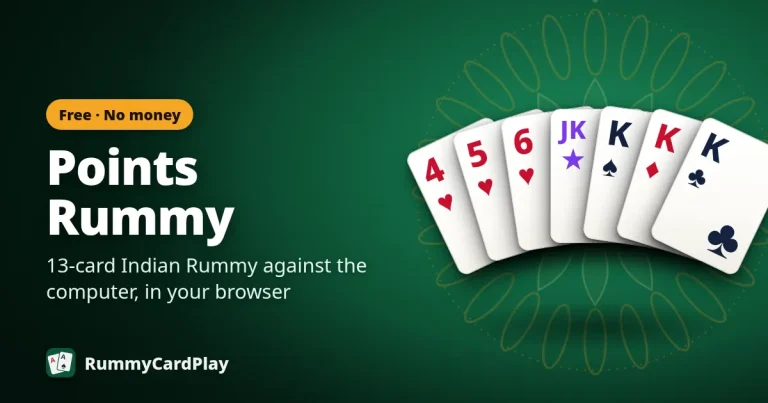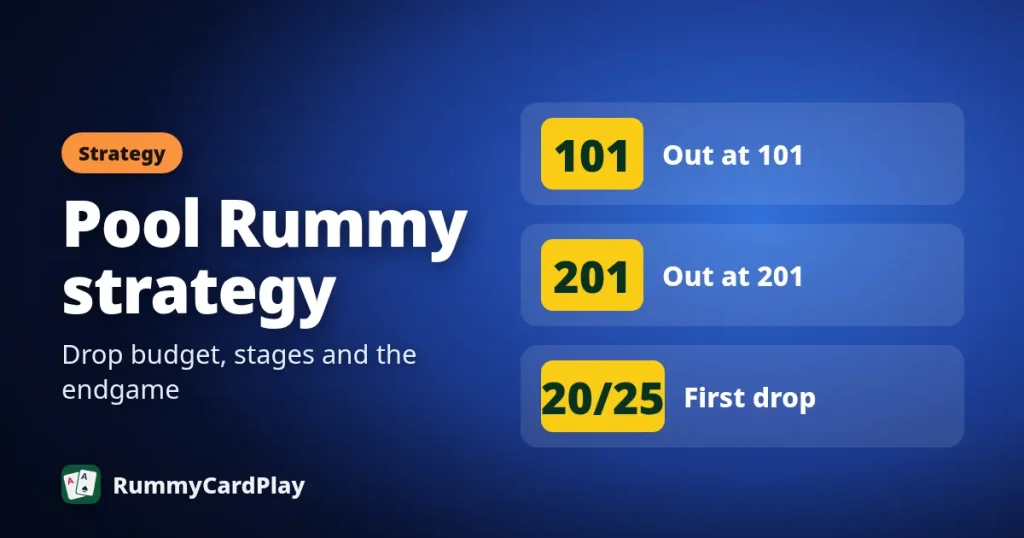
Pool Rummy is 13-card Indian Rummy played over many hands. Your points add up, and when your total reaches the limit (101 or 201) you are out. The last player left wins. That one change turns every decision into a question of budget: how many points can you still afford to lose? This guide covers strategy for each stage of a pool, the difference between 101 and 201, and a real decision near the limit, checked by our rules engine. The rules themselves, including a drop-budget table for every score, are on our Pool Rummy 101 and Pool Rummy 201 pages.
How long a pool lasts
We played complete pools between our strongest computer players, with the games’ normal rules (drops allowed):
| Pool | Players | Pools played | Median hands per pool | First player out, median hand |
|---|---|---|---|---|
| 101 | 2 | 2,000 | 4 | 4 |
| 201 | 2 | 2,000 | 9 | 9 |
| 101 | 6 | 600 | 5 | 2 |
| 201 | 6 | 600 | 8 | 4 |
In other words, a 101 pool is short: one full count of 80 takes you most of the way out. A 201 pool gives you room to recover from one or two bad hands. More detail is in our study Pool Rummy 101 vs 201 in numbers.
Your drop budget
Before each hand, work out how many first drops you can still afford without reaching the limit. In 101 Pool a first drop costs 20, so at a score of 0 you can take 5 and stay on 100. At 61 you can afford only one (61 + 20 = 81; a second would take you to 101 and out). In 201 Pool the first drop is 25: at 0 you can take 8 (200), at 151 only one (176).
Two rules of thumb follow:
- Spend drops early, on truly bad hands. A drop at a score of 0 to 40 costs you little of the pool. A full count of 80 costs you most of it.
- Keep at least one drop in reserve for as long as you can. Players with no drops left must play every hand out, and everyone at the table knows it.
The rummy points calculator shows each player’s drops left on the score sheet as you play.
Early, middle and late pool
Early (scores well below the limit). Play as in Points Rummy, but drop slightly more often: a 20-point first drop on a hopeless hand protects the budget you will need later. Our when to drop checklist applies unchanged.
Middle (one or two drops left). The cost of a full count is now elimination or close to it. Prioritise the pure sequence even more than usual, and count your hand before every discard. If someone looks close (they have stopped picking from the open pile), a middle drop at 40 can be cheaper than the risk.
Late (no drops left, or you are the last two). You must play every hand. Aim to get your count low rather than to win: a hand that loses with 15 points keeps you alive; one that loses with 80 does not. Throw high cards early and keep low cards that might group.
When an opponent is near the limit, they cannot afford to drop or to be caught. They usually play more cautiously, so their early discards tell you less (see reading discards), and they may hold on to low cards rather than chase a win.
A decision near the limit (101 Pool, Queens wild)
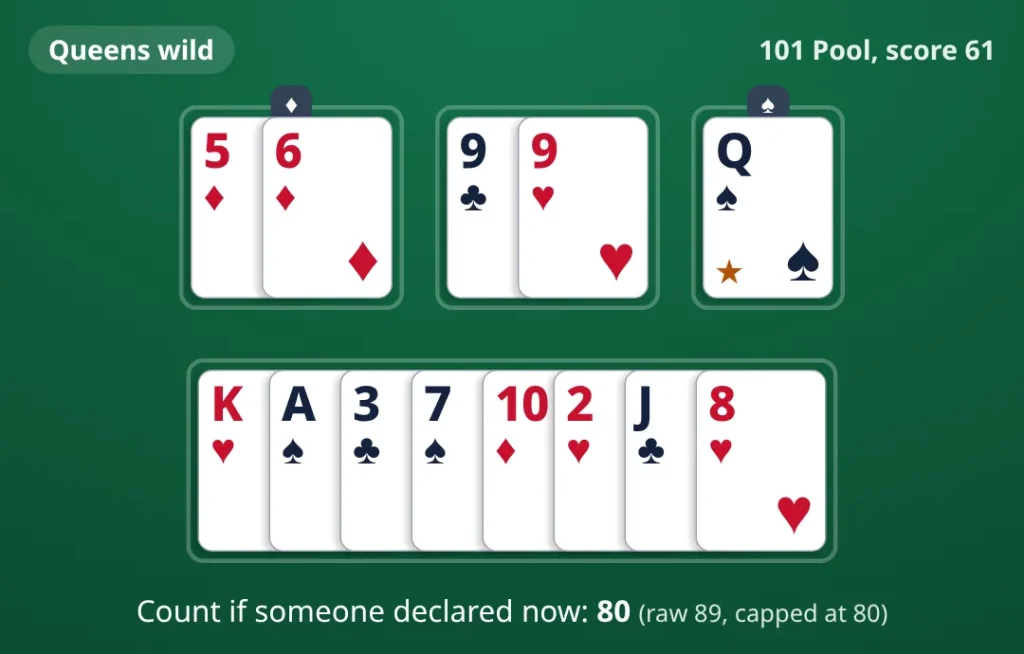
5♦ 6♦ · 9♣ 9♥ · Q♠ · K♥ A♠ 3♣ 7♠ 10♦ 2♥ J♣ 8♥
Your score is 61. You are dealt this hand: no pure sequence, one connected pair (5♦ 6♦, completed by 4♦ or 7♦), a pair of 9s and one joker (the Q♠). The engine counts it at 80 (89 raw) if someone declared now.
- First drop: you go to 81 and stay in, but with no drops left for the rest of the pool.
- Play on: if someone declares before you fix this hand, 61 + 80 = 141 and you are out.
This is the hard case. The hand has one 4-card pure-sequence chance plus a joker that can turn the 9s into a set or the J♣ into a run, so it is not hopeless. But it needs at least two good draws before it counts less than 40. At a two-player table, where hands last longer, playing on is reasonable. Our simulations agree: in Points Rummy, one-joker hands with no pure sequence averaged −6.1 with two players but −30.7 with six (drop or play on?). At a full table, where somebody often declares within a few rounds, the first drop that keeps you in the pool is usually the safer choice.
If you do play on, the plan is clear: chase the diamond run first, throw K♥, A♠ and 10♦ (lonely tens) in your first three turns, and be ready to middle-drop on your next turn if the run has not come and the open pile shows another player collecting.
Pool 101 vs Pool 201
| Pool 101 | Pool 201 | |
|---|---|---|
| Out at | 101 | 201 |
| First / middle drop | 20 / 40 | 25 / 50 |
| Full counts before you are out (from 0) | 1 (80), and a second takes you out | 2 (160), and a third takes you out |
| Style | Short and tense: every hand matters | Longer: more room to recover |
In 201, the drops are dearer but the budget is more than twice as large, so it pays to play on with borderline hands a little more often than in 101.
FAQ
How many drops do I get in 101 Pool Rummy?
As many as your score allows. Each first drop costs 20, and you are out at 101, so at 0 you can take five first drops (100). The drop-budget table on our Pool Rummy 101 page shows the number for every score.
Should I drop more in Pool Rummy than in Points Rummy?
Early in a pool, slightly more: a 20-point drop protects your budget. Late in a pool, when you have no drops left, you have no choice and must play every hand.
What is the best strategy when I am close to being out?
Keep your count low rather than chasing a win. Throw high cards early, keep low cards and jokers, and only declare when you are sure the show is valid; a wrong show costs 80.
Is Pool 201 easier than Pool 101?
Not easier, but more forgiving. Drops cost more (25 and 50), yet you can absorb two full counts before going out, so one bad hand rarely decides a 201 pool. In 101 a single full count uses up most of your budget.