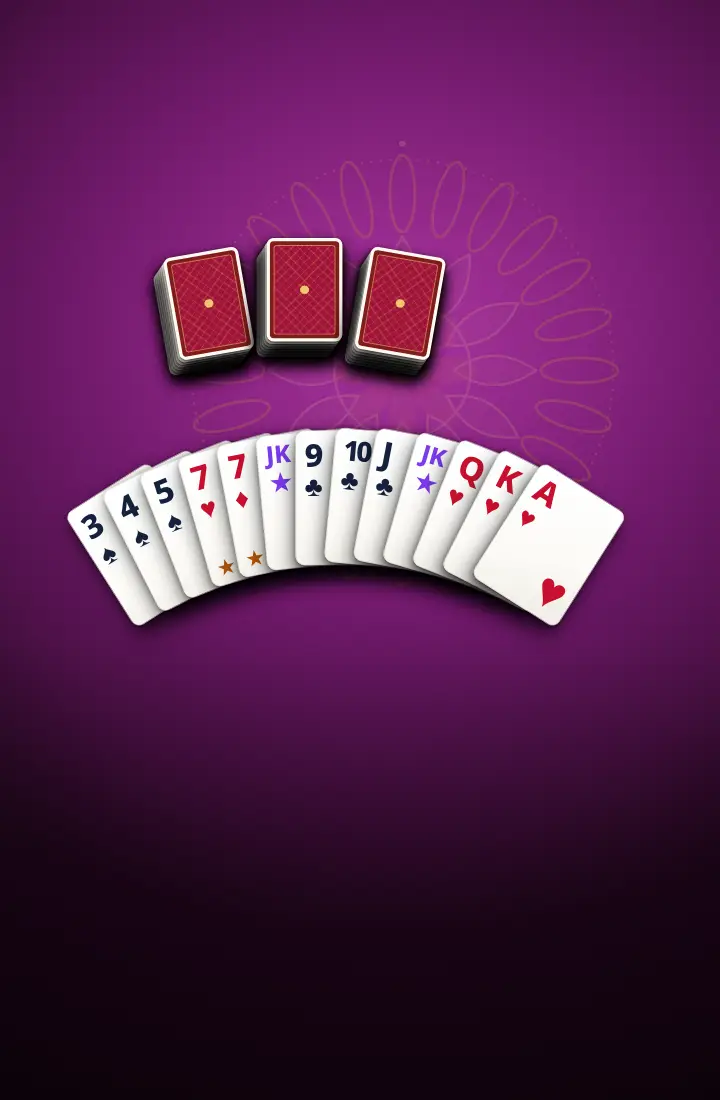
Play 21 Card Rummy free in your browser, against 1 to 5 computer players. It is the bigger Indian Rummy: three decks, 21 cards each, three pure sequences to declare, upper and lower jokers, and value cards that can pay you even in a hand you lose. Points are just a score kept on your phone. Tap the table above to start, or tap हिं to play in Hindi.
21 Card Rummy at a glance
- 21 cards each from three decks with 3 printed jokers (159 cards). You against 1 to 5 computer players, on Easy, Medium or Hard.
- The cut card sets the wild joker. In the cut card’s suit, the cards one rank above and below it (the upper and lower jokers) are wild too.
- To declare you need 3 pure sequences with every other card in a valid group, or 3 Tunnelas, 8 Dublees or 8 jokers.
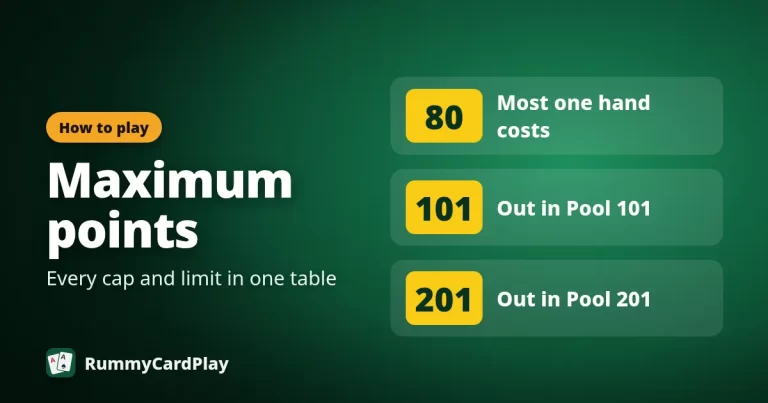
- Losers count their cards, at most 120. First drop 30, middle drop 70, wrong declaration 120.
- Value cards (and the marriage, worth 100) are settled between the players still in the hand, on top of the points.
- Free: no money, no sign-up, no download. Points are only a score.
The 21 Card rules used in this game
21 Card Rummy is played with many house rules in India, so here is exactly what this game does. Each line below is enforced by the game’s rules engine and checked by its tests.
Cards, deal and jokers
- 2 to 6 players. Three standard decks plus 3 printed jokers: 159 cards. Everyone gets 21 cards, one card is turned face up as the cut card, and the next card starts the open pile.
- The cut card is out of play. Every card of its rank is wild, and so are the printed jokers.
- Upper and lower joker: the cards one rank above and one rank below the cut card, in its suit, are wild as well. With the cut card 7♥, all 7s, 8♥ and 6♥ are wild. The Ace sits next to both the King and the 2 here, so with the cut card K♠ the upper joker is A♠.
- If a printed joker is cut, Aces are wild and there are no upper or lower jokers and no value cards that hand.
- Jokers can’t be picked up from the open pile.
Groups
- Sequence: 3 or more cards in a row of one suit. Ace goes low (A-2-3) or high (Q-K-A), not K-A-2. A pure sequence has no joker standing in for a missing card. A wild card in its own place keeps a sequence pure, so 6♥ 7♥ 8♥ is pure.
- Set: 3 or 4 cards of one rank, all in different suits.
- Tunnela: three identical cards, such as 5♣ 5♣ 5♣. A Tunnela counts as a pure sequence.
- Dublee: two identical cards. Dublees only matter for the 8-Dublee declaration.
A valid declaration
You draw, then declare with your 22nd card as the discard, showing your 21 cards in groups. One of these must hold:
- 3 pure sequences (Tunnelas count), and every other card in a valid sequence, set or Tunnela; or
- 3 Tunnelas; or
- 8 Dublees; or
- 8 jokers in one group.
With routes 2 to 4 the other cards do not need to be arranged. Anything else is a wrong declaration and costs 120.
Counting a losing hand
- A, K, Q, J and 10 count 10; 2 to 9 count their face value; jokers count 0.
- With 3 pure sequences, only the cards outside valid groups count (cards in Dublees count too). Without them, every card counts.
- A count is capped at 120. The game always counts your best arrangement, not the one on screen.
- First drop (before your first draw) 30; middle drop 70; wrong declaration 120.
Value cards and the marriage
In the cut card’s suit, three kinds of card are value cards: other copies of the cut card, the upper joker and the lower joker. They are worth points just for being in your hand:
| Held | Value |
|---|---|
| One kind: 1 card, 2 cards, 3 cards | 10, 30, 50 |
| One of each kind (a marriage) | 100 |
| Two marriages, three marriages | 300, 500 |
At the end of the hand, every player still in it (the winner and everyone who played on to lose) collects the difference between their value and each other such player’s value. Players who dropped or made a wrong show are left out of this settlement: they neither pay nor collect. The value points go into the running totals with the hand points, so every hand’s changes add up to zero.
Points and the running total
There is no target and no elimination. The winner of a hand collects every loser’s count. Each loser’s count is taken off their own running total, which can go below zero.
Where other tables differ
Pagat notes that some groups play 21-card Rummy as a relative of the Nepali game Marriage, and house rules vary. In Marriage the joker is not shown at the start: a player first lays down three pure combinations and only then looks at it. Wikipedia’s Indian Marriage article) describes a hidden joker too, with much smaller values (4 for the joker card, 2 each for the cards beside it, 14 for a marriage) traded between every pair of players, as here. This game uses the face-up cut card of 13-card Indian Rummy and bigger values, so the value cards matter next to a 120-point count.
A worked example: one hand, three players
You, Asha and Ravi play. The cut card is 7♥, so all 7s, 8♥ (the upper joker) and 6♥ (the lower joker) are wild. Every count below comes from the game’s own rules engine, and the cards were checked to be a legal deal from three decks.
Your hand
You declare with A♠ 2♠ 3♠ 9♦ 10♦ J♦ 4♣ 5♣ 6♣ 10♣ J♣ 8♥ K♠ K♦ K♣ 5♠ 5♦ 5♥ 2♥ 3♥ 7♠.
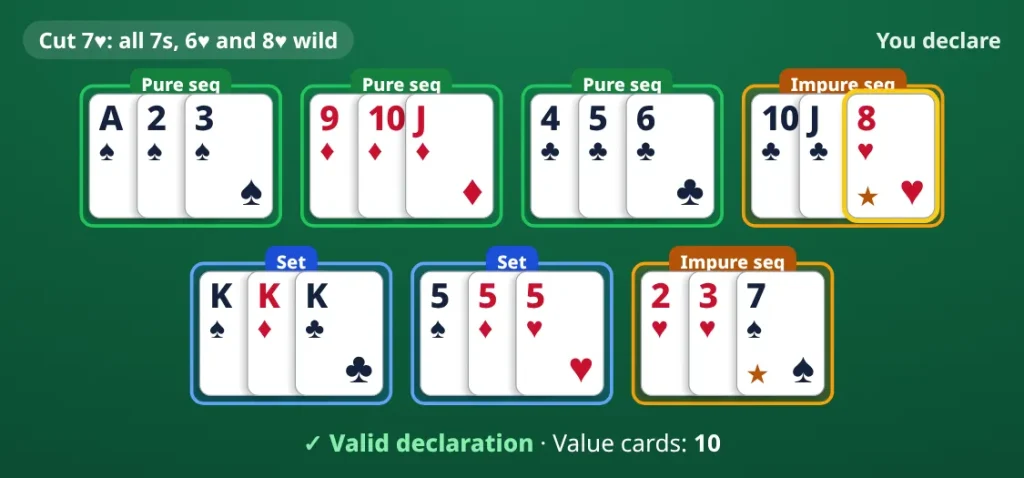
Three pure sequences (A♠ 2♠ 3♠, 9♦ 10♦ J♦, 4♣ 5♣ 6♣), two impure ones using wild cards (8♥ stands in for Q♣, 7♠ for 4♥) and two sets. That is a valid declaration. Your 8♥ is an upper joker, so you hold 10 in value cards.
Asha
Asha is caught with 6♥ 7♥ 8♥ 9♣ 10♣ J♣ K♦ K♥ K♣ Q♥ Q♦ 4♠ 5♠ A♣ 2♣ 3♦ 9♠ 8♠ 10♥ J♠ 4♦.
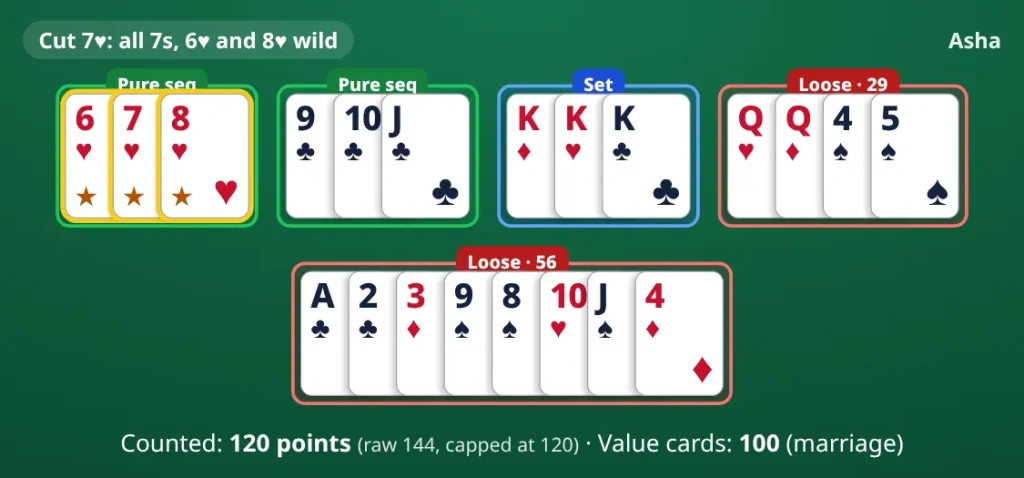
She has only two pure sequences, so every card counts: 144, capped at 120. But 6♥ 7♥ 8♥ is a marriage: lower joker, a copy of the cut card and upper joker together, worth 100 in value cards.
Ravi
Ravi is caught with A♥ 2♥ 3♥ 5♦ 6♦ 7♦ J♥ Q♥ K♥ 9♥ 9♠ 9♦ K♣ Q♣ 4♠ 2♦ 3♣ 8♣ 10♠ 6♠ 5♣.
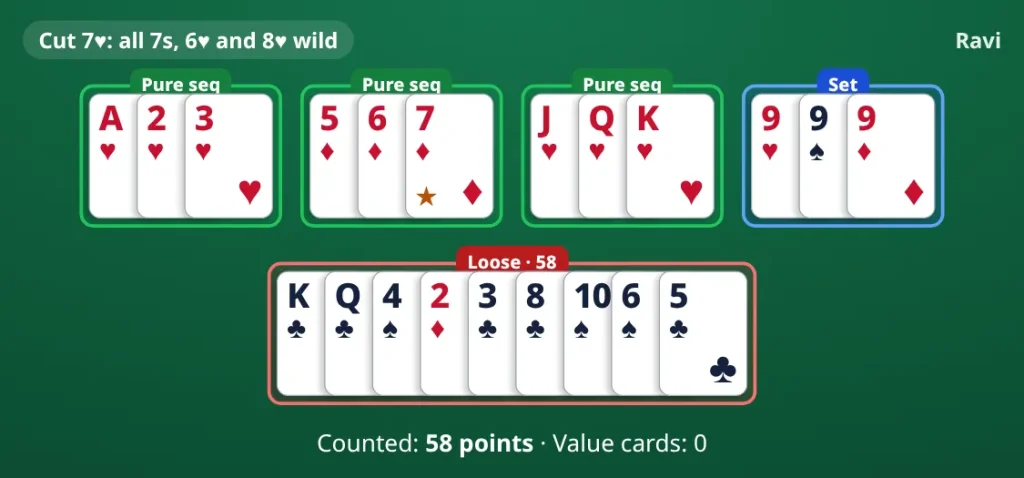
He has three pure sequences (the 7♦ is in its own place in 5♦ 6♦ 7♦) and a set of 9s, so only his nine loose cards count: 58. He holds no value cards.
Settling the hand
You collect 120 + 58 = 178 points. Then the value cards are settled between all three of you, because nobody dropped:
| Player | Points | Value | Value settlement | Change |
|---|---|---|---|---|
| You | +178 | 10 | (10 − 100) + (10 − 0) = −80 | +98 |
| Asha | −120 | 100 | (100 − 10) + (100 − 0) = +190 | +70 |
| Ravi | −58 | 0 | (0 − 10) + (0 − 100) = −110 | −168 |
The changes add up to zero. Asha lost the hand with the maximum count and still gained 70 points, because her marriage paid 90 from you and 100 from Ravi.
21 Card Rummy strategy
1. Three pure sequences come first
Until you have three pure sequences, every card in your hand counts. Counted in full, a starting hand of 21 cards averages 132.6, and 76.9% of starting hands are over the 120 cap (50,000 simulated deals). Build pure sequences before you collect sets, and remember that a Tunnela counts as one.
2. Expect several jokers
With three wild kinds of card per hand, your 21 cards hold 2.65 jokers on average, and just over half of all hands (51.4%) start with three or more (200,000 simulated deals with the game’s own deck). Plan on using jokers for impure sequences and sets, and keep your natural cards for the pure ones.
3. Count your value cards before you drop
A drop takes you out of the value settlement, so you neither pay nor collect. 67.8% of starting hands hold at least one value card, and 2.65% hold a complete marriage. If you hold value cards, staying in can pay even with a weak hand. If you hold none, a first drop for 30 also saves you from paying out on everyone else’s value cards.
4. Keep an eye on Dublees
Three decks mean identical pairs are common. Eight Dublees, or three Tunnelas, is a valid declaration that doesn’t need the other cards arranged. A hand with five or six Dublees early on is worth steering that way.
5. Discard high cards that aren’t working
The cap is 120, not 80. A King you hold for a sequence that never comes costs 10, and in a long hand those costs pile up. Throw high cards early unless they are already part of a group or a sequence you are close to finishing.
6. Read the open pile
With 159 cards and up to six players, the open pile moves fast. The History button lists the last 30 moves, so you can see what others have picked up and avoid feeding the sequences they are building.
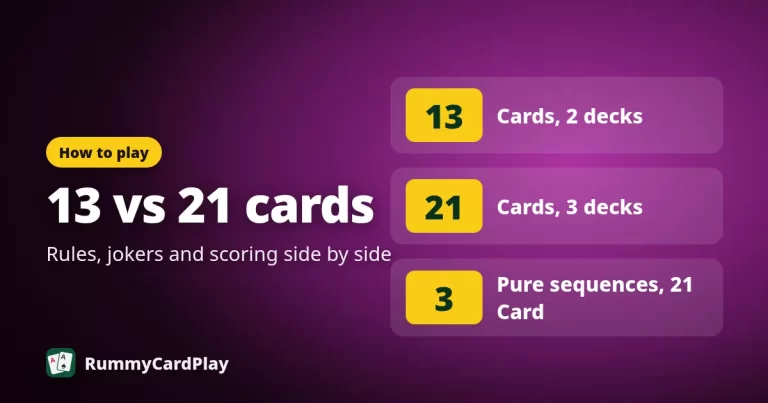
Going deeper: 21 Card Rummy tips walks through an opening hand and a full value-card settlement. Not sure which game to learn? 13 card vs 21 card rummy compares them side by side.
Common 21 Card Rummy mistakes
- Declaring with two pure sequences. You need three (or a Tunnela in place of one). A wrong show costs 120.
- Forgetting the upper and lower jokers. With the cut card 7♥, 8♥ and 6♥ are jokers too. They are easy to throw away by mistake.
- Putting identical cards in a set. A set needs different suits. 5♣ 5♣ 5♦ is not a set; 5♣ 5♣ 5♣ is a Tunnela.
- Dropping with a marriage in your hand. A drop gives up your value cards. A marriage is worth 100 from each player still in.
- Counting a wild card in its own place as a joker. 6♥ 7♥ 8♥ is a pure sequence, not an impure one.
What players ask about 21 Card Rummy
Paraphrased from public sources, with links.
- Is it the same as Marriage? Close relatives. Pagat calls 21-card Rummy a relative of Marriage, the three-deck, 21-card game from Nepal, and Wikipedia) lists “21-cards rummy” and “marriage rummy” as other names for a game played in India and Nepal. The biggest difference here is that the cut card is face up from the start.
- Why don’t the value cards match how my family plays? Values differ a lot from table to table. Wikipedia’s version scores a marriage as 14; this game scores it as 100, and explains every number on this page so you can compare.
- Upper joker, lower joker, Tiplu, Paplu? The names vary too. Pagat uses tiplu (the cut card’s own card), poplu (one above) and jhiplu (one below). This game shows them as “upper joker” and “lower joker”, and the glossary lists the other names.
- Keeping track of discards. In an r/digitalcards thread about a free rummy game, one commenter asked to see the discard pile instead of remembering it. Here the History button lists the last 30 moves.
Prefer Hindi? Read the 21 Card Rummy rules in Hindi.
Features of this 21 Card Rummy game
- 2 to 6 players: you against 1 to 5 computer players on Easy, Medium or Hard.
- The wild cards on screen: the top bar shows the cut card and its upper and lower jokers, and every joker in your hand carries a ★.
- Colour-coded groups: pure sequences and Tunnelas green, impure sequences amber, sets blue, Dublees purple, invalid groups red, with a live line showing your pure sequences, count and value cards.
- A clear result screen: every hand is shown face up, with each player’s count, value cards and the value settlement.
- English or Hindi, switchable at any time with हिं / EN.
- Discard history of the last 30 moves.
- Fair play: cryptographic shuffle, computer players that see only public cards, every hand revealed after each deal.
- Resume and offline: the hand is saved after every move, and the game works offline once added to your Home screen.
- Free: points have no money value. No ₹ deposit, no prize, no ads during a hand.
Our testing
- Rules check: a separate checker followed 300 complete hands with 3 to 6 computer players on mixed levels. It checked that all 159 cards were accounted for, re-counted every loser from their cards with the 120 cap, re-checked the winner’s declaration, confirmed no joker was taken from the open pile, and checked that value settlements and running totals add up to zero. It found 0 violations. The 2,400 duel hands below also had every count and declaration re-checked, with 0 errors.
- Deal statistics: 200,000 simulated three-player deals with the game’s own deck and shuffle: 2.65 jokers per 21-card hand on average, 51.4% of hands with three or more, 67.8% with at least one value card, 2.65% with a marriage, and a printed joker cut in 1.90% of deals.
- Difficulty levels: 800 one-on-one hands per pairing, with seats alternated. Hard won 54.5% of hands against Medium (+6.0 points per hand, ±6.4), so the two are close. Hard won 73.5% against Easy (+36.7 ±6.3), and Medium won 67.3% against Easy (+25.0 ±7.0). The ± figures are 95% ranges.
- Browser tests check the deal (21 cards each, 159 cards in all), the wild-card line, a first drop of 30, a running total going below zero, valid declarations by three pure sequences and by three Tunnelas, the value settlement of a marriage, a wrong show of 120, the Hindi switch, and that a reload restores the hand.
21 Card Rummy FAQ
Is 21 Card Rummy free here?
Yes. There is no money, no sign-up and no download. Points are a score kept on your own device, and you can’t buy, win or cash out anything.
How many pure sequences do I need?
Three, with every other card in a valid group. A Tunnela counts as a pure sequence. You can also declare with 3 Tunnelas, 8 Dublees or 8 jokers in one group.
What are the upper and lower jokers?
The cards one rank above and one rank below the cut card, in the cut card’s suit. With the cut card 7♥ they are 8♥ and 6♥. They are wild, like every 7 and the printed jokers.
What is a marriage worth?
100 points from each other player still in the hand at the end (minus whatever value cards they hold). A marriage is one copy of the cut card, one upper joker and one lower joker, in the cut card’s suit.
Do I get value points if I lose the hand?
Yes, as long as you played the hand out. Value cards are settled between the winner and every player who played on to the end. Players who dropped or made a wrong show are left out.
What is the most I can lose in a hand?
Your count is capped at 120, and a wrong show costs 120. On top of that you may pay out on other players’ value cards, which is why a drop can make sense with a poor hand and no value cards.
Can my running total go below zero?
Yes. Each loser’s count is taken off their own total, so a few bad hands put you below zero. It’s only a score that shows how you are doing.
Why are there 159 cards?
Three standard 52-card decks (156 cards) plus one printed joker per deck.
What if I close the browser mid-hand?
The hand is saved after every move. Open the game again and carry on. Starting a new game ends the old one.
Can I play 21 Card Rummy in Hindi?
Yes. Tap हिं at the top of the table, and the game remembers your choice.