21 Card Rummy asks more of you than the 13-card game: three pure sequences instead of one, a 120-point cap, upper and lower jokers, and value cards that are settled even when you lose. This guide is a planning companion to the rules on our 21 Card Rummy page. It shows how to read a 21-card opening hand, how the value-card settlement changes the drop decision, and the alternative routes to a declaration. Both example hands were checked by the rules engine that runs our free 21 Card game.
Reading a 21-card opening hand
Sorting 21 cards on a phone takes longer, so use a fixed order:
- Find every wild card. With the cut card 7♥: all 7s, plus the upper joker 8♥ and the lower joker 6♥. Printed jokers too.
- Look for wild cards in their natural place. A 7♣ next to 8♣ 9♣ is a pure sequence, because the 7♣ is used as itself. In 21 Card this happens often, because there are so many wild cards.
- Count pure sequences and pure-sequence chances. You need three. A Tunnela (three identical cards) counts as one.
- Count your value cards (copies of the cut card and the upper and lower jokers, in the cut suit). They decide whether a drop is ever right.
An opening hand (cut card 7♥)
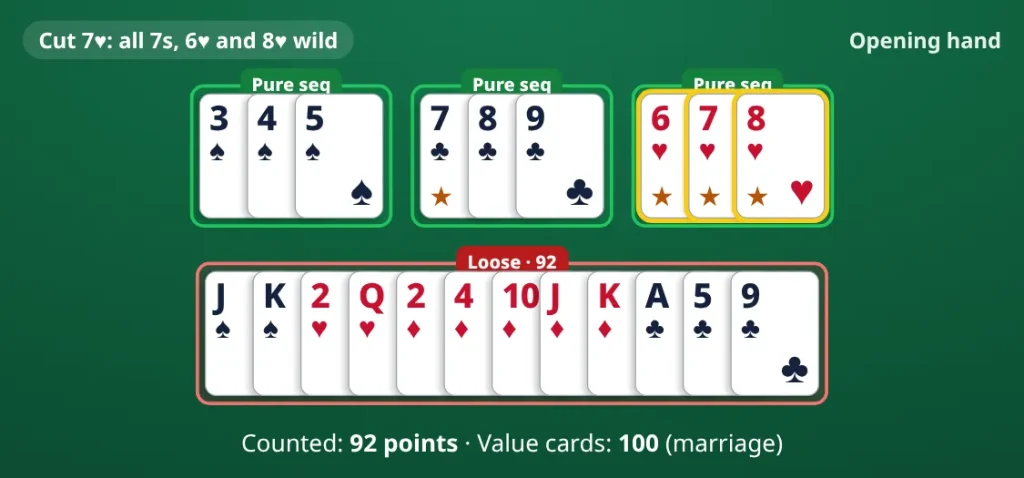
3♠ 4♠ 5♠ · 7♣ 8♣ 9♣ · 6♥ 7♥ 8♥ · J♠ K♠ 2♥ Q♥ 2♦ 4♦ 10♦ J♦ K♦ A♣ 5♣ 9♣
A lucky deal, and a useful one to study:
- Three pure sequences at once. 3♠ 4♠ 5♠ is plain. 7♣ 8♣ 9♣ is pure because the 7♣ sits in its natural place. 6♥ 7♥ 8♥ is pure for the same reason, even though all three cards are jokers this hand.
- A marriage. 6♥, 7♥ and 8♥ are the lower joker, a copy of the cut card and the upper joker: one of each kind, worth 100 in value points.
- The count is still high. With three pure sequences only the loose cards count, but there are twelve of them: the engine says 92. The next job is to group them: K♠ K♦ needs one more King or a joker, 10♦ J♦ needs 9♦ or Q♦, and 2♥ 2♦ needs a third 2.
Notice the trade-off: the hearts run uses your three value cards as natural cards, so you keep both the pure sequence and the marriage. Breaking it up to use the 7♥ and 8♥ as jokers elsewhere would cost a pure sequence.
Value cards and the drop
Value points are settled at the end of every hand between all players still in the hand: the winner and everyone who played on to lose. Players who dropped or made a wrong show are left out. Each pair of players settles the difference between their values.
A worked example with three players who all play the hand out: you hold a marriage (100), Asha holds one value card (10), Ravi holds none (0).
| Player | Value | Settles with the others | Net value points |
|---|---|---|---|
| You | 100 | +90 from Asha, +100 from Ravi | +190 |
| Asha | 10 | −90 to you, +10 from Ravi | −80 |
| Ravi | 0 | −100 to you, −10 to Asha | −110 |
The net values always add up to zero. Now suppose you had taken a first drop (30): you pay 30, and you are out of the settlement, so your +190 is gone. Even a full count of 120 against you is smaller than that swing. So:
- With a marriage, play the hand out. The value settlement usually outweighs any count.
- With no value cards and a poor hand, a first drop is doubly useful: it caps your loss at 30 and keeps you out of paying everyone else’s value cards.
- One or two single value cards (10 or 30 points) are worth less than a bad count. Decide on the hand, not on the value cards.
A finished hand
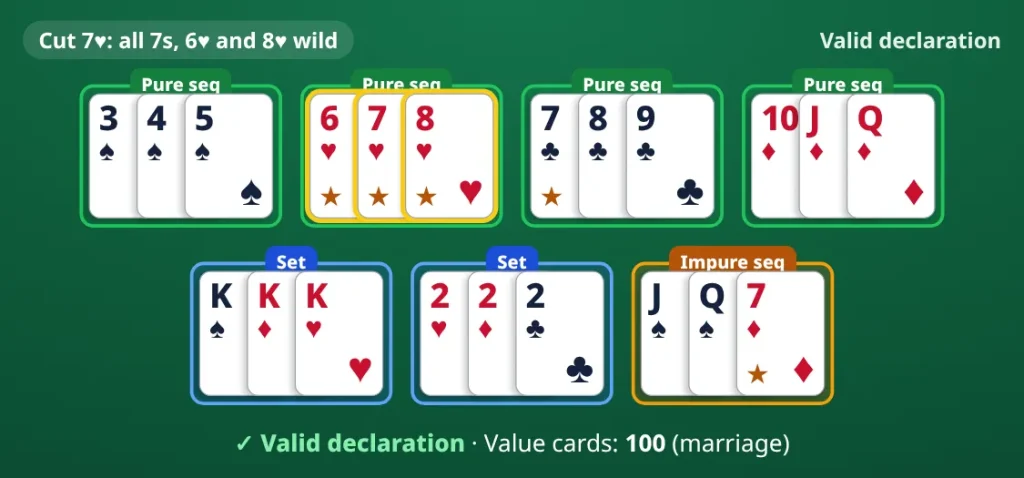
3♠ 4♠ 5♠ · 6♥ 7♥ 8♥ · 7♣ 8♣ 9♣ · 10♦ J♦ Q♦ · K♠ K♦ K♥ · 2♥ 2♦ 2♣ · J♠ Q♠ 7♦
A valid declaration: four pure sequences (three are needed), two sets of different suits, and J♠ Q♠ with the 7♦ joker as an impure sequence. It still holds the marriage, so on top of their counts, every other player who played on pays you 100 minus their own value points.
Other routes to a declaration
The rules on our game page allow three more ways to declare, without arranging the other cards:
- Three Tunnelas (three identical cards each, such as 5♣ 5♣ 5♣).
- Eight Dublees (identical pairs). With three decks, pairs are common, so a hand with five or six Dublees early on can be steered this way.
- Eight jokers in one group.
These are rare. Steer towards them only when the three-pure-sequence route looks slow, for example when you have many Dublees but few same-suit neighbours.
Habits that save points
- Throw high cards early. The cap is 120, so a lonely King costs you 10 until the very end of a long hand.
- Never throw an upper or lower joker by mistake. With the cut card 7♥, the 6♥ and 8♥ look like ordinary cards.
- Do not put identical cards in a set. 5♣ 5♣ 5♦ is not a set; 5♣ 5♣ 5♣ is a Tunnela.
- Keep score with real cards using the 21 Card mode of the points calculator (cap 120, drops 30 and 70). Value cards are settled separately.
FAQ
How many pure sequences do you need in 21 Card Rummy?
Three. A Tunnela (three identical cards) counts as one. The other cards must all be in valid sequences or sets, unless you declare with three Tunnelas, eight Dublees or eight jokers.
What are the upper and lower jokers in 21 Card Rummy?
The cards one rank above and one rank below the cut card, in the cut card’s suit. With the cut card 7♥ they are 8♥ and 6♥. They are wild, and they are also value cards.
Should I drop in 21 Card Rummy if I have value cards?
Not if you have a marriage: a drop takes you out of the value settlement, which can be worth far more than any count. With no value cards and a poor hand, a first drop (30) is often right.
Can wild cards make a pure sequence in 21 Card Rummy?
Yes, when they are used as themselves. With the cut card 7♥, 6♥ 7♥ 8♥ is a pure sequence even though all three cards are wild.