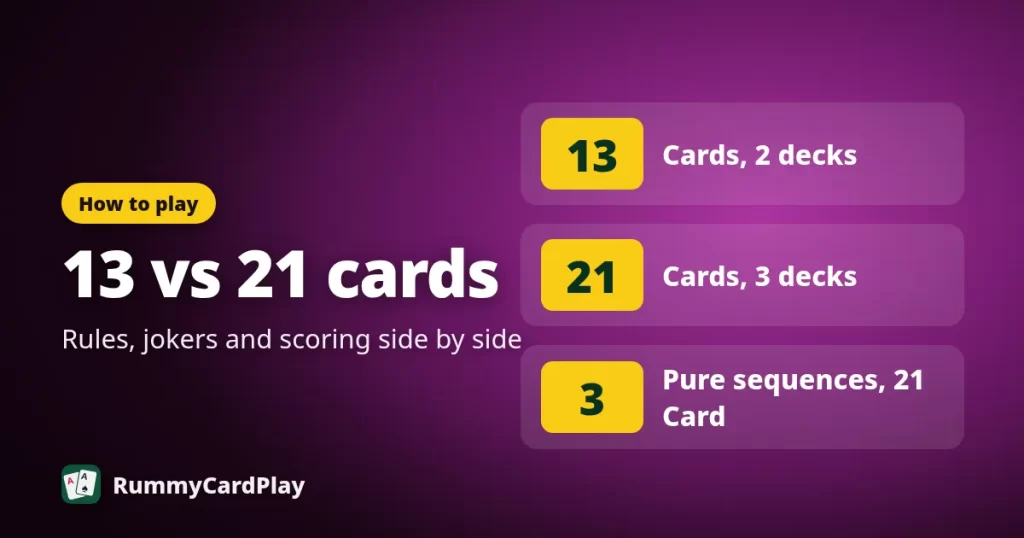
Both games are Indian Rummy, and both are about forming sequences and sets, but 13 card and 21 card rummy play quite differently. 21 Card Rummy uses a third deck, deals eight more cards and asks for three pure sequences instead of one. This guide compares the two as our free games play them, then helps you pick one. The rules named here are exactly those our engine enforces: see the full pages for 13-card Points Rummy and 21 Card Rummy.
13 card vs 21 card rummy at a glance
| 13-card rummy (Points, Pool, Deals) | 21 Card Rummy | |
|---|---|---|
| Cards in your hand | 13 | 21 |
| Decks | 2 decks plus 2 printed jokers (106 cards) | 3 decks plus 3 printed jokers (159 cards) |
| Players in our games | You against 1 to 5 computer players | You against 1 to 5 computer players |
| Wild jokers | Cut card’s rank and the printed jokers | The same, plus the upper and lower joker of the cut card’s suit |
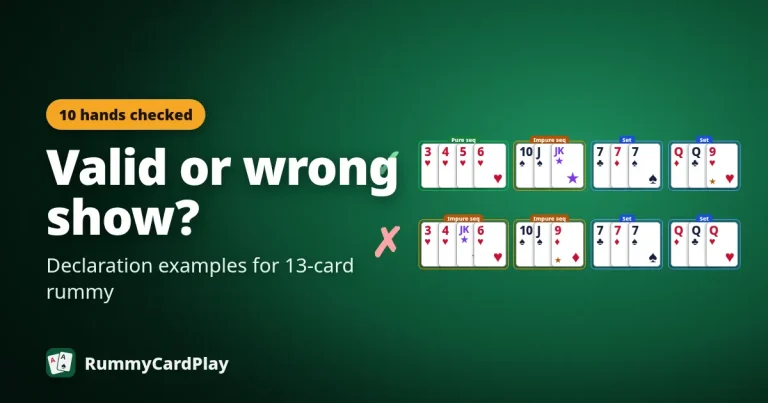
| To declare | At least two sequences, one of them pure; every card in a valid group | Three pure sequences with every other card in a valid group, or 3 Tunnelas, 8 Dublees or 8 jokers |
| Value cards and marriage | None | Yes: cut-card copies and the upper and lower jokers pay you for holding them |
| Most a hand can cost | 80 | 120 |
| First drop / middle drop | 20 / 40 (25 / 50 in Pool 201) | 30 / 70 |
| Wrong show | 80 | 120 |
| How a game ends | Single hand, pool to 101 or 201, or 2 or 3 deals | One hand at a time, with a running total and no target |
How the cards and jokers differ
In 13-card rummy one card is turned up and every card of its rank is wild, together with the printed jokers. If a printed joker is cut, Aces are wild. 21 Card Rummy keeps that and adds two more wild cards: the cards one rank above and one rank below the cut card, in its suit (the upper and lower joker). With the cut card 7♥, that makes all 7s, the 8♥ and the 6♥ wild. Names for these cards vary between tables; the rummy glossary explains tiplu, paplu and nichlu.
What you need to declare
This is the biggest difference. A 13-card hand needs two sequences, and only one of them must be pure. In 21 Card Rummy you need three pure sequences, so you should plan pure sequences from the first turn. Our pure sequence guide gives the 13-card odds, and 21 Card Rummy tips show how to plan the three pure sequences. The bigger game also allows three Tunnelas (three identical cards count as a pure sequence), eight Dublees (pairs) or eight jokers.
How points and value cards change the game
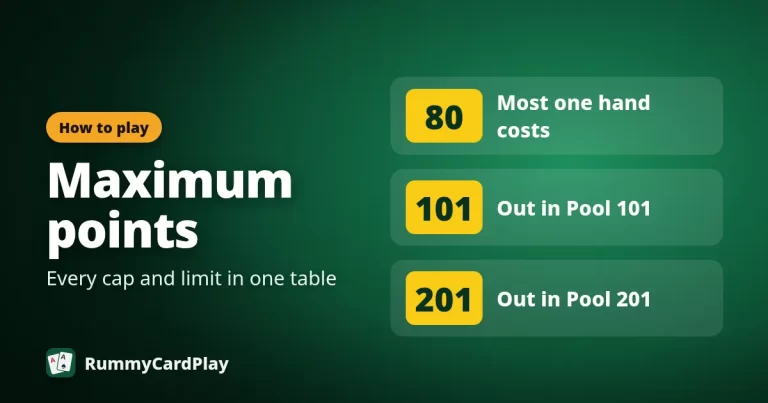
The counting rules are alike: A, K, Q, J and 10 are 10, other cards their number, jokers 0, and the count is capped. The caps differ, 80 against 120, and 21 Card Rummy has no pool or elimination. It has value cards instead: in the cut card’s suit, a copy of the cut card, the upper joker and the lower joker are worth 10, 30 or 50 for one, two or three held, and 100 for a marriage (one of each). Players still in the hand settle these among themselves on top of the hand points. See maximum points in rummy for every cap and limit in one table.
Which is easier to learn?
Start with 13 card rummy. The hand is smaller, and its rules are the base for the 21-card game. In our simulations of 10 lakh opening hands, 36.6% were dealt a pure sequence and 43.5% had one after the first draw (the data). That is why a pure sequence is a realistic first target in 13 cards. With 21 cards you need three, so there is more to plan, and drop decisions also depend on the value cards you hold.
A sensible path:
- Play Points Rummy until the pure sequence and second sequence rules feel natural.
- Try Pool Rummy 101 for budgeting drops.
- Move to 21 Card Rummy when you want a longer, more complex hand.
Gin Rummy is a third option: two players, 10 cards, and melds without any pure-sequence requirement. It is closer to classic rummy than to either of these. See the Gin strategy guide.
Where other sources differ
Rules for the 21-card game vary a lot between tables. Pagat calls 21-card rummy a relative of the Nepali game Marriage, where the joker is not shown at the start and a player must first lay down three pure combinations. Our game uses the version in the table above. When you play with real cards, check the declaration rule, the caps and the value of a marriage before the first deal.
FAQ
What is the difference between 13 card and 21 card rummy?
In 13-card rummy you hold 13 cards from two decks and need two sequences, one of them pure. In 21 Card Rummy you hold 21 cards from three decks and need three pure sequences, or one of a few special hands. The 21-card game also has upper and lower jokers, value cards and a higher cap of 120 against 80.
Is 21 card rummy harder than 13 card rummy?
It takes longer and asks for more planning, because you need three pure sequences and have more cards to manage. The basic ideas are the same, so most players learn the 13-card game first.
How many decks are used in 21 card rummy?
Three standard decks plus three printed jokers, 159 cards in total. 13-card rummy uses two decks and two printed jokers, 106 cards.
What are value cards in 21 card rummy?
In the cut card’s suit, other copies of the cut card and the upper and lower jokers. Holding them is worth 10, 30 or 50 points (one, two or three of them) and a marriage of all three kinds is worth 100. In our game these points are only a score.
Can I play both free here?
Yes. Points Rummy and 21 Card Rummy are both free in your browser, against the computer, in English or Hindi, with no money and no sign-up.