Deals Rummy is 13-card Indian Rummy played for chips over a fixed number of deals, usually two or three. In our version there is no drop: every deal is played to the end. That makes two skills matter more than in any other format: losing small when the cards go against you, and reading the scoreboard before the last deal. This guide goes deeper into both, with a real hand counted by our rules engine and data from thousands of simulated hands played without drops. The rules and a worked two-deal match are on our Deals Rummy page.
What a lost deal costs
Our Points Rummy simulations had dropping switched off, so every hand was played out exactly as in Deals Rummy. Across 20,000 losing hands at two-player tables and 30,000 at six-player tables:
| 2 players | 6 players | |
|---|---|---|
| Average count of a losing hand | 39.7 | 47.8 |
| Losing hands that hit the 80 cap | 15.9% | 23.7% |
| Losing hands that counted 20 or less | 37.1% | 26.4% |
The gap between a small loss and a full count is around 60 chips per deal. Over a two- or three-deal match, that is usually more than the margin of victory.
Losing small without a drop
The key fact: without a pure sequence, every card counts, up to 80. So throwing high cards only helps once your raw total is below 80, or once you have a pure sequence. The fastest way to cut your count is still to make that pure sequence.
A bad deal (3s wild)
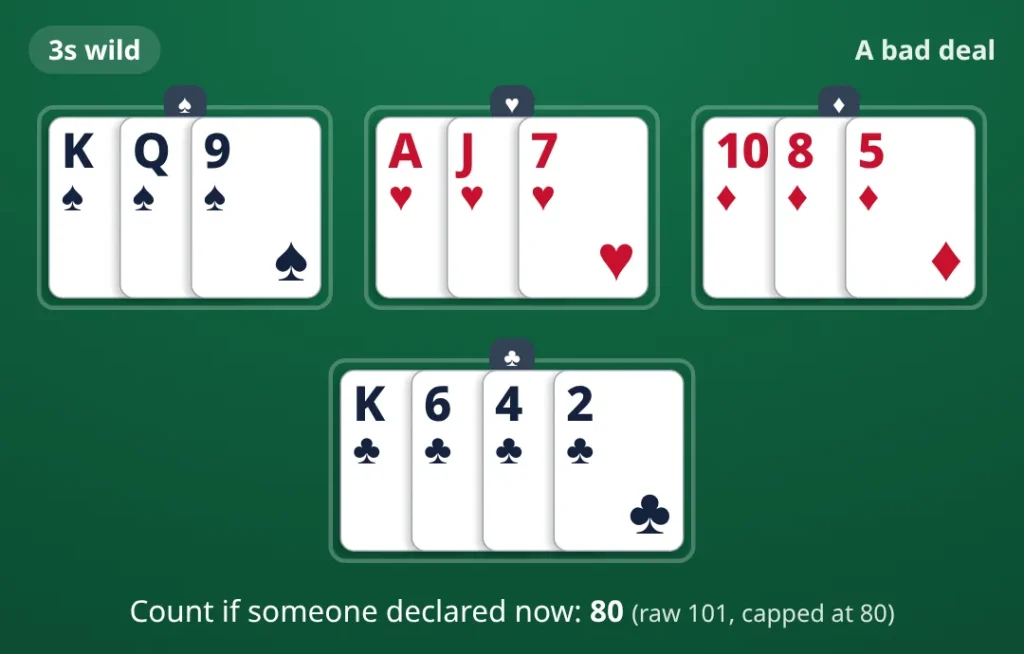
K♠ Q♠ 9♠ · A♥ J♥ 7♥ · 10♦ 8♦ 5♦ · K♣ 6♣ 4♣ 2♣
No joker, no pure sequence, raw count 101. In a points game this is a first drop. In Deals you have to play it, so the plan is: get any pure sequence, and throw the lonely tens while you wait.
Four turns later
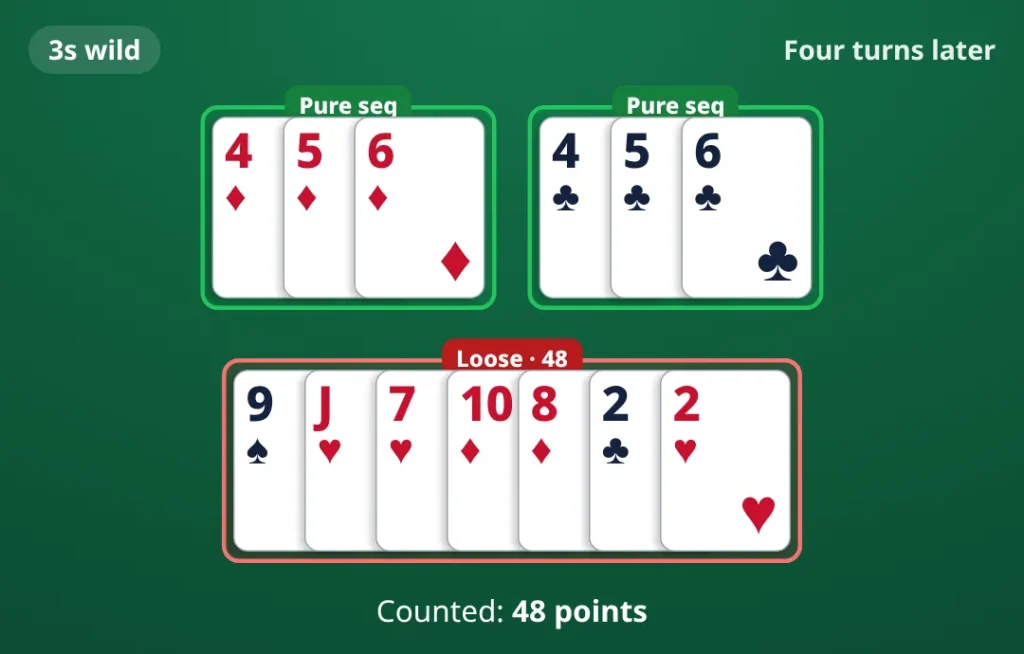
4♦ 5♦ 6♦ · 4♣ 5♣ 6♣ · 9♠ J♥ 7♥ 10♦ 8♦ 2♣ 2♥
Turn 1: drew 4♦, threw K♣. Turn 2: drew 6♦, completing 4♦ 5♦ 6♦, threw A♥. Turn 3: drew 2♥, threw K♠. Turn 4: drew 5♣, completing 4♣ 5♣ 6♣, threw Q♠.
Two pure sequences, so only the seven loose cards count: the engine says 48, down from 80. Nothing here is close to a declaration, yet the hand has already saved 32 chips. The next targets: a 3 (the joker) next to 2♣ 2♥ for a set, and 9♦ between 8♦ and 10♦.
The last deal: play the scoreboard
Before the final deal, work out what you need.
Two players. Every chip you lose goes to your opponent, so the gap moves by twice the loser’s count. If you lead by L chips:
| Your lead before the last deal | Your opponent wins the match if they declare while you hold more than |
|---|---|
| 20 | 10 |
| 40 | 20 |
| 60 | 30 |
| 100 | 50 |
| 160 | Never: holding 80 only ties the match |
| More than 160 | Cannot be caught (the most you can lose is 80) |
A count exactly at the line means a tie and a tie-breaker deal. If you lead comfortably, play for a low count from the first turn: throw high cards, keep jokers and low cards, and do not chase a slow set. If you are far behind, a small loss changes nothing, so keep the cards that give you the best chance to declare first.
Three or more players. The winner of the last deal collects from everyone. If the player chasing you declares, the gap closes by twice your count plus the third player’s count. So a lead that looks safe heads-up can disappear at a bigger table. Keep your count low and watch which player is collecting from the open pile (see reading discards).
Deal-by-deal habits
- Deal 1: play normally, but never risk a wrong show; 80 chips in the first deal is hard to win back.
- Middle deals: note the chip gap before each deal. The points calculator keeps a chips sheet for Deals Rummy.
- Last deal: decide before your first draw whether you are playing to win the deal or to lose small, and stick to it.
- Tie-breaker: it is a single deal between the tied players only. Play it like a last deal with a lead of zero: you need to declare first.
FAQ
Can you drop in Deals Rummy?
Not in our version, and not in many online versions either. Some tables allow drops at 20 and 40, so check before you play.
How are chips calculated in Deals Rummy?
Each loser’s count (at most 80) goes from their chips to the winner of the deal. Everyone starts with 80 chips for each player at the table, so 160 each with two players and 240 each with three.
What is the best strategy for the final deal?
Work out the chip gap first. Leading heads-up by 60, you only lose the match if your opponent declares while you hold more than 30, so keep your count low. Far behind, play to declare first.
Is Deals Rummy more about luck than Points Rummy?
With only two or three deals, the cards matter a lot. Skill shows in how small your losing hands are: the difference between losing 30 and losing 80, several times a match.