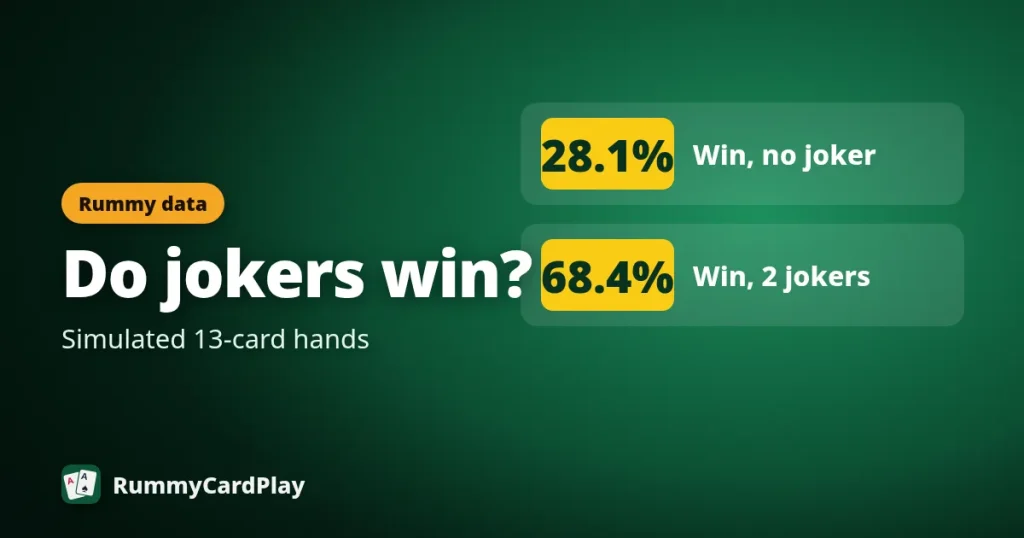
How much is a joker really worth in 13-card Indian Rummy? To find out, we let the computer players from our free Points Rummy game play 26,000 complete hands against each other and recorded every opening hand and every result. This study reports what we found, how we measured it and where the numbers stop being useful.
Key findings
- In two-player games, a player dealt no joker won 28.1% of hands. With two jokers that rose to 68.4%, and with three or more to 82.6%.
- At six-player tables, where an average player wins one hand in six (16.7%), the same steps were 3.2%, 11.9%, 29.5% and 52.9%.
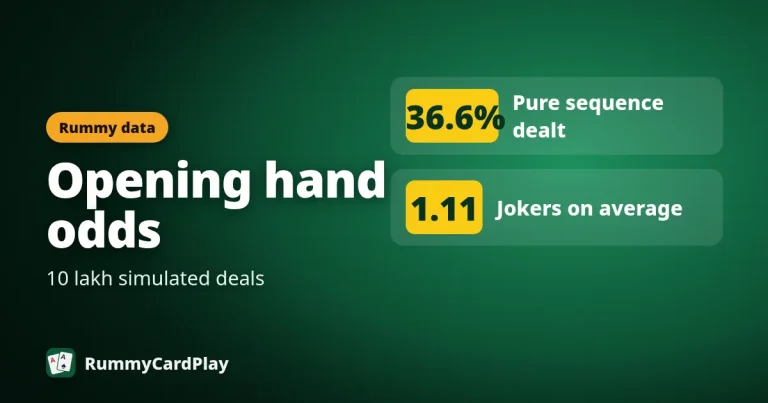
- A pure sequence at the deal lifted the two-player win rate from 46.2% to 56.7%.
- In two-player games the player who plays first won 53% of hands.
- A losing hand cost 39.7 points on average with two players and 47.8 with six, and 15.9% and 23.7% of losing hands hit the 80-point cap.
Win rate by jokers dealt
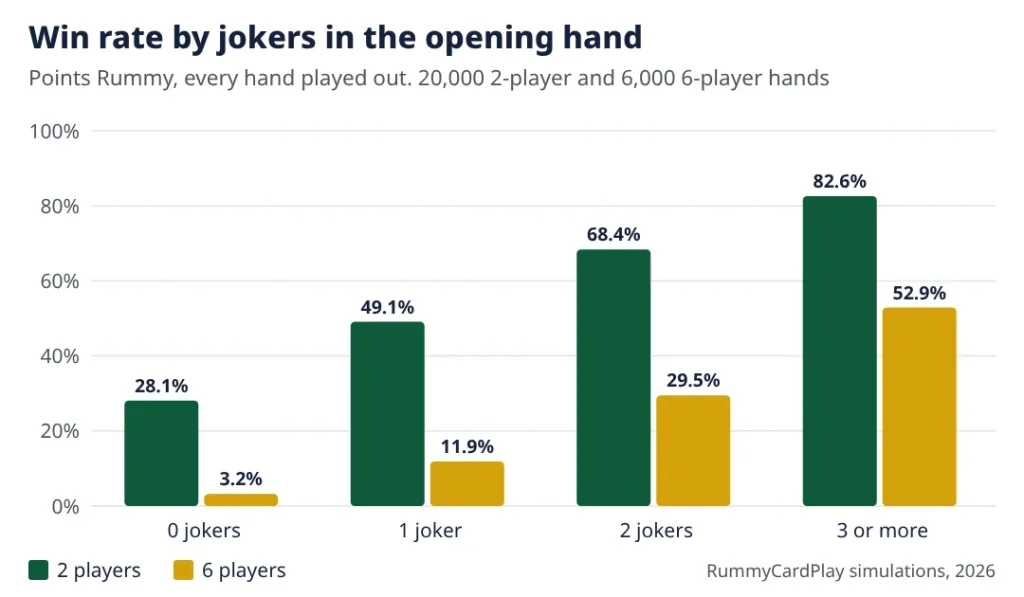
We counted jokers in the 13 cards dealt to each player: printed jokers plus every card of the wild rank (Aces, if a printed joker was cut). “Net” is the average points won or lost per hand by a player in that group, so a hand you win counts as plus what the others paid you.
Two players
| Jokers dealt | Players | Win rate | Net per hand |
|---|---|---|---|
| 0 | 11,642 | 28.1% | −24 |
| 1 | 16,122 | 49.1% | 0.9 |
| 2 | 9,059 | 68.4% | 17.9 |
| 3 or more | 3,177 | 82.6% | 32.6 |
Six players
| Jokers dealt | Players | Win rate | Net per hand |
|---|---|---|---|
| 0 | 10,422 | 3.2% | −50.9 |
| 1 | 14,488 | 11.9% | −11.6 |
| 2 | 8,189 | 29.5% | 43.2 |
| 3 or more | 2,901 | 52.9% | 118.9 |
Every extra joker helps. With two players the first joker adds the most; at six-player tables each joker adds more than the last, because only the fastest hand at the table wins. Yet a hand with no joker still won 28.1% of two-player hands: the jokers decide the odds, not the result. How to use the ones you get is in our rummy joker strategy guide.
When a player with jokers lost, the loss was not always smaller. In two-player games the average loss was 46.8 with no joker, 34.2 with one and 43.3 with three or more. Jokers count zero, but a player who is dealt several of them is often still waiting for a pure sequence when the other player declares.
A pure sequence at the deal
| Opening hand | Win rate, 2 players | Net, 2 players | Win rate, 6 players | Net, 6 players |
|---|---|---|---|---|
| Pure sequence dealt | 56.7% | 12 | 23.8% | 34.9 |
| No pure sequence | 46.2% | −6.9 | 12.6% | −20.1 |
A dealt pure sequence was worth less than a second joker, but it also cut the average loss: 26.7 points against 45.8 without one (two players). That is the point of a first life: once it is down, everything else you group starts to protect you.
How fast a pure sequence arrives
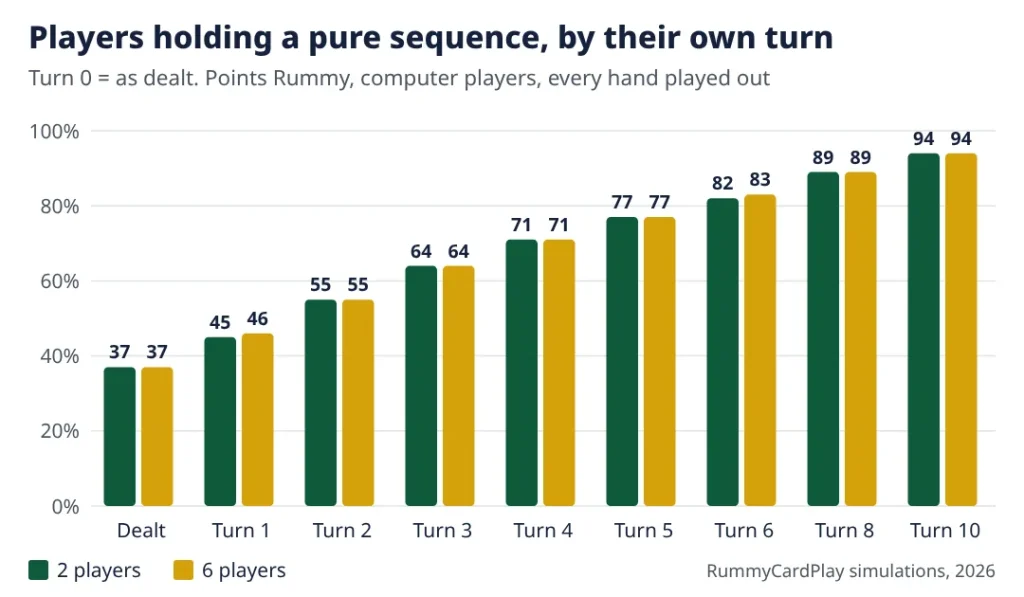
| By the end of own turn | 2 players | 6 players |
|---|---|---|
| Dealt | 36.5% | 36.5% |
| 1 | 45.4% | 46% |
| 3 | 63.8% | 63.9% |
| 6 | 81.7% | 82.7% |
| 10 | 93.5% | 93.6% |
Hands end at different times, so a plain average would only count the slow hands that were still going. We used the Kaplan-Meier method instead: at each turn, a player only counts if their hand was still in play. A winning two-player hand took a median of 7 turns of the winner’s own (12 turns in total). Tips for building the first life faster are in how to make a pure sequence.
Seat order
With two players, the player who draws first won 53% of hands and the dealer 47%. At six-player tables, from first to play to the dealer:
| Seat | 1 | 2 | 3 | 4 | 5 | 6 (dealer) |
|---|---|---|---|---|---|---|
| Win rate | 20% | 18% | 17.9% | 15.7% | 15.5% | 12.9% |
Playing first is a real edge: you take your turns before everyone else, and when a hand ends early the later seats have had one turn fewer. The gap is bigger at a full table, where a winning hand needed a median of only 4 of the winner’s own turns. Our games rotate the dealer every hand, so over a session it evens out.
Method
- Rules: 13-card Points Rummy as played on this site: two decks with two printed jokers (106 cards), one cut joker, two sequences required including a pure one, 80-point cap, Aces count 10. Full rules are on the Points Rummy page.
- Players: every seat was played by the “Hard” computer player that ships with our games, using the same engine and declaration checker as the game you can play. Dropping was switched off, so every hand was played to the end and every opening hand has a result.
- Sample: 20,000 two-player hands (40,000 player results) and 6,000 six-player hands (36,000 player results). The dealer rotated every hand.
- Randomness: each hand was shuffled from a fixed seed (1,401 plus the hand number), so the whole run can be repeated exactly. We keep the simulation scripts and raw results with the site’s source.
- Measures: win rate is the share of hands won. Net is points won minus points lost per hand. The pure-sequence timing uses the Kaplan-Meier method described above.
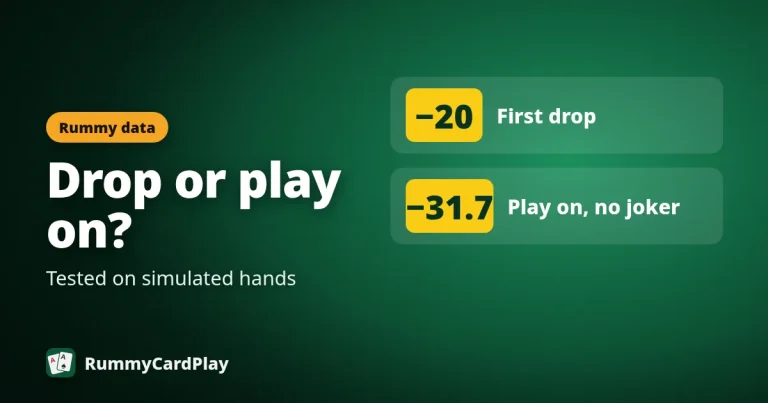
Limitations. These are computer players, not people. They play consistently, never bluff and never drop in this study, so real losses are lower: a sensible player drops many of the worst hands for 20. Win rates in groups of a few thousand players are accurate to about one to two percentage points. Other rule sets (a 10-point first drop, different cap) would change the points, though not the order of the results.
Related studies and guides
- Rummy opening hand odds: how often each kind of opening hand is dealt.
- Drop or play on?: the same hands, compared with the cost of dropping.
- Pool Rummy 101 vs 201 in numbers
- Rummy joker strategy and when to drop in rummy
FAQ
Do more jokers always win in rummy?
No. More jokers raise the odds a lot, but in our two-player test a hand with three or more jokers still lost 17.4% of the time, and a hand with none won 28.1%.
Is a pure sequence or a joker more valuable at the deal?
In our simulations a second joker added more to the win rate than a dealt pure sequence. But without a pure sequence no joker can protect you, so build the pure sequence first.
Are these real players’ results?
No. Every hand was played by our own computer players, so the numbers show how the cards behave under good, consistent play. People make more mistakes and drop more often.
Can I check these numbers?
The rules and the engine are the same as in our free games. Every hand used a fixed random seed, and we keep the scripts and raw data so the run can be repeated exactly.