Jokers are the most flexible cards in 13-card Indian Rummy. They count zero, they can stand in for any card in a set or an impure sequence, and a hand with two or three of them usually comes together quickly. They also tempt players into mistakes. This guide covers the types of joker, where a joker earns most, the mistakes that waste one, and what our simulations say about how much a joker is worth. Every example hand was checked by the engine that runs our free Points Rummy game.
What is a wild joker in rummy?
The wild joker (also called the cut joker) is the card turned face up after the deal. Every card of that rank, in all four suits, becomes a joker for that hand, and so do the printed jokers. If the turned-up card is a 7, then every 7 is wild. A wild joker can stand in for any card in a set or in an impure sequence, and it counts 0 points. It changes every hand, which is what makes jokers different from the printed ones.
| Wild joker | Printed joker | |
|---|---|---|
| What it is | Every card of the cut rank | The picture joker that comes with the deck |
| In 13-card rummy (two decks) | Up to 7 more cards in play | 2 cards |
| Acts as a joker | Yes, for this hand | Always |
| Counts in your hand | 0 | 0 |
| Can be in a pure sequence | Only as itself, in its natural place | No |
It can be confusing at first, because the same card is a joker or an ordinary card depending on the hand. The rummy glossary defines the terms, and the section below explains where a joker earns most.
The jokers in a 13-card game
- Wild joker (cut joker): after the deal, one card is turned face up. Every card of that rank, in all four suits, is wild for the hand. With two decks that is up to 7 more wild cards in play.
- Printed jokers: the two picture jokers that come with the decks. Always wild.
- Printed joker as the cut card: then Aces are wild. Most modern rule sets play it this way, and so do our games. Some home games use other conventions; Pagat describes a few.
- Wild card in its natural place: if 7s are wild, 5♥ 6♥ 7♥ is still a pure sequence, because the 7♥ is used as itself.
Jokers count 0 if someone else declares, so holding one never costs you points. In our games you also cannot pick a joker from the open pile, so a joker that is thrown away is gone for the hand.
Where a joker earns most
In order of value:
- Completing your second sequence. Once you have a pure sequence, a joker in your second sequence protects every card around it. This is almost always the best use.
- Filling a gap. 9♠ _ J♠ with a joker is a sequence. A joker turns a gapped pair, which normally has only 2 outs, into a finished group.
- Completing a set after both sequences are done.
- Never in your first, pure sequence. A sequence with a joker in it is impure by definition.
Placing one joker (4s wild)
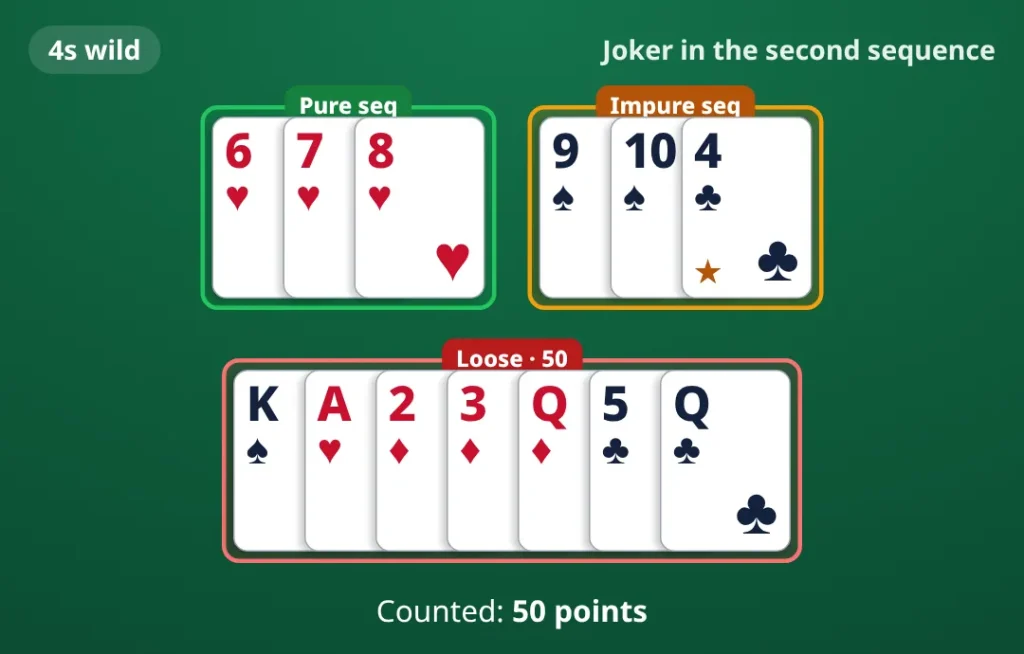
6♥ 7♥ 8♥ · 9♠ 10♠ 4♣ · K♠ A♥ 2♦ 3♦ Q♦ 5♣ Q♣
You hold one joker, the 4♣. The tempting move is to complete the Queens: Q♣ Q♦ 4♣ is a set. But with only one sequence a set protects nothing, and the engine counts that arrangement at 69. Put the joker with 9♠ 10♠ instead and you have a second sequence. Now only the loose cards count: 50. That is 19 points saved by one placement, and the Queens are still a pair that a third Queen or another joker can finish.
Jokers in a finished hand
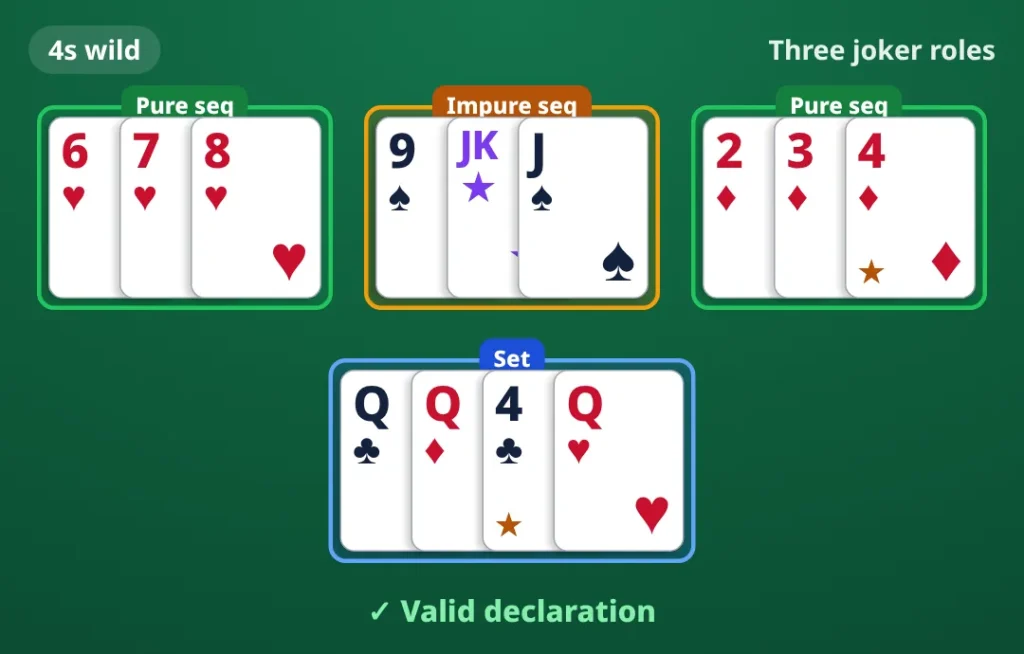
6♥ 7♥ 8♥ · 9♠ PJ J♠ · 2♦ 3♦ 4♦ · Q♣ Q♦ 4♣ Q♥
A valid show with 4s wild. Three different joker roles appear here:
- The printed joker fills a gap: 9♠ PJ J♠ is an impure sequence.
- The 4♦ is wild, but used as itself: 2♦ 3♦ 4♦ is a pure sequence. The hand has two pure sequences, which is more than it needs.
- The 4♣ completes a set of Queens of different suits.
The engine confirms the declaration is valid. Notice that 2♦ 3♦ 4♦ would be impure if the wild card were a 4♣ standing in for the 4♦. Test your own hands in the declare checker.
What the numbers say
We played 20,000 two-player and 6,000 six-player hands of Points Rummy between our strongest computer players, with dropping switched off so that every hand was played to the end. Then we grouped players by how many jokers they were dealt:
| Jokers dealt | Win rate, 2 players | Win rate, 6 players |
|---|---|---|
| 0 | 28.1% | 3.2% |
| 1 | 49.1% | 11.9% |
| 2 | 68.4% | 29.5% |
| 3 or more | 82.6% | 52.9% |
Each extra joker raises the chance of winning the hand, but a hand with none is far from hopeless. The full method, sample sizes and average points lost are in our study Do jokers win rummy hands?.
Joker mistakes to avoid
- Throwing a joker to “bluff”. It saves you nothing (jokers count 0 anyway) and helps the next player if your rules allow picking it up.
- Two jokers in one group when one would do. 9♠ PJ J♠ 4♣ (played as 9 10 J Q) is valid, but the second joker could have finished a set elsewhere.
- Calling a sequence with a joker in it “pure”. It is not, unless the wild card is in its natural place. This is one of the most common wrong shows; see valid vs invalid declarations.
- Forgetting the Aces when a printed joker is cut. They are all wild for that hand.
- Keeping a joker over a pure-sequence card. Until you have a pure sequence, the card that completes it is worth more than a joker.
FAQ
Can a joker be used in a pure sequence?
Only as itself. If 7s are wild, 5♥ 6♥ 7♥ is pure because the 7♥ is in its natural place. A joker standing in for a missing card always makes a sequence impure.
How many jokers are there in 13-card rummy?
With two decks: up to two printed jokers, plus every card of the wild rank. The cut card itself is face up on the table, so up to 7 cards of the wild rank are left in play.
Can I make a set with two jokers?
Yes. Q♣ Q♦ plus two jokers is a valid set of four in our games, as long as the natural cards are of different suits. It is usually better to spend the second joker elsewhere.
What happens when a printed joker is the cut card?
All Aces become wild jokers for that hand in our games. Some home games use different conventions, so agree the rule before you play.
What is a wild joker in rummy?
The card turned face up after the deal. Every card of its rank is a joker for that hand, together with the printed jokers. Wild jokers count 0 and can replace any card in a set or an impure sequence, but not in a pure sequence.
Is the wild joker the same as the printed joker?
No. The printed joker is a picture card that is always wild. The wild joker is a rank chosen by the cut card, so it changes every hand. In 13-card rummy both count 0 and both can be used in sets and impure sequences.
Do jokers count as points in rummy?
No. Jokers count 0 points in your hand.